

5 Grounding Techniques That Help Slow Your Life Down
Life in America moves fast. Notifications ping every few minutes. Work deadlines pile up. Your brain races through a thousand thoughts before breakfast. Sound familiar? Most people don’t realize they’ve lost touch with the present moment until anxiety takes over completely. That’s exactly where grounding techniques step in. These simple yet powerful practices pull you back into your body, slow your racing mind, and help you feel safe again. This article walks you through five proven grounding techniques that work — even on your busiest days.
What Are Grounding Techniques and Why They Matter for Slow Living

Grounding techniques are practical tools that help you stay present in the moment by reconnecting your awareness to what’s happening right now. Instead of replaying yesterday’s mistakes or worrying about tomorrow, you anchor yourself to your current physical environment — your breath, your body, your surroundings. Think of it like dropping an anchor before a storm. The anchor doesn’t stop the waves. But it stops you from drifting.
For millions of Americans caught in the cycle of hustle culture, slow living has become a genuine movement. People are stepping back from the constant noise and choosing intentional, calmer lives. Mindfulness grounding techniques are the bridge between that chaotic “always-on” lifestyle and a more peaceful existence. Research from the American Psychological Association shows that chronic stress affects 77% of Americans physically. Grounding isn’t just trendy — it’s a necessity.
How Grounding Techniques Calm Your Nervous System Naturally

When stress hits, your brain activates the fight-or-flight response. Cortisol and adrenaline flood your body. Your heart rate spikes. Your thoughts scatter. Grounding exercises for stress directly interrupt this cycle. They stimulate the vagus nerve — the long nerve connecting your brain to your gut — which signals your whole nervous system to calm your nervous system and shift into rest mode. It’s biology working in your favor.
you may also like this:10 Easy Slow Living Home Swaps That Calm Your Nervous System
Here’s the fascinating part. You don’t need medication or a therapist’s office to trigger this calming response. Emotional grounding techniques like focused breathing or sensory awareness activate the parasympathetic nervous system — your body’s natural “rest and digest” mode. According to a 2021 study published in Frontiers in Psychology, mindfulness-based grounding practices reduce anxiety naturally in as little as eight minutes. That’s less time than scrolling social media before bed.
5 Grounding Techniques That Help You Slow Down and Feel Present
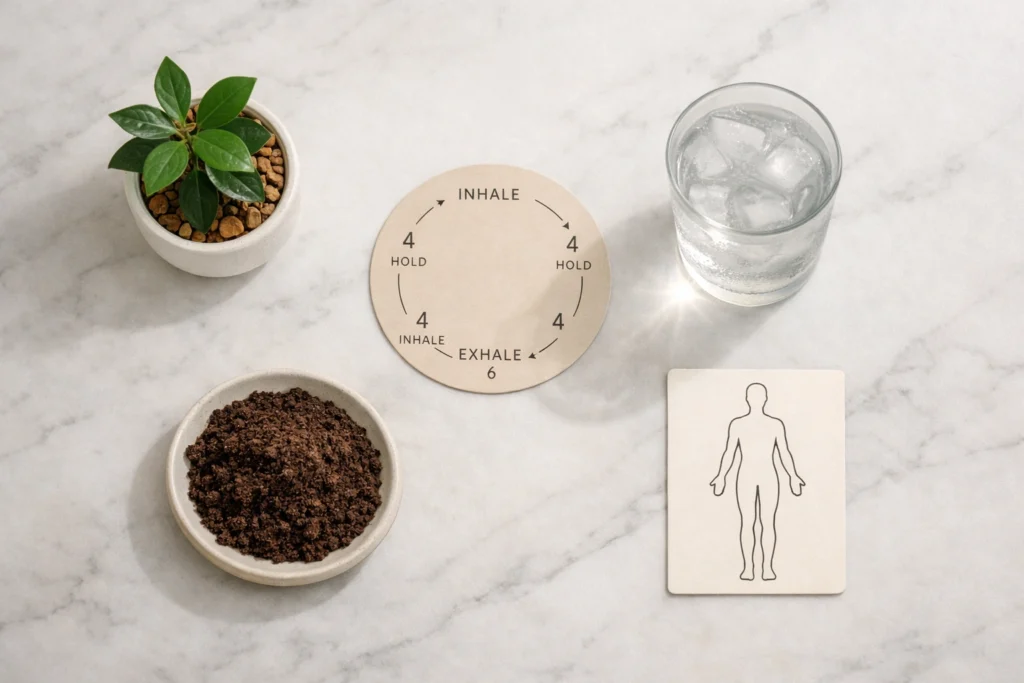
Ready to manage stress and panic before it manages you? These five techniques are practical, proven, and designed for real life — not just meditation retreats. Each one targets a different pathway: sensory, respiratory, physical, thermal, and somatic. Try them all. Then stick with the ones that click.
Technique 1 — The 5-4-3-2-1 Sensory Method

This is one of the most popular simple grounding techniques available. It works by flooding your brain with sensory input, which pushes anxious thoughts out of the spotlight. Here’s how it works: name 5 things you can see, 4 things you can hear, 3 things you can physically touch, 2 things you can smell, and 1 thing you can taste. That’s it. Each sense you engage helps bring awareness to surroundings and pulls you further from panic.
Therapists widely use this method as one of the core grounding techniques for panic attacks. It works because anxiety lives in the past or the future — never in the present. The moment you actively notice the texture of your chair or the sound of traffic outside, your nervous system registers safety. Emotional regulation techniques don’t get much simpler than this. Try it the next time your chest tightens.
| Step | Sense | Action |
|---|---|---|
| 5 | Sight | Name 5 things you can see around you |
| 4 | Sound | Identify 4 sounds you can hear right now |
| 3 | Touch | Feel 3 surfaces or textures with your hands |
| 2 | Smell | Notice 2 scents in your environment |
| 1 | Taste | Identify 1 taste in your mouth |
Technique 2 — Box Breathing (The 4-4-4-4 Method)
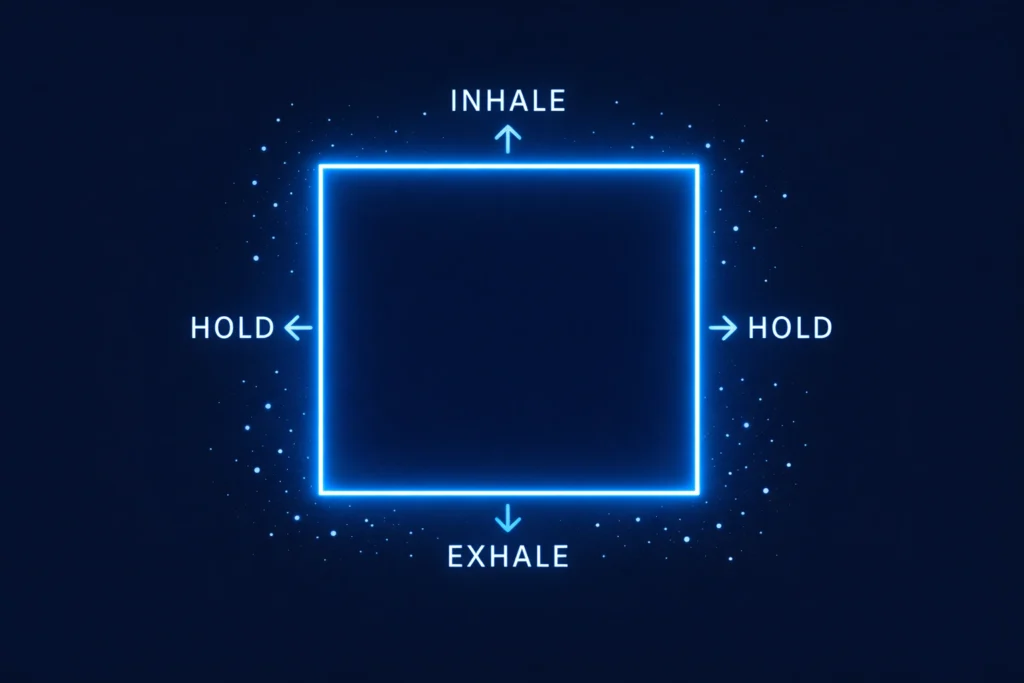
Box breathing is one of the most powerful grounding techniques for adults because it works physiologically. Inhale for 4 counts. Hold for 4. Exhale for 4. Hold again for 4. Repeat four times. This rhythmic pattern regulates oxygen and carbon dioxide levels in your bloodstream, which directly slows your heart rate. The US Navy SEALs use this exact technique before high-pressure operations. If it works in combat, it’ll work in your Tuesday afternoon meeting.
What makes box breathing exceptional as a mindfulness grounding technique is its portability. You need zero equipment, zero space, and zero explanation. It’s one of the most effective coping strategies for anxiety ever documented. Studies from Stanford University’s Neuroscience Department confirm that controlled breathing activates the prefrontal cortex — the rational, calm part of your brain — while quieting the amygdala, which drives fear and panic. Two minutes of box breathing genuinely changes your brain chemistry.
Technique 3 — Barefoot Earthing
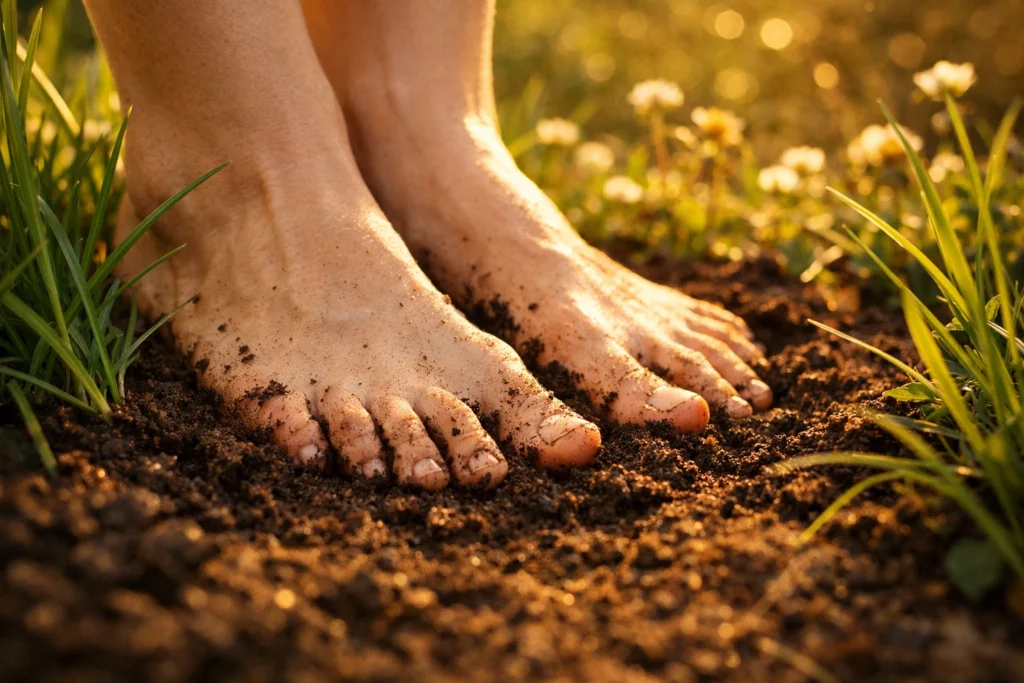
Earthing — also called grounding in the literal sense — means placing your bare feet on natural ground. Grass. Soil. Sand. The science behind it is surprisingly robust. The earth carries a mild negative electrical charge. When your skin makes direct contact, free electrons transfer into your body and neutralize oxidative stress. A 2015 study in the Journal of Environmental and Public Health found that earthing significantly reduce anxiety naturally and improved sleep quality in participants after just 30 minutes.
This qualifies as one of the most underrated grounding methods for mental health available to everyday people. You don’t need a prescription. You need a backyard — or even a patch of local park. Americans living in urban environments can find green spaces in virtually every city. Central Park in New York, Millennium Park in Chicago, Griffith Park in Los Angeles — all free, all grounding-friendly. Walk barefoot for 20 minutes. Reconnect with your body and feel the shift happen in real time.
Technique 4 — Cold Water Grounding

This one surprises people. Splashing cold water on your face — or even holding an ice cube — triggers what’s called the mammalian dive reflex. Your heart rate drops. Blood flow redirects to vital organs. Your body interprets the cold shock as an urgent signal to calm your nervous system and conserve energy. It’s primal. It’s fast. And it works in under 30 seconds.
Grounding techniques for anxiety don’t have to be slow and meditative. Sometimes urgency calls for urgency. Cold water is one of the most accessible grounding exercises for stress in existence. Run cold water over your wrists. Hold an ice cube in your palm. Splash your face three times. Dialectical Behavior Therapy (DBT) — a clinically proven therapeutic approach — lists cold water immersion as a core emotional grounding technique for managing intense emotions. You’re not being dramatic. You’re using neuroscience.
Technique 5 — Body Scan Meditation

The body scan is the most introspective of all five grounding techniques. Lie flat on your back — a bed, a yoga mat, a carpeted floor. Close your eyes. Start at the top of your skull and slowly move your attention down through your body — forehead, jaw, neck, shoulders, chest, arms, belly, hips, thighs, knees, calves, feet. Wherever you notice tension, breathe into it. Don’t try to fix anything. Just observe.
This is among the most transformative grounding techniques for overthinking because it redirects obsessive mental energy toward physical sensation. Relaxation and mindfulness practices like the body scan have been studied extensively at institutions like Harvard Medical School, where researchers confirmed significant reductions in anxiety symptoms after eight weeks of regular practice. It takes 10–15 minutes. It costs nothing. And it builds the kind of feeling safe and centered awareness that makes all other grounding techniques easier over time.
How to Practice Grounding Techniques in Daily Life
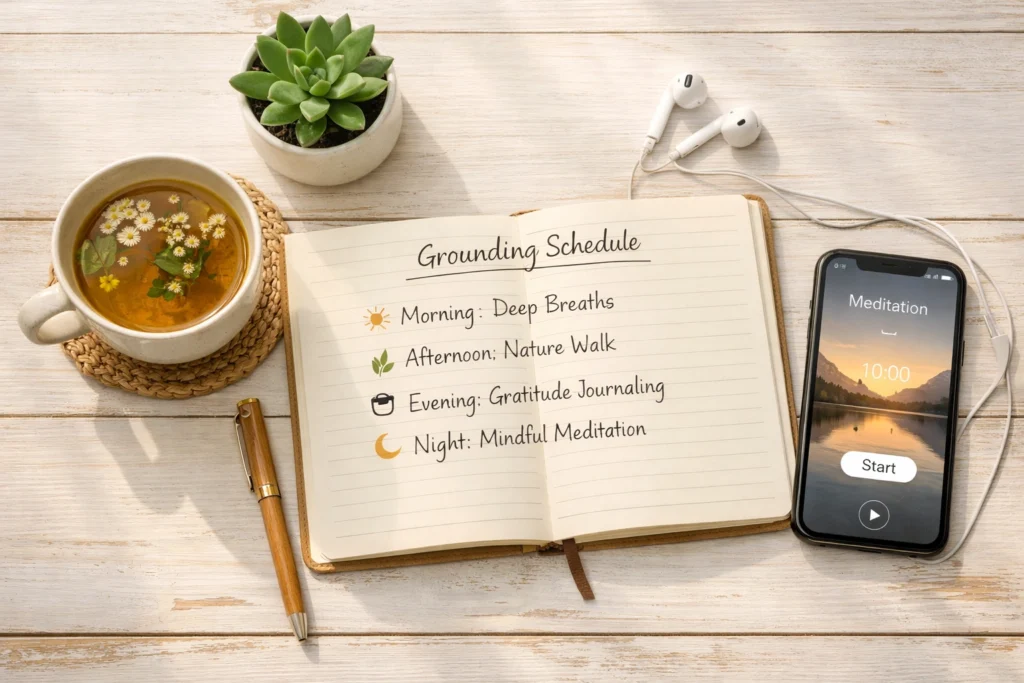
Consistency turns simple grounding techniques into second nature. The goal isn’t to meditate for an hour every morning. The goal is to weave small moments of grounding into what you’re already doing. Practice box breathing during your morning commute. Do the 5-4-3-2-1 method while waiting in line at a coffee shop. Take your shoes off in the backyard for ten minutes after work. Grounding techniques for adults work best when they become habits — not events.
Habit stacking is your best friend here. Link each mindfulness grounding technique to an existing routine. Box breathing after brushing your teeth. A body scan before sleep. Barefoot earthing on your Saturday morning walk. The brain loves predictable sequences. Within three to four weeks, these practices become automatic. You won’t have to think about grounding. Your nervous system will simply reach for it whenever stress appears.
Grounding Techniques for Anxiety, Stress, and Overthinking

Grounding techniques for anxiety are widely recommended by licensed therapists as frontline coping strategies for anxiety — especially for those who experience panic attacks, generalized anxiety disorder (GAD), or PTSD. Cognitive Behavioral Therapy (CBT) and Dialectical Behavior Therapy (DBT) both incorporate emotional grounding techniques as core tools because they interrupt the anxiety feedback loop at the sensory level. When the body feels safe, the mind follows.
“Grounding techniques work because they shift attention from internal distress to external reality. They’re not just calming — they’re reorienting.” — Dr. Bessel van der Kolk, author of The Body Keeps the Score
Grounding techniques for overthinking are particularly effective because overthinking is fundamentally a disconnection from the present. Your thoughts spiral into hypothetical futures or regretted pasts. Engaging your senses — cold water, earthing, the 5-4-3-2-1 method — physically interrupts that loop. Grounding exercises for stress operate on the same principle. They give your brain something concrete to process. And concrete beats catastrophic every single time.
| Condition | Best Grounding Technique | Why It Works |
|---|---|---|
| Panic attacks | 5-4-3-2-1 Sensory Method | Overloads sensory cortex, stops spiral |
| Chronic stress | Barefoot Earthing | Regulates cortisol through electron transfer |
| Overthinking | Body Scan Meditation | Redirects mental energy to physical sensation |
| Acute anxiety | Cold Water Grounding | Triggers dive reflex, drops heart rate fast |
| Daily tension | Box Breathing | Regulates nervous system in real time |
Common Mistakes People Make When Trying Grounding Techniques
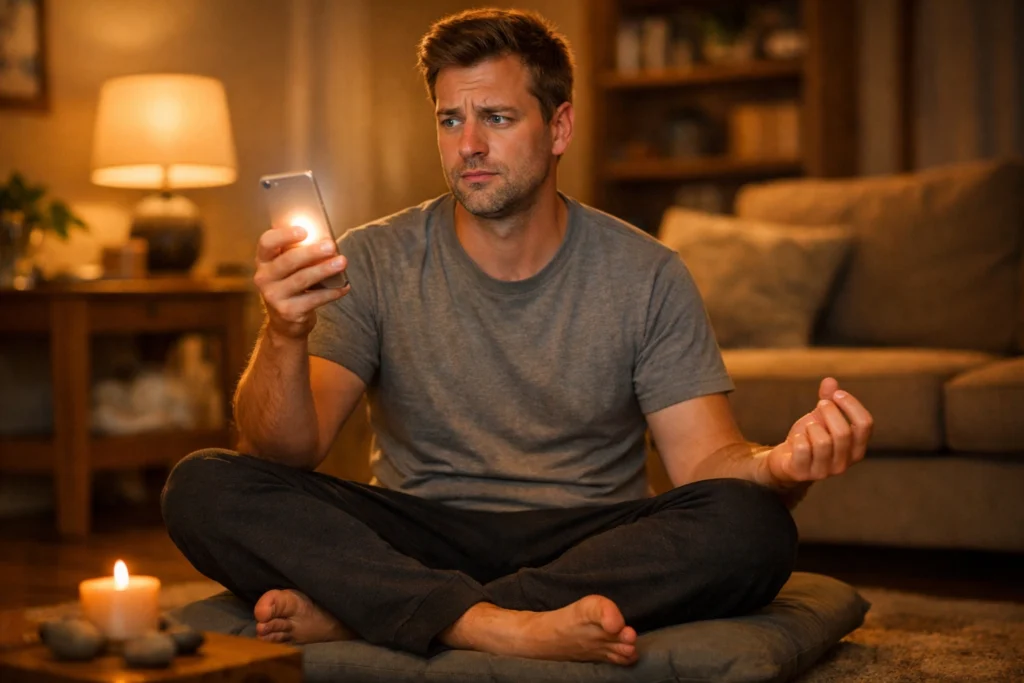
The most common mistake is expecting instant, dramatic results every single time. Grounding methods for mental health work cumulatively. One session might calm you slightly. Twenty sessions rebuild your baseline. People quit after two or three tries because they expected fireworks and got a gentle breeze. That gentle breeze is still changing your nervous system. Stick with it. Impatience is anxiety’s best ally.
Another frequent error is multitasking during grounding. You can’t scroll your phone while doing a body scan and call it grounding. Genuine relaxation and mindfulness practices demand your full attention — even briefly. Doing them while distracted is like trying to fill a cup with a hole in it. Additionally, many people choose the wrong technique for the moment. Cold water suits acute panic. A body scan suits bedtime tension. Matching the tool to the situation dramatically improves effectiveness.
How Often Should You Use Grounding Techniques for Best Results
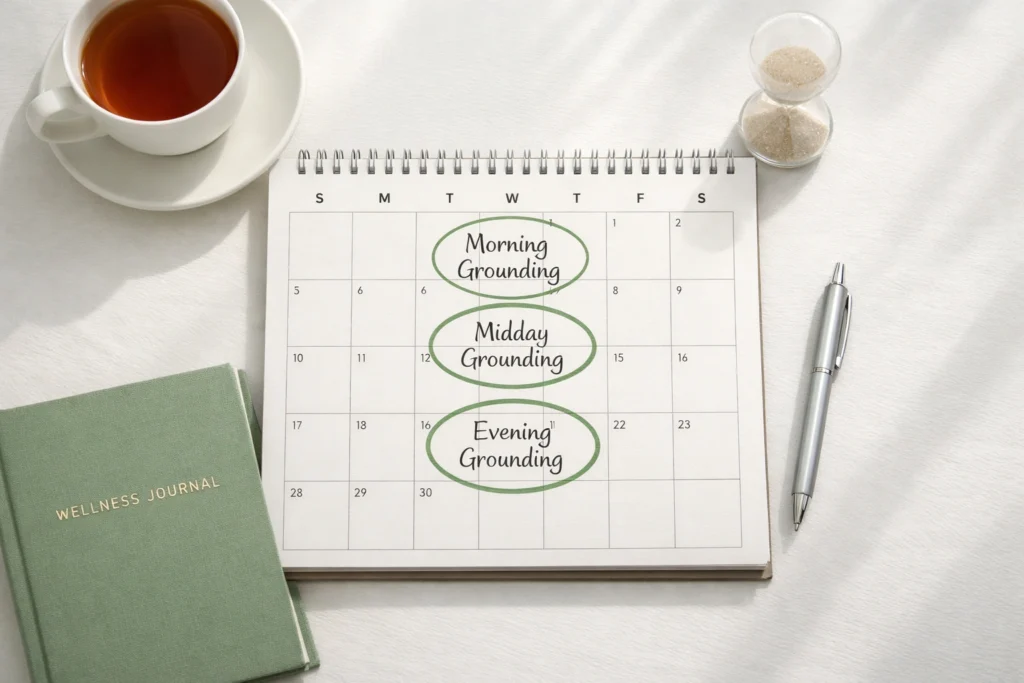
Grounding techniques for calm mind work best with regular, intentional use. Aim for at least two to three grounding sessions per day — morning, midday, and evening. Think of it like brushing your teeth. You don’t brush once a week and expect good dental health. The same logic applies to your nervous system. Consistent emotional regulation techniques retrain your brain’s default stress response over time.
Research from the University of Massachusetts Medical School — the birthplace of Mindfulness-Based Stress Reduction (MBSR) — confirms that daily mindfulness grounding techniques produce measurable changes in brain structure within eight weeks. The prefrontal cortex thickens. The amygdala shrinks. Your baseline anxiety drops. Track your practice in a journal. Note which techniques worked best and when. Over time, patterns emerge that help you customize your grounding practice for maximum impact.
| Frequency | Expected Benefit | Timeframe |
|---|---|---|
| Once daily | Mild stress reduction | 2–3 weeks |
| 2–3 times daily | Noticeable calm baseline | 4–6 weeks |
| 4+ times daily | Significant anxiety reduction | 6–8 weeks |
| Consistent for 8 weeks | Measurable brain structure changes | 8 weeks |
Final Thoughts: Slowing Your Life Down One Grounded Moment at a Time
Slow living isn’t about doing less. It’s about doing things with full presence. Grounding techniques make that possible. They’re the bridge between the life that’s pulling you in ten directions and the life you actually want — calm, focused, intentional. Every time you practice, you’re investing in a version of yourself that doesn’t get swallowed whole by stress.
Start today. Not tomorrow. Pick one technique — the easiest one, the one that made you curious — and try it for five minutes. The 5-4-3-2-1 method if you’re at your desk. Box breathing if you’re stuck in traffic. Bare feet on grass if you have a moment outside. Grounding techniques for adults don’t need perfect conditions. They just need you to show up. One grounded moment leads to another. And slowly, beautifully, life starts to feel like yours again.
Conclusion
Five grounding techniques stand between you and the relentless pace of modern life. The 5-4-3-2-1 sensory method brings you back to your environment instantly. Box breathing resets your nervous system in under two minutes. Barefoot earthing reconnects you to the earth’s natural calming charge. Cold water grounding stops panic in its tracks. And the body scan meditation releases tension you didn’t even know you were carrying. Together, these grounding techniques form a complete toolkit for slowing down, managing anxiety, and living with more intention. Use them daily. Watch your life change.
Frequently Asked Questions
Q1: What are grounding techniques used for?
Grounding techniques help manage anxiety, stress, panic attacks, overthinking, and emotional overwhelm. They’re also widely used in trauma therapy, PTSD treatment, and as part of a slow living practice. Therapists, psychologists, and wellness coaches all recommend them as foundational coping strategies for anxiety.
Q2: How long do grounding techniques take to work?
Some techniques like cold water grounding work within 30–60 seconds. Others, like the body scan and barefoot earthing, deliver deeper benefits over time. For lasting results and a genuinely calm mind, consistent daily practice over four to eight weeks produces the most significant changes.
Q3: Can grounding techniques replace therapy?
No. Grounding methods for mental health are powerful complements to professional therapy but don’t replace it. If you’re dealing with serious anxiety, PTSD, or depression, always work with a licensed mental health professional. Grounding can make therapy more effective by giving you real-time tools between sessions.
Q4: Are grounding techniques safe for children?
Yes. Many simple grounding techniques — especially the 5-4-3-2-1 sensory method and box breathing — are child-friendly with minor modifications. School counselors across the US use adapted grounding exercises to help children manage anxiety and emotional dysregulation in classroom settings.
Q5: What’s the easiest grounding technique for beginners?
The 5-4-3-2-1 sensory method is the most beginner-friendly grounding technique for anxiety. It requires no equipment, no training, and no special environment. Anyone can do it anywhere in under three minutes. It’s also one of the most clinically studied grounding techniques for panic attacks.
Q6: Do grounding techniques work for PTSD?
Yes. Emotional grounding techniques are a core component of trauma-informed therapy approaches including EMDR and DBT. They help PTSD sufferers stay present in the moment instead of dissociating or re-experiencing traumatic memories. Always use grounding as part of a broader treatment plan guided by a licensed trauma therapist.