
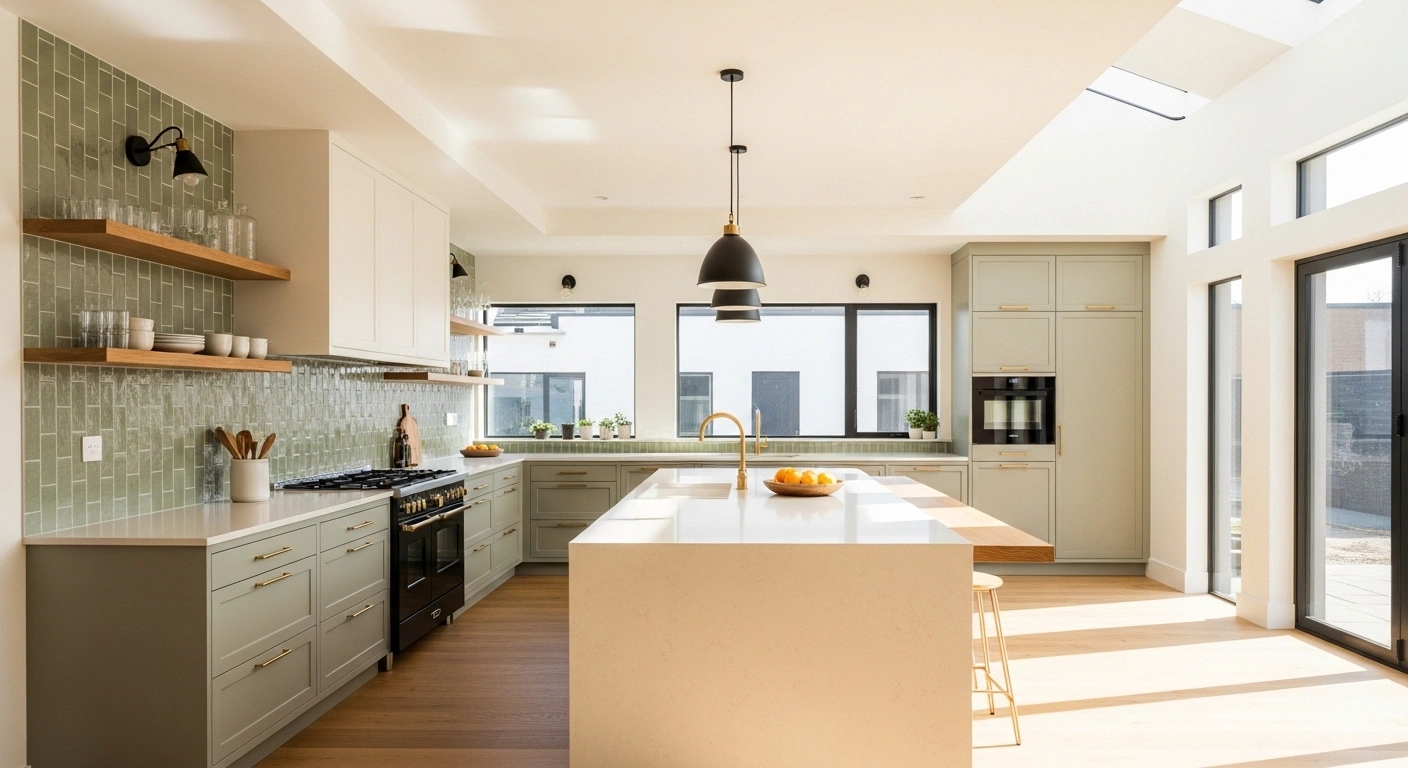
15 Kitchen Trends 2026: Bold Design Ideas Transforming American Homes
The kitchen has always been the heart of the American home. But in 2026 it’s becoming something more — a wellness space, a design statement, a technology hub, and a genuine reflection of how families want to live. Kitchen trends 2026 represent the most significant philosophical shift in residential kitchen design in at least a decade. The cold, sterile all-white kitchen that dominated the 2010s is giving way to something warmer, richer, and more intentionally human. Whether you’re planning a full renovation or simply refreshing what you already have, these 14 bold design ideas show exactly where American kitchen design is heading — and why you’ll want to follow.
Why Kitchen Trends 2026 Are the Most Exciting Design Shift in a Decade
American homeowners are spending more on kitchens than ever before. The National Kitchen and Bath Association reports that kitchen renovation spending across the United States exceeds $170 billion annually — a figure that continues climbing as post-pandemic home investment drives bold design choices nationwide. Kitchen renovation trends 2026 reflect three converging forces that make this particular moment genuinely different from previous design cycles: a wellness movement that demands healthier and calmer living environments, a sustainability imperative that prioritizes responsible material choices, and a technology wave that’s making smart integrated kitchens mainstream rather than luxury. Modern kitchen trends 2026 aren’t just about aesthetics. They’re about how the kitchen functions as a whole lifestyle system.
What makes kitchen trends 2026 ideas particularly exciting is their coherence. Previous years brought disconnected micro-trends that often conflicted with each other visually and functionally. This year the dominant trends share a common philosophical language — warmth, intention, nature, and quiet sophistication. Social media platforms and design apps like Houzz, Pinterest, and Instagram have accelerated trend adoption so dramatically that ideas originating in European design studios reach American renovators within months rather than years. Best kitchen design trends 2026 reflect this accelerated global conversation while retaining distinctly American priorities around space, functionality, and return on renovation investment. The kitchen you design today using these trends will still feel fresh and relevant ten years from now.
Trend 1 — Warm Earthy Tones Replace Cold White Kitchens in 2026
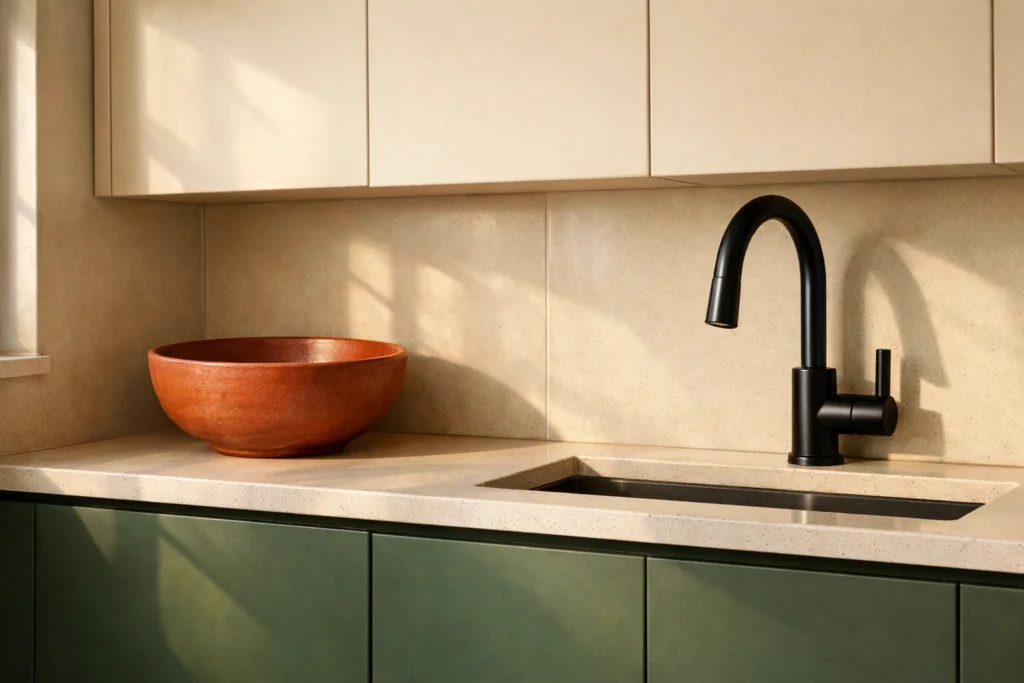
The all-white kitchen is over. Not declining — over. Kitchen color trends 2026 have shifted decisively toward warm terracotta, dusty sage green, deep mushroom, warm taupe, and creamy off-white tones that create psychological warmth and genuine daily comfort that cold white walls and cabinets never could. Color psychology research consistently demonstrates that warm earth tones lower cortisol levels and increase the perceived comfort of a space — qualities that matter enormously in a room where families spend multiple hours daily. Earthy warm kitchen tones 2026 also photograph dramatically more beautifully than white kitchens — the dimensional depth and warmth of earthy colors translates to stunning imagery that resonates across every design platform.
Specific color combinations dominating kitchen cabinet trends 2026 include warm sage green lowers paired with warm white uppers, deep terracotta islands contrasting with cream perimeter cabinets, and warm mushroom grey cabinetry throughout with natural wood accents providing contrast. Benjamin Moore’s Cushing Green and Sherwin-Williams’ Accessible Beige both continue their dominance as top kitchen color picks precisely because they deliver warmth without overwhelming a space. Bold kitchen color palette 2026 doesn’t require bold in the loud sense — it requires bold in the courageous sense of choosing color over the safe default of white. According to Zillow’s Home Improvement research, warm-toned kitchens command measurably higher buyer interest in current real estate markets confirming that warm color choices benefit both daily living and resale value simultaneously.
Trend 2 — Japandi Kitchen Style Takes Over American Home Design
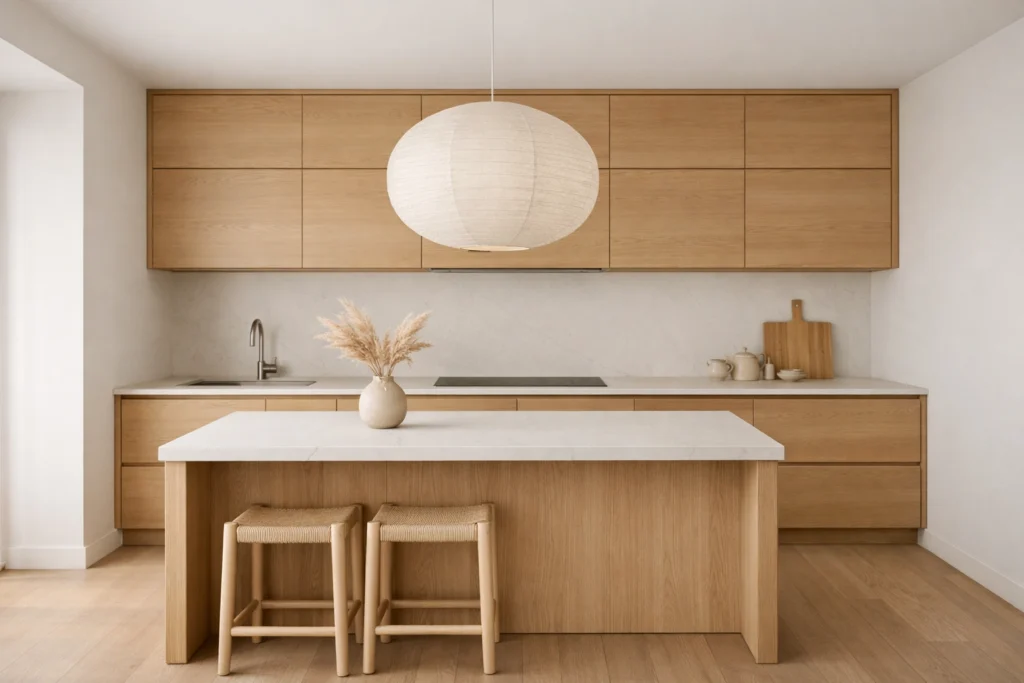
Japandi kitchen style 2026 represents the single most influential design philosophy shaping kitchen renovation decisions across America right now. The term combines Japanese wabi-sabi — the appreciation of imperfect natural beauty — with Scandinavian hygge — the pursuit of cozy intentional comfort — into a design language that feels simultaneously serene, warm, and deeply considered. American homeowners drawn to Japandi kitchens aren’t simply following a trend. They’re responding to a genuine need for living spaces that calm rather than stimulate — and the kitchen, as the home’s most active room, benefits from calming design principles more than any other space. Minimalist kitchen cabinets 2026 in Japandi style feature clean handleless fronts in warm natural wood or muted warm white with zero decorative embellishment — beauty emerging from proportion and material rather than ornamentation.
you may also like this:The Complete Home Decluttering Guide: How To Finally Let Go and Live With Less
The Japandi kitchen material palette grounds every design decision in natural authenticity. Light oak and walnut cabinetry, honed stone countertops, natural linen window treatments, washi paper pendant lights, and handmade ceramic accessories all speak the same organic visual language that makes natural wood kitchen elements central rather than incidental to the design. Japandi kitchens avoid the cold sterility that plagued minimalist design’s earlier iterations by consistently prioritizing warm tones and tactile natural textures over clinical smooth surfaces. Modern kitchen trends 2026 that draw from Japandi principles tend to age more gracefully than trend-driven kitchens built around a single fashionable color or surface because the underlying philosophy is timeless rather than seasonal.
Trend 3 — Fluted Cabinet Doors Bring Texture and Drama to Every Kitchen
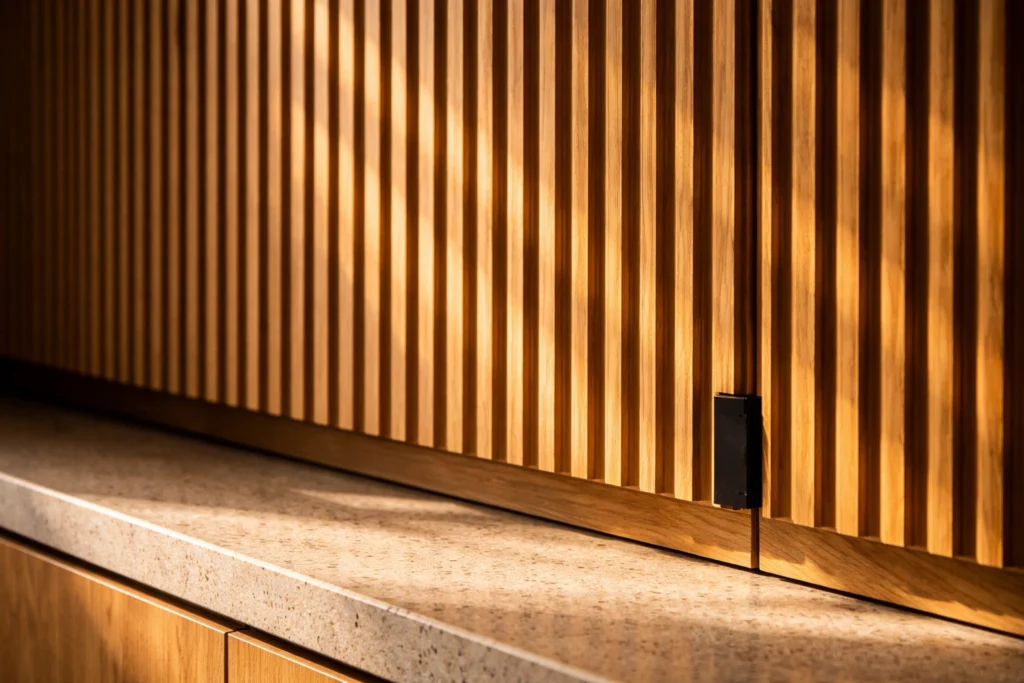
Fluted kitchen cabinet doors have captured the attention of interior designers worldwide and for very good reason — they solve the flat, featureless appearance problem that plagues most modern kitchen cabinet installations with genuine elegance. The vertical groove pattern running down the cabinet door face creates a subtle play of light and shadow across the surface that shifts throughout the day as natural light moves across the room — a quality no flat slab door can replicate. Kitchen cabinet trends 2026 consistently feature fluted details as the primary texture element that distinguishes a custom-feeling kitchen from a builder-grade installation regardless of overall budget level. Fluted doors work equally well in traditional farmhouse contexts and contemporary modern kitchens — a versatility that most individual design elements don’t possess.
Material options for fluted kitchen cabinet doors span the full range of renovation budgets. MDF painted in a matte finish offers the most affordable entry point — the fluted profile mills cleanly from MDF and accepts paint beautifully. Natural wood veneer fluted doors deliver rich grain texture alongside the vertical groove detail for a layered natural complexity that painted versions can’t match. Glass panel inserts with a fluted profile create a cabinet door that diffuses interior light softly rather than revealing contents clearly — a popular choice for upper cabinets where dishware display adds visual interest. Luxury kitchen trends 2026 frequently feature fluted brass or unlacquered metal cabinet inserts that catch light dramatically and age with beautiful patina character over years of use.
Trend 4 — Smart Integrated Appliances Become the New Kitchen Standard
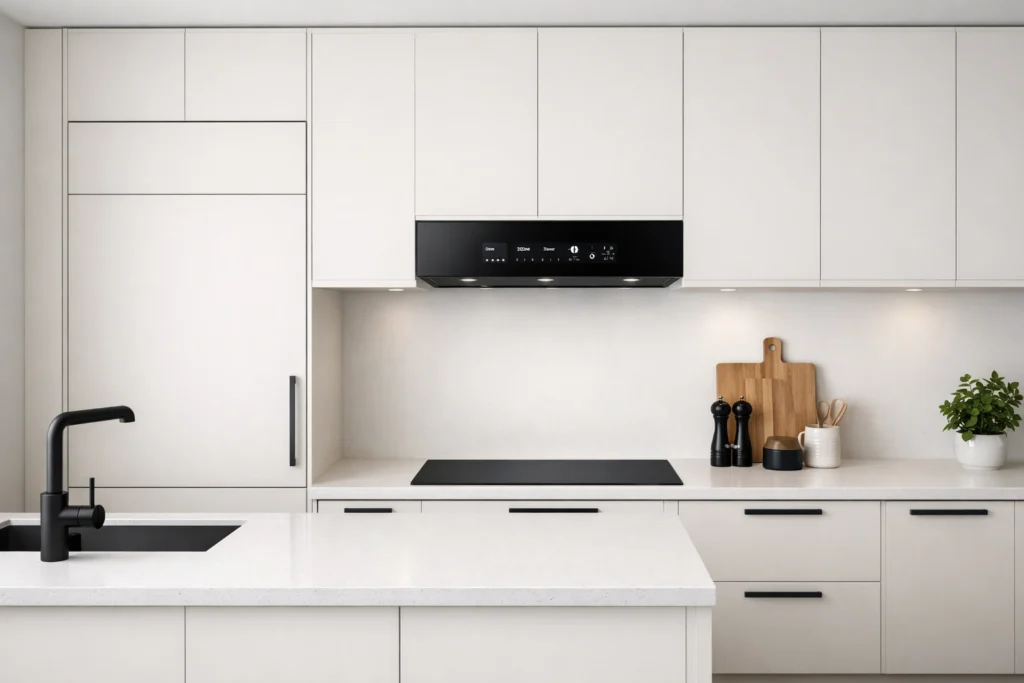
2026 marks the genuine tipping point at which smart kitchen technology 2026 transitions from luxury feature to mainstream expectation in American kitchen renovations. The shift from standalone appliances to integrated smart appliances kitchen environments — where refrigerators, ovens, range hoods, and dishwashers communicate with each other and with the homeowner’s smartphone — is happening faster than most industry observers predicted even two years ago. Kitchen appliance trends 2026 center on three priorities: visual integration where appliances disappear behind matched cabinet panels, energy intelligence where appliances optimize their consumption patterns automatically, and usage connectivity where cooking assistance, inventory management, and recipe guidance merge into the appliance interface itself.
Panel-ready appliances represent the most significant aesthetic advancement in kitchen design in years. A refrigerator hidden behind cabinet door panels that match the surrounding cabinetry completely transforms the kitchen’s visual coherence — the kitchen reads as a unified architectural composition rather than a room with appliances placed inside it. Energy efficient kitchen appliances from brands including Bosch, Thermador, and Samsung achieve energy star ratings that reduce kitchen operating costs by 30 to 40 percent compared to standard appliance alternatives. Small kitchen trends 2026 benefit enormously from integrated appliance design because hiding appliance faces behind matched panels dramatically reduces visual noise in compact spaces — making small kitchens feel dramatically larger and more considered than their actual square footage suggests.
Trend 5 — Curved Kitchen Design Elements Soften Modern Interiors
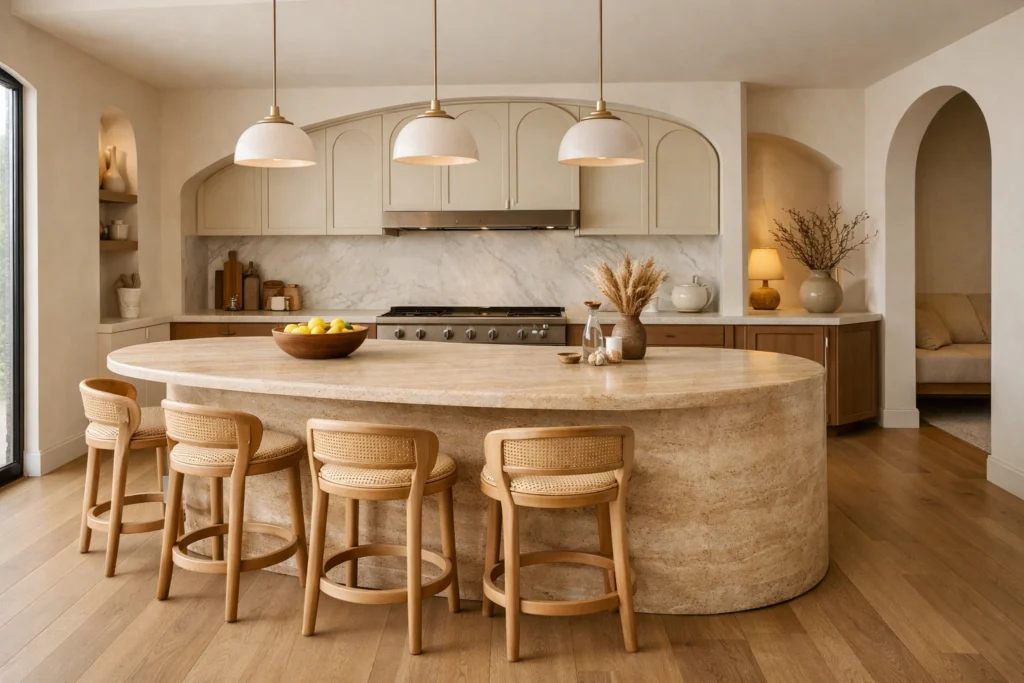
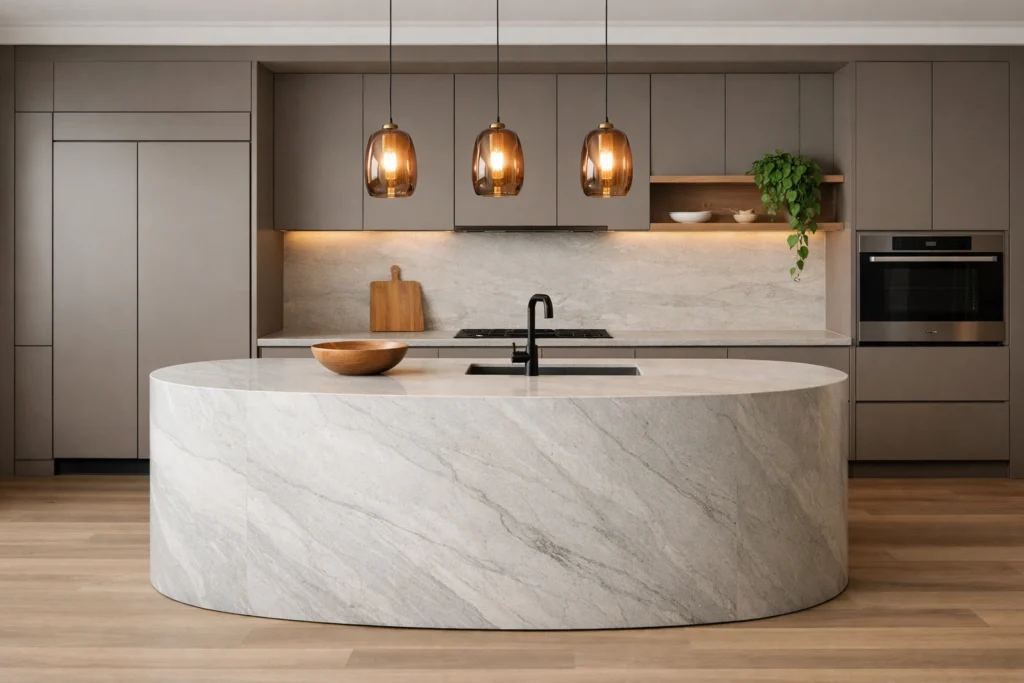
Curved kitchen design elements are one of 2026’s most visually distinctive and psychologically significant trends. After years of right angles, sharp corners, and rectangular rigidity dominating kitchen design, curves are re-entering the American kitchen with confident authority. Rounded kitchen islands replace rectangular equivalents creating flowing traffic patterns and softer visual landscapes. Arched cabinet doors reference classical architectural proportions that feel simultaneously historic and thoroughly contemporary. Curved countertop edges replace sharp 90-degree profiles with gentle radii that feel safer and more inviting at every interaction point. Kitchen island trends 2026 increasingly feature the oval or kidney-shaped island as a sophisticated alternative to the rectangle that facilitates conversation and movement around the space more naturally.
The psychological case for curves in kitchen design is genuinely compelling. Neuroscience research from the University of Toronto demonstrates that curved environments produce measurably lower anxiety responses than angular ones in human subjects. This biological preference for organic flowing forms connects directly to the broader biophilic and wellness design movements shaping kitchen trends 2026 ideas across every budget category. Curves don’t require structural renovation to introduce — rounded bar stools, curved pendant light shades, arched window treatments, and oval dining tables all contribute to the softened aesthetic that defines this trend at accessible price points. Kitchen renovation trends 2026 that incorporate even one curved element consistently score higher on homeowner satisfaction surveys than equivalent renovations that maintained strict angularity throughout.
Trend 6 — Statement Backsplashes Become the Kitchen’s Focal Masterpiece
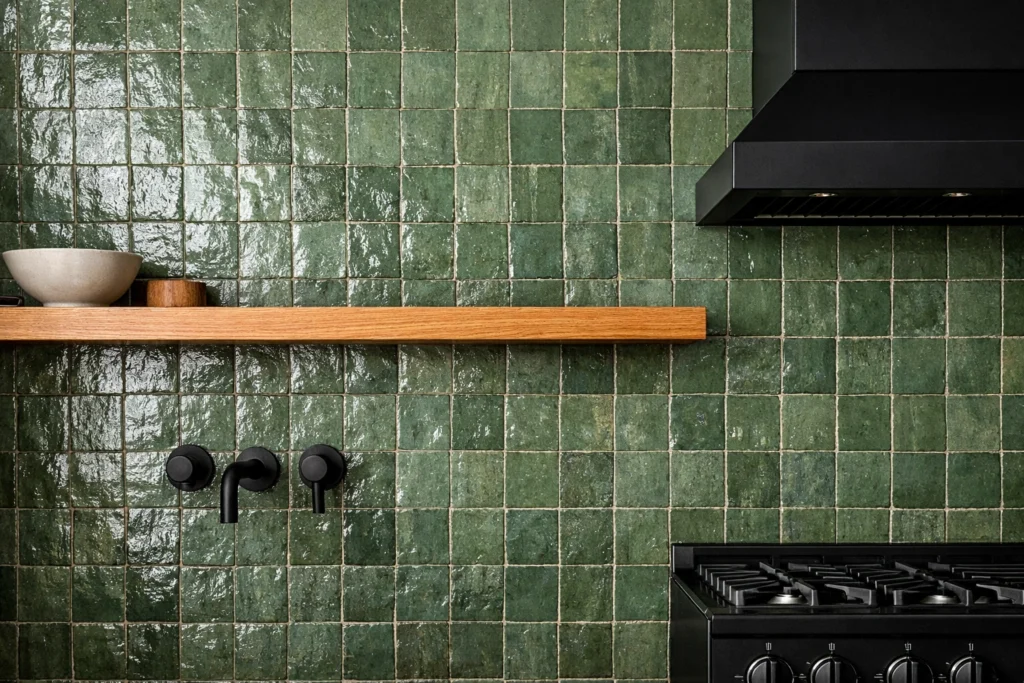
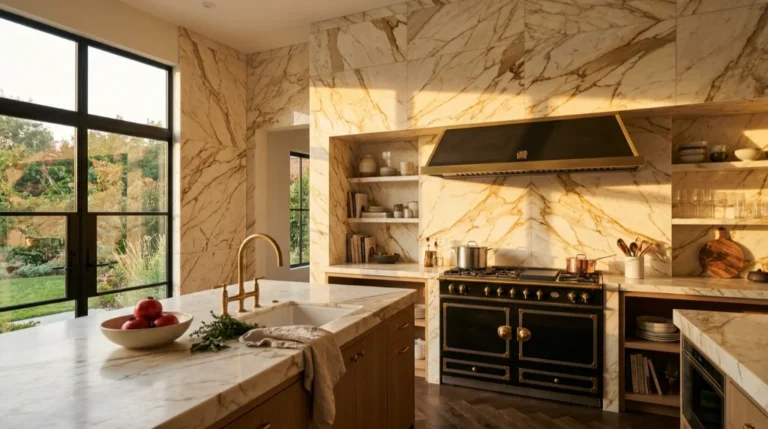
The kitchen backsplash has completed its evolution from humble functional surface to genuine artistic centerpiece. Statement kitchen backsplash 2026 designs extend the tile installation from the traditional countertop-to-cabinet range to a dramatic floor-to-ceiling treatment that transforms the cooking wall into the kitchen’s most visually impactful architectural feature. Kitchen backsplash trends 2026 favor zellige tile — the handmade Moroccan clay tile with its distinctive irregular glaze surface — as the dominant choice for statement installations because its natural variation creates depth and movement that machine-made tiles categorically cannot replicate. Full-height zellige installations in sage green, warm terracotta, or deep navy create statement walls that photograph magnificently and command genuine admiration from every visitor.
Budget-conscious homeowners achieve statement backsplash impact through several alternatives to premium handmade tile. Limewash paint applied to the backsplash wall in a complementary earthy tone creates an organic textured surface that reads as sophisticated at a fraction of tile cost. Premium peel-and-stick tile products have improved dramatically in quality and now provide convincing stone and zellige-style appearances suitable for rental properties and transitional installations. Farmhouse kitchen trends 2026 favor shiplap-style vertical wood plank backsplashes that combine rustic character with practical wipe-clean surface treatments. Kitchen color trends 2026 expressed through a bold backsplash choice deliver more design impact per renovation dollar than almost any other single kitchen investment available to American homeowners.
Trend 7 — Natural Stone and Quartz Countertops Dominate 2026 Kitchens
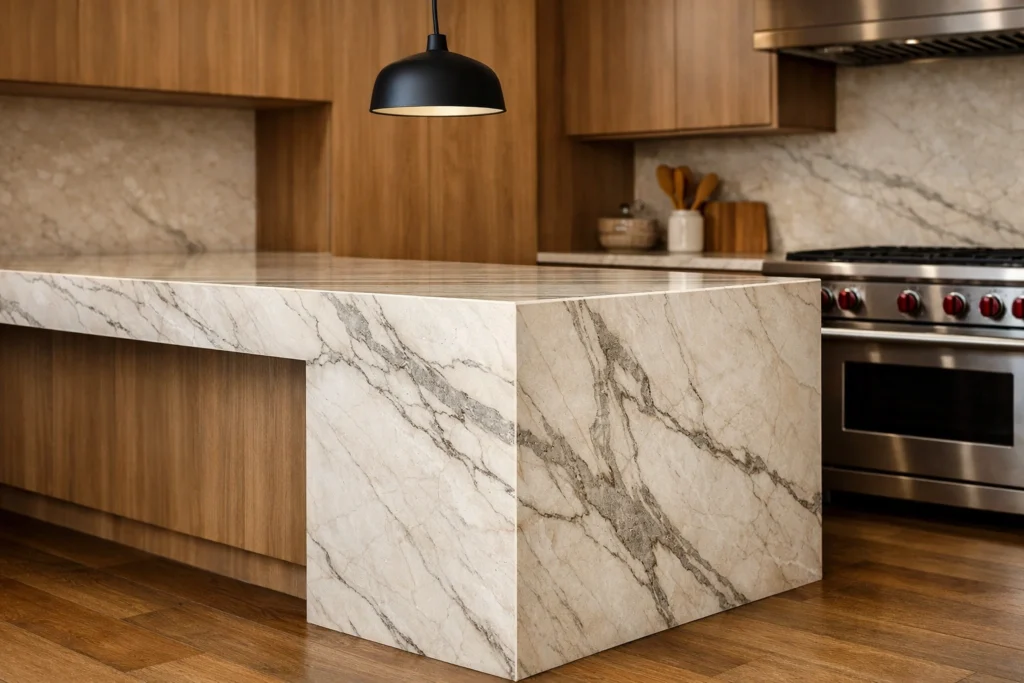
Natural stone countertops are experiencing their strongest demand cycle in two decades. Quartz and stone countertops 2026 dominate kitchen countertop trends 2026 with a clear hierarchy emerging between materials. Quartzite — a naturally metamorphic stone that combines marble’s veined visual beauty with granite’s practical durability — has emerged as the material that finally resolves the long-running conflict between wanting marble’s aesthetics and needing a surface that withstands daily kitchen use without staining or etching. Leathered granite finishes provide a matte tactile surface that hides fingerprints and minor scratches while delivering the genuine natural stone authenticity that engineered surfaces cannot duplicate. Kitchen waterfall island design featuring stone that wraps continuously from countertop surface down the island sides to the floor remains one of the most visually dramatic and persistently popular kitchen installation choices.
| Countertop Material | Durability | Maintenance | Cost Range | Best For |
|---|---|---|---|---|
| Quartzite | Excellent | Low-medium | $80–$150/sqft | Marble lovers who cook seriously |
| Engineered quartz | Excellent | Very low | $55–$120/sqft | Families with heavy daily use |
| Leathered granite | Very good | Low | $60–$130/sqft | Texture lovers, rustic styles |
| Honed marble | Good | High | $75–$200/sqft | Luxury kitchens with careful users |
| Recycled glass | Good | Low | $50–$125/sqft | Sustainability-focused renovations |
Trend 8 — Two Tone Kitchen Cabinets Create Bold Visual Contrast
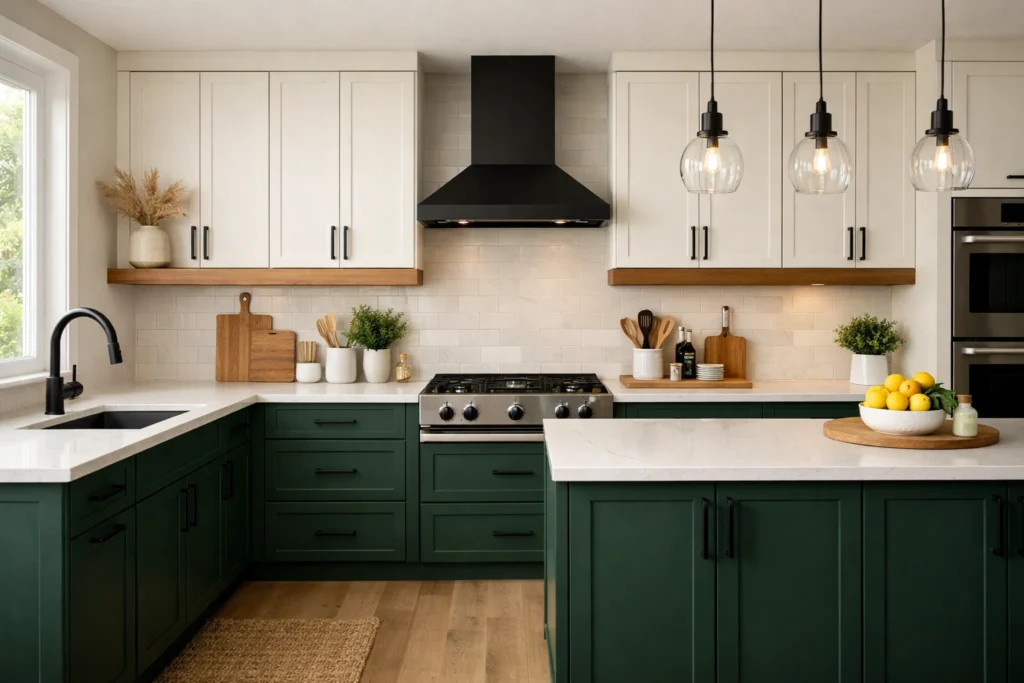
Two tone kitchen cabinets 2026 have moved from trend to established design standard — a category shift that signals genuine permanence rather than passing fashion. The most successful combinations in kitchen cabinet trends 2026 pair darker tones on lower cabinets against lighter tones on upper cabinets following the grounding principle that heavier visual weight belongs closest to the floor. Deep navy or forest green lowers against warm white or cream uppers create a sophisticated contrast that reads as both deliberately designed and entirely natural. Sage green lowers against warm off-white uppers produce a softer more organic contrast that suits farmhouse kitchen trends 2026 particularly beautifully. The island as the kitchen’s accent color anchor consistently produces better results than perimeter accent cabinets — using the island as the color statement while perimeter cabinets maintain a unified tone creates focal clarity without visual chaos.
Bold kitchen color palette 2026 expression through two-tone cabinetry works equally well in small and large kitchens — arguably better in small kitchens where the visual interest compensates for the spatial limitation. The color relationship between the two tones matters more than the individual colors themselves — successful two-tone kitchens always feature hues from the same broad color family or tones that share a common undertone rather than colors chosen for maximum contrast regardless of harmony. Cabinet painting services make kitchen renovation trends 2026 two-tone results achievable without full cabinet replacement — a professionally painted kitchen with new hardware and a two-tone color scheme delivers 80 percent of a full cabinet renovation’s visual impact at approximately 30 percent of the cost.
Trend 9 — Hidden Storage and Handleless Cabinets Define Seamless Kitchens
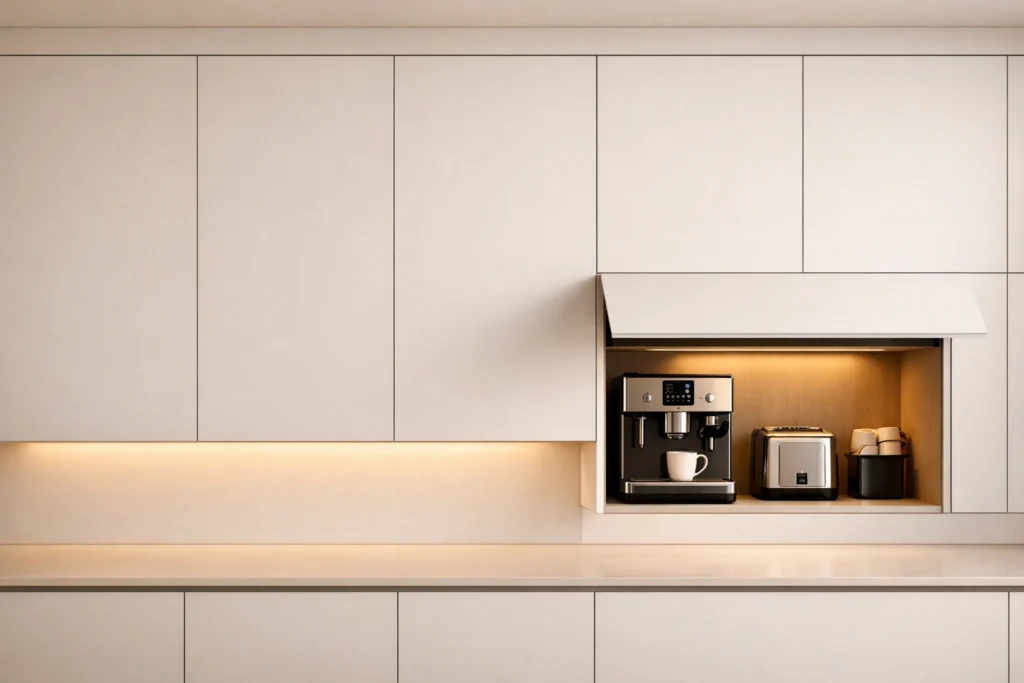
Hidden kitchen storage solutions and handleless kitchen cabinet design together create the seamless uninterrupted kitchen aesthetic that defines 2026’s most sophisticated residential installations. Push-to-open mechanisms and touch-latch systems eliminate the need for hardware entirely — cabinet doors open at the lightest touch, close with a satisfying magnetic click, and present a completely unbroken surface to the room when closed. The visual result is a kitchen that reads more like a beautifully paneled room than a collection of individual storage units — an architectural coherence that dramatically elevates the perceived quality and craftsmanship of even modestly budgeted installations. Minimalist kitchen cabinets 2026 achieve their most refined expression through handleless design combined with careful proportion and quality material selection.
Deep drawer systems replacing traditional base cabinets represent one of the most functionally transformative storage upgrades in modern kitchen design. A single deep drawer base cabinet accessed from the front provides more usable organized storage than three-shelf base cabinet with doors because everything in the drawer remains visible and accessible simultaneously rather than requiring items at the back to be reached over items at the front. The charging drawer trend — built-in USB-A, USB-C, and wireless charging pads integrated into kitchen island drawer interiors — addresses the practical reality that American families charge devices in the kitchen more than any other room. Smart kitchen technology 2026 manifests most practically not in voice-controlled appliances but in thoughtfully integrated infrastructure like charging drawers, integrated lighting, and sensor-activated cabinet systems that serve genuine daily needs invisibly.
Trend 10 — Butler Pantries Make a Powerful Comeback in 2026
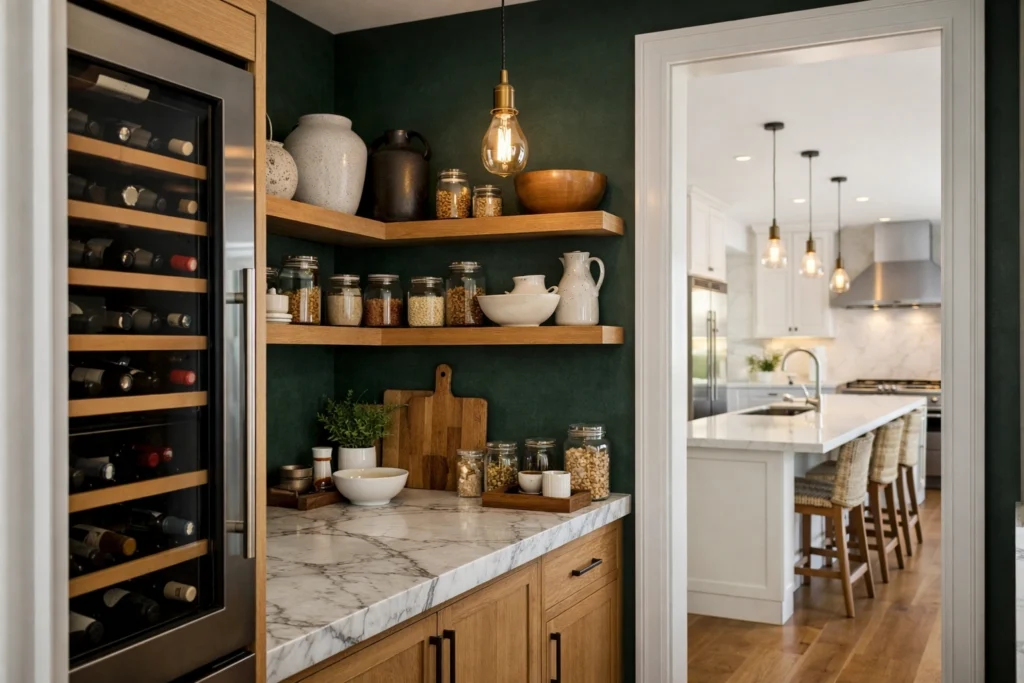
The butler pantry has returned with remarkable force in kitchen trends 2026 and its comeback reflects a genuinely practical response to the open-plan kitchen dilemma. Open-plan living demands visually pristine kitchen presentation at all times — a standard that conflicts fundamentally with the reality of active daily cooking. Butler pantry design 2026 solves this conflict by providing a dedicated secondary space adjacent to the main kitchen where the actual work of food preparation, small appliance storage, coffee station operation, and kitchen organization happens invisibly. The main kitchen remains perpetually party-ready while the butler pantry absorbs all the glorious chaos that real cooking generates. According to Houzz’s Kitchen Trends Study, butler pantry requests to kitchen designers have increased by over 40 percent in the past two years confirming that this isn’t a niche luxury preference but a mainstream functional priority.
Luxury kitchen trends 2026 butler pantry installations feature statement wallpaper — often a bold botanical or geometric pattern — that creates a visually dramatic contrast against the main kitchen’s more restrained palette. Open shelving kitchen walls in the butler pantry display curated collections of glassware, ceramics, and pantry staples in beautiful vessels that contribute to the space’s overall aesthetic rather than simply storing items practically. The wine storage integration — temperature-controlled wine refrigerator columns built into the butler pantry cabinetry — transforms this secondary space into an entertainment hub that functions independently of the main kitchen during parties. A minimum of 30 square feet is sufficient for a functional butler pantry meaning that most American homes with existing layout flexibility can incorporate this feature without structural modification.
Trend 11 — Biophilic Design Brings Nature Fully Into the 2026 Kitchen
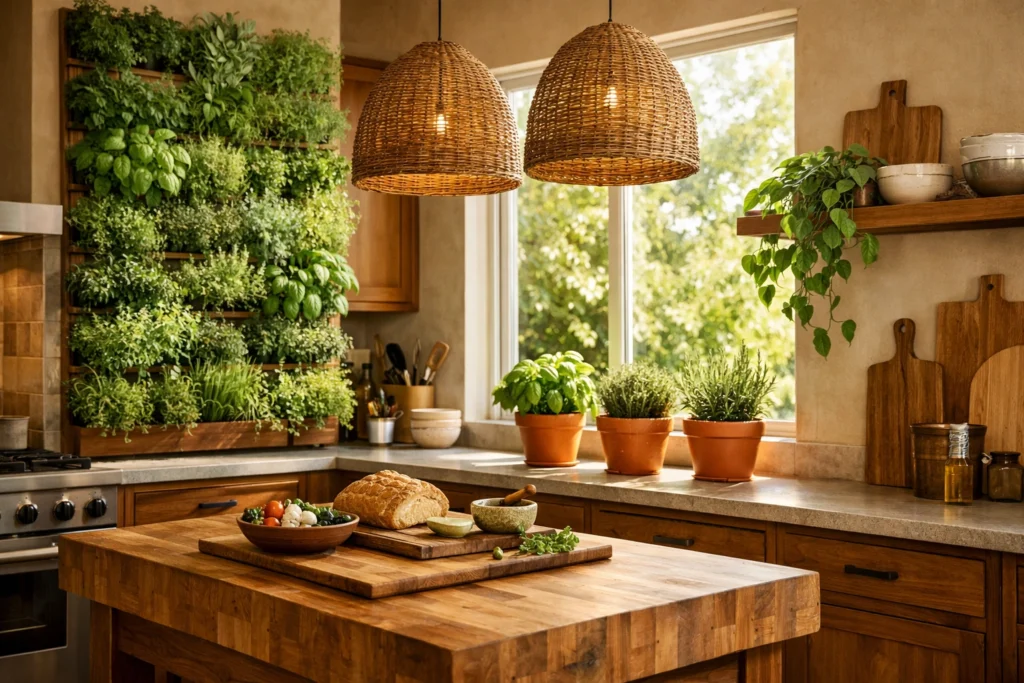
Biophilic kitchen design ideas have moved from design theory into practical mainstream application in 2026 and the kitchen is the room where biophilic principles deliver the greatest daily quality-of-life return on investment. Biophilic design — the intentional connection of interior spaces to natural systems, materials, and living elements — responds to the fundamental human need for contact with the natural world that modern indoor living systematically removes. Indoor kitchen herb garden installations ranging from simple window-mounted terracotta pot systems to sophisticated wall-mounted hydroponic growing units bring living plants into the kitchen’s daily visual field while providing fresh culinary herbs that genuinely improve cooking quality. Natural wood kitchen elements in cabinetry, open shelving, cutting boards, and kitchen accessories connect the space to the organic world in ways that synthetic materials simply cannot replicate regardless of how convincingly they simulate natural appearance.
Natural light maximization works as biophilic design’s most powerful and most underutilized kitchen tool. Enlarging kitchen windows, adding skylights above kitchen work areas, and positioning kitchen islands beneath existing natural light sources all amplify the biophilic quality of any kitchen design without adding a single decorative element. Kitchen wellness design trend and biophilic design overlap significantly — both prioritize environmental conditions that support human biological functioning rather than simply aesthetic preferences. Research from the Human Spaces Report confirms that biophilically-designed workspaces produce measurably higher wellbeing scores and the same principle applies equally to residential kitchen environments where hours of daily activity occur. Sustainable kitchen design 2026 and biophilic design align naturally — choosing natural materials that connect inhabitants to the organic world simultaneously reduces the synthetic material dependency that drives unsustainable manufacturing.
Trend 12 — Matte Black Hardware Remains the Designer’s Favorite Accent
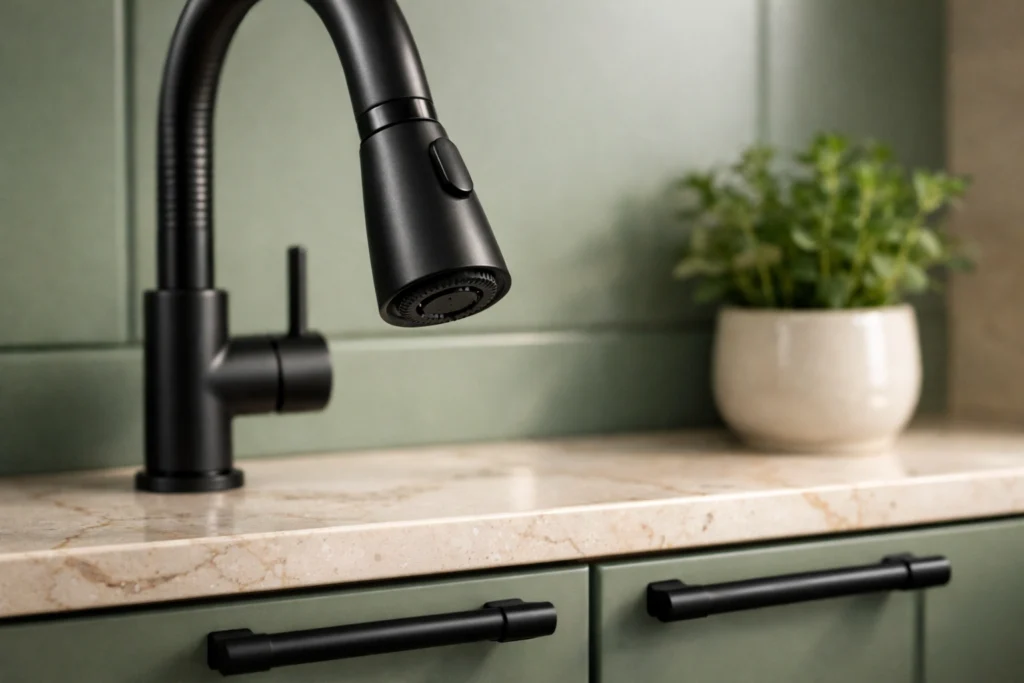
Matte black kitchen hardware 2026 has accomplished something remarkable in design terms — it has transcended the trend cycle and achieved the status of a durable classic. Introduced as a bold counter-cultural response to ubiquitous brushed nickel and polished chrome in the mid-2010s, matte black hardware has proven its staying power by demonstrating genuine versatility across every kitchen design style. It grounds earthy warm kitchen tones 2026 with sophisticated contrast. It anchors Japandi kitchen style 2026 with clean unobtrusive precision. It defines farmhouse kitchens with industrial authenticity. Kitchen lighting trends 2026 consistently feature matte black pendant fixtures as the designer’s first choice for kitchen island lighting because the finish bridges contemporary and traditional aesthetics without favoring either exclusively.
The warm black versus cool black distinction separates satisfying hardware choices from slightly-off ones that most homeowners notice without being able to identify the source of their dissatisfaction. Warm matte black hardware — with its slightly brown underlying undertone — harmonizes naturally with earthy palettes, natural wood cabinetry, and warm stone surfaces. Cool matte black — with its slightly blue underlying tone — suits contemporary monochromatic kitchens and high-contrast black and white schemes more precisely. Mixing matte black kitchen hardware 2026 with warm unlacquered brass accents creates one of 2026’s most sophisticated material combinations — the two metals share a warmth and patina philosophy that makes their juxtaposition feel intentional and harmonious rather than conflicted. Maintenance reality: matte black finishes show water spots and fingerprints more readily than brushed finishes requiring more frequent wiping in high-use areas.
Trend 13 — Kitchen Wellness Design Becomes a Non-Negotiable Priority
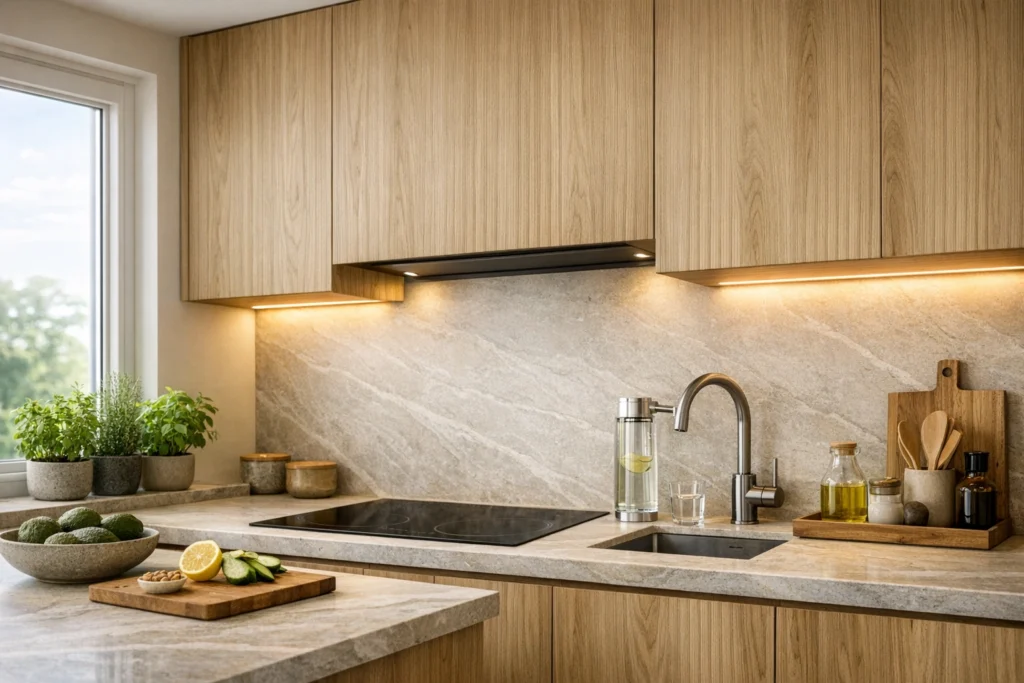
Kitchen wellness design trend has graduated from lifestyle aspiration to design specification in 2026 — homeowners now include specific wellness requirements in renovation briefs alongside aesthetic and functional requirements. Air quality represents the most urgent wellness priority: the EPA reports that cooking activities produce indoor air pollution concentrations two to five times higher than outdoor air, making powerful ventilation not a luxury upgrade but a genuine health necessity. Sustainable kitchen design 2026 and kitchen wellness align in their shared insistence on non-toxic material specification — zero-VOC cabinet finishes, natural stone and solid wood surfaces that don’t off-gas synthetic chemicals, and non-toxic sealants and adhesives throughout the installation. Circadian lighting systems that shift kitchen illumination color temperature from energizing blue-white morning light to warming amber evening light support natural biological rhythms throughout the day.
Ergonomic kitchen design receives dramatically more attention in 2026 renovation planning than in any previous era. Varied counter heights — traditional 36-inch standard counters supplemented by 32-inch prep areas for seated work and 42-inch raised bar sections for standing task work — accommodate different body types, working positions, and abilities more inclusively than the single-height kitchen that remains standard in most American homes. Energy efficient kitchen appliances contribute to kitchen wellness by eliminating the combustion byproducts that gas cooking produces — induction cooktops cook as quickly as gas with zero indoor air quality impact and 85 percent energy efficiency compared to gas’s approximately 40 percent. Water filtration integration — under-counter reverse osmosis systems connected to dedicated filtered drinking taps — addresses another wellness priority with practical kitchen infrastructure that serves genuine daily health needs rather than simply aesthetic ones.
Trend 14 — Energy Efficient and Sustainable Kitchen Materials Lead 2026
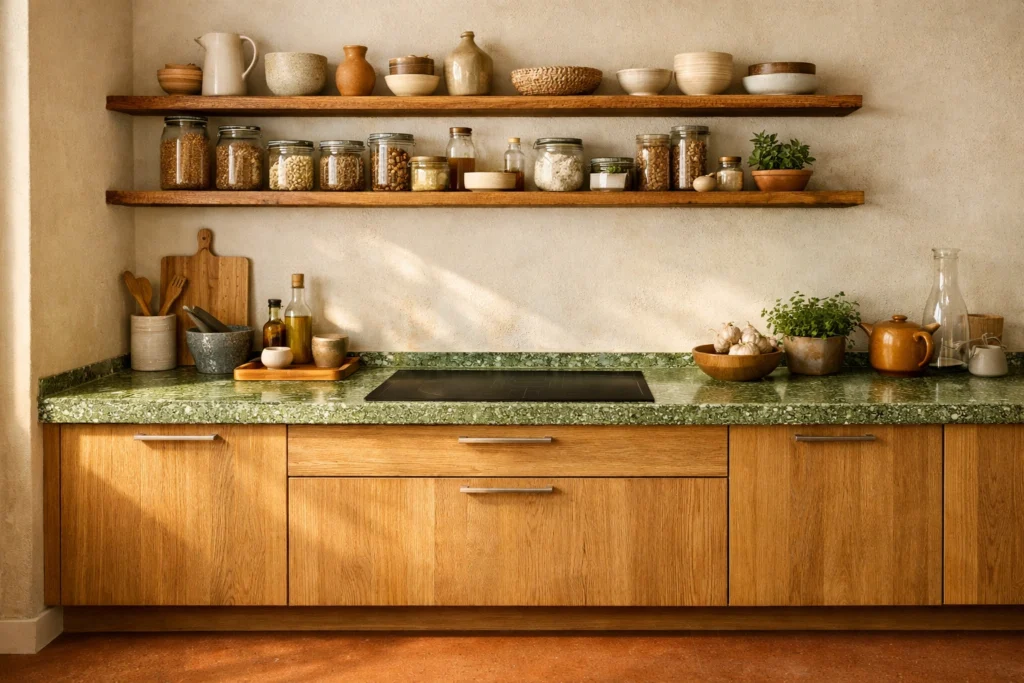
Sustainable kitchen design 2026 has reached the mainstream American renovation market with genuine momentum rather than as a niche premium option accessible only to affluent homeowners. Recycled glass countertops — manufactured from post-consumer glass bottles and windows — deliver striking visual beauty in a wide range of colors and finishes while diverting waste from landfill and requiring significantly less energy to produce than quarried stone alternatives. Reclaimed wood open shelving brings authentic history and irreplaceable character to kitchen walls while consuming zero new forest resources. FSC-certified cabinet materials ensure that the wood-based products used in kitchen cabinetry originate from responsibly managed forests with verified chain-of-custody documentation. Kitchen flooring trends 2026 increasingly feature natural linoleum — a genuinely biodegradable flooring material made from linseed oil, cork dust, and wood flour — as an alternative to vinyl that’s both more environmentally responsible and more durable over its lifespan.
Induction cooking has reached the tipping point of mainstream American adoption in 2026 driven by energy efficient kitchen appliances incentives, improving technology, and growing awareness of gas cooking’s indoor air quality implications. Kitchen appliance trends 2026 show induction cooktop installations in new kitchen renovations surpassing gas installations for the first time nationally — a historic market shift that reflects both environmental values and the practical reality that modern induction technology has eliminated the performance gap that previously made gas cooking preferable for serious home cooks. The Energy Star appliance standard has become a baseline expectation rather than a premium specification — homeowners now approach any non-Energy Star kitchen appliance recommendation with skepticism that their kitchen designer or retailer must actively address. Kitchen trends 2026 in sustainability reflect a maturation of American consumer values where environmental responsibility and practical self-interest have finally aligned around the same choices.
Final Thoughts on Kitchen Trends 2026 and How to Use Them
Kitchen trends 2026 share a unified philosophical foundation beneath their individual design expressions. Every trend covered here — from earthy warm tones to biophilic herb gardens to wellness-focused air quality systems — reflects the same underlying insight: that kitchens should actively support human flourishing rather than simply function as food production facilities. The cold, efficient, purely functional kitchen philosophy is giving way to something warmer, more intentional, and more genuinely livable. This shift represents genuine design maturation — the field learning from decades of clinical minimalism that humans need warmth, nature, and sensory richness in their daily environments to thrive.
Starting points matter enormously when applying kitchen renovation trends 2026 within realistic budgets. Cabinet hardware replacement to matte black and earthy color tone introduction through accessories and soft furnishings deliver the fastest visual transformation for the least financial investment — both achievable over a single weekend for under $500 combined. Statement backsplash installation as a DIY weekend project using premium peel-and-stick zellige-style tiles can transform a kitchen’s focal wall for $200 to $400. Full cabinet painting with two-tone color application by a professional service typically runs $1,500 to $3,500 and delivers 80 percent of a new cabinet installation’s visual impact at a fraction of the cost. Kitchen design trends 2026 reward strategic prioritization — choosing one or two high-impact trends to execute beautifully always outperforms attempting to incorporate every trend simultaneously at lower execution quality.

One Comment