
13 Outdoor Pallet Projects for Kids That Are Fun Easy and Budget Friendly
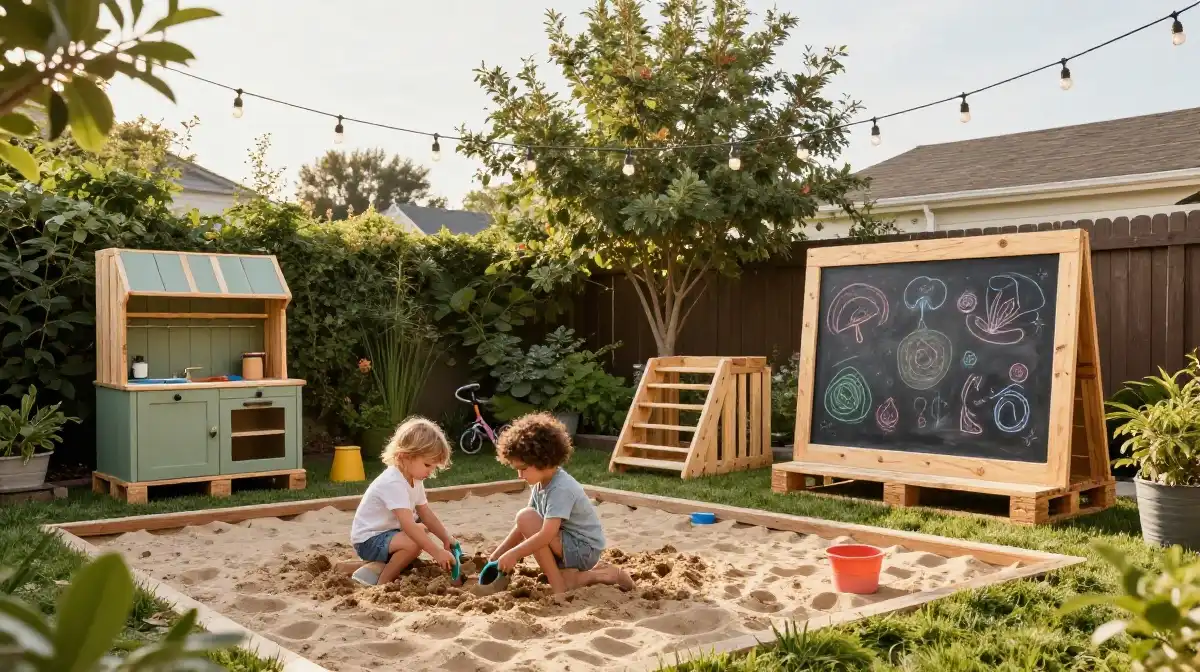
Every backyard has untapped potential. Most parents just haven’t found the key yet. Outdoor pallet projects for kids are that key — a collection of creative, affordable, and genuinely exciting DIY builds that transform ordinary backyard spaces into extraordinary play zones children actually want to spend time in. The best part? Wood pallets are practically free. Businesses, warehouses, hardware stores, and garden centers give them away every single day because recycling or disposing of them costs money. You take them off someone’s hands and turn raw pallet wood into something your kids will remember for years. This guide covers 10 specific builds — from sandboxes and mud kitchens to reading nooks and water tables — alongside complete safety guidance, tool lists, budget breakdowns, and everything else you need to start building this weekend.
Why Outdoor Pallet Projects for Kids Are the Best Backyard Activity
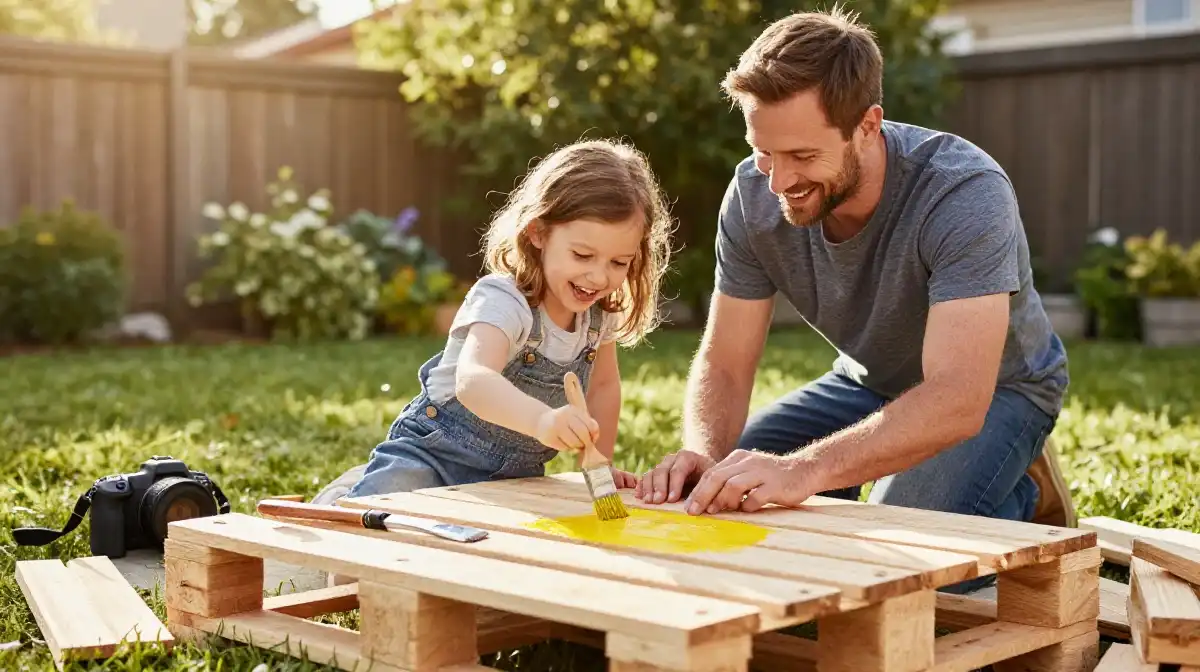
There’s a reason outdoor pallet projects for kids have exploded across every DIY platform in America over the past five years. Children who build things — or watch their parents build things for them — develop a fundamentally different relationship with their environment. They understand that objects can be created rather than only purchased. They learn that creativity and effort produce results. And they spend time outside, away from screens, doing something genuinely engaging with their hands and their imaginations. According to I’m the Chef Too, pallet projects provide anchor memories for children — teaching them that they have agency in the world and can change their environment through effort and creativity.
Fun outdoor pallet projects for kids also deliver extraordinary value for the cost. A professionally built wooden sandbox retails for $200 to $500 at most outdoor retailers. A DIY pallet sandbox costs $20 to $60 in total materials — sand included. A pallet mud kitchen that would sell for $300 at a children’s outdoor play store costs under $30 to build from scratch using salvaged wood and a few basic supplies. Cheap outdoor pallet projects for kids consistently outperform their purchased equivalents in durability too — because you build them with your specific space, your specific climate, and your specific child’s needs in mind. No mass-produced product does that.
How to Choose Safe Pallets for Kids Outdoor Projects
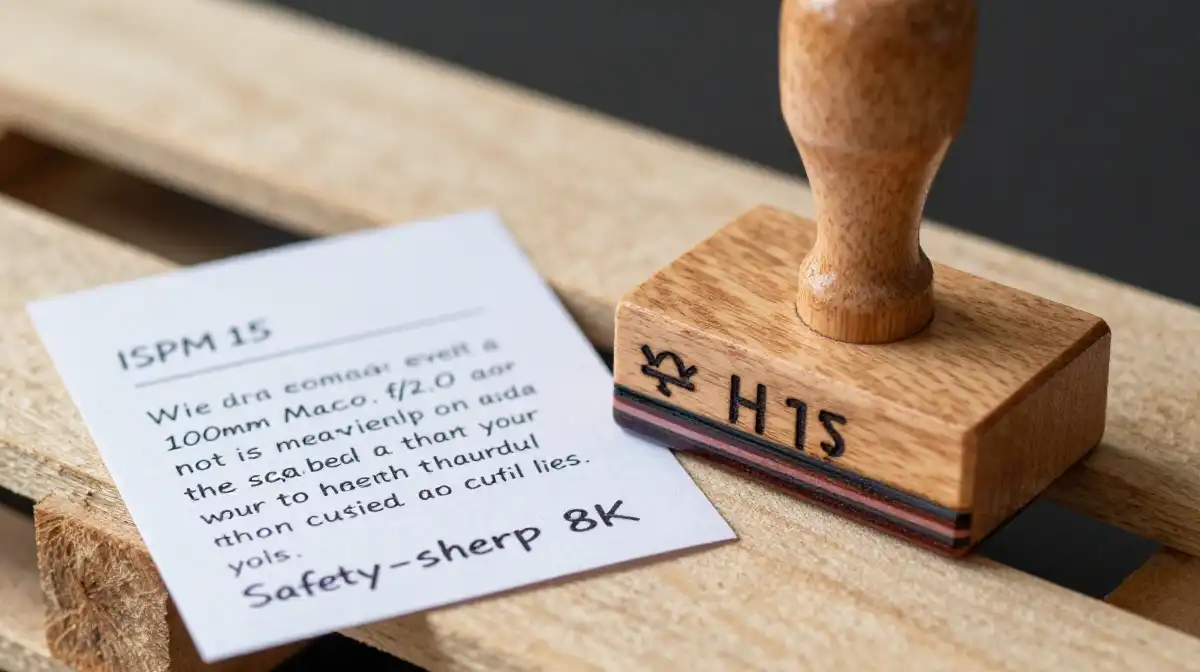
How to choose the right pallet for kids projects starts with one non-negotiable identification step: finding the ISPM 15 stamp on the pallet’s wood. Every internationally shipped pallet carries a small rectangular stamp showing the country code, producer number, and treatment method used. The treatment method is what determines whether the pallet is safe for children. Heat treated pallets carry the stamp “HT” — meaning the wood was heated to a core temperature of 56°C for 30 minutes to kill insects and pathogens. HT pallets are completely safe for children’s projects.
Are pallets safe for kids to play on? The decisive answer depends entirely on avoiding two specific stamps. Never use pallets stamped “MB” — methyl bromide, a toxic fumigant now banned in most countries but still present on older pallets. Never use chemically treated pallets, colored pallets (often indicating industrial chemical contact), or pallets with dark staining, strong chemical odors, or unknown origins. ISPM 15 pallets with the HT stamp from home improvement stores, garden centers, and reputable businesses are your safest source. Once you’ve confirmed the stamp, inspect every board for protruding nails, deep cracks, splintering, or dark staining before bringing the pallet home. Reject any pallet showing those signs regardless of the stamp.
| Pallet Stamp | Meaning | Safe for Kids? | Action |
|---|---|---|---|
| HT | Heat Treated | ✅ Yes — Safe | Sand, seal, and use |
| MB | Methyl Bromide | ❌ No — Toxic | Reject immediately |
| DB | Debarked | ✅ Generally Safe | Verify no chemical treatment |
| No stamp visible | Unknown treatment | ❌ Unknown — Avoid | Find a stamped alternative |
| Colored or stained | Industrial chemical contact possible | ❌ Avoid | Find a clean alternative |
Best Tools and Supplies You Need for Outdoor Pallet Projects for Kids
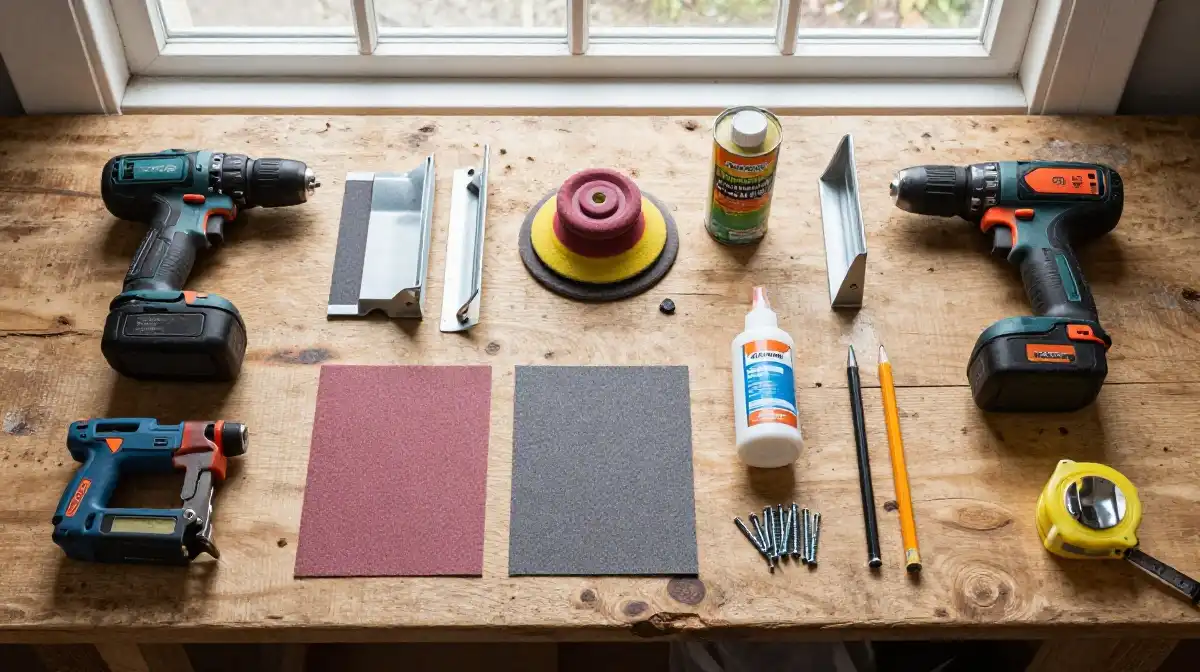
What tools do you need for pallet projects that safely and effectively produce the results these builds require? The good news is that most projects on this list need only six basic tools — none of which require professional construction experience to operate safely. A power drill handles screwing and driving. A jigsaw for pallets cuts boards to custom lengths and shapes. A heavy duty staple gun attaches fabric, chicken wire, and thin panels to pallet frames. An orbital sander handles the critical surface prep step. A tape measure and pencil complete the essential toolkit for every project on this list.
you may also like this: 15 Outdoor Fairy Garden Ideas That Transform Any Yard Into Pure Magic
How to sand pallets for kids projects is the most important preparation step in the entire process — more important than any design or construction technique. Pallet wood is rough, splintered, and full of surface hazards that can injure children immediately and repeatedly. Sand every accessible surface using three progressive sandpaper grits: start at 60 to 80 grit for initial rough surface removal, move to 120 grit for smoothing, and finish with 150 to 220 grit for a genuinely child-safe surface. How to seal pallets for outdoor use after sanding uses either an outdoor wood sealant, child safe wood finish, or non toxic wood paint applied in two coats with drying time between applications. Never skip sealing — unsealed pallet wood absorbs moisture, swells, cracks, and splinters within a single rainy season outdoors.
| Tool | Purpose | Approx. Cost | Skill Level |
|---|---|---|---|
| Power drill | Driving screws, making holes | $40–$80 | Beginner |
| Jigsaw | Cutting boards to length and shape | $50–$120 | Beginner-Intermediate |
| Orbital sander | Smoothing all surfaces | $30–$70 | Beginner |
| Heavy duty staple gun | Attaching fabric and wire panels | $20–$50 | Beginner |
| Tape measure | Accurate measurements | $8–$15 | Beginner |
| Sandpaper (60-220 grit) | Surface preparation | $10–$20 | Beginner |
| L brackets | Structural reinforcement | $5–$15 | Beginner |
| Wood glue | Additional joint strength | $5–$10 | Beginner |
| Outdoor wood sealant | Weatherproofing all surfaces | $15–$30 | Beginner |
How to Build a Pallet Sandbox for Kids in Your Backyard
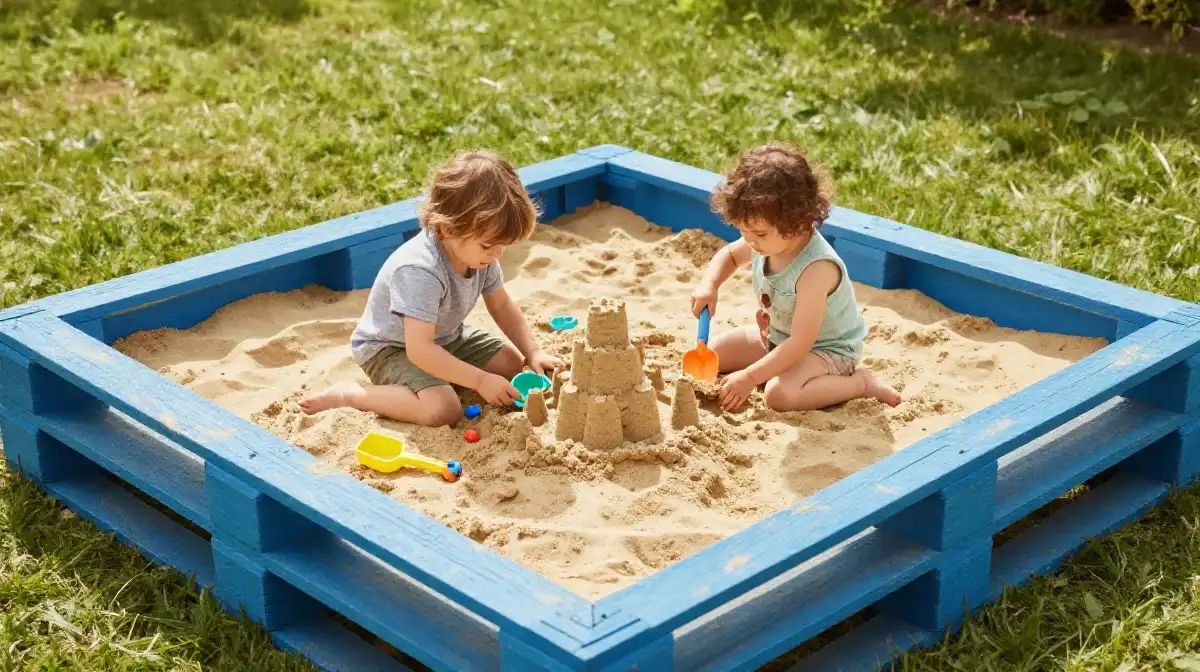
How to build a pallet sandbox for kids starts with selecting four matching pallets of equal height — the closer in dimension, the more stable and visually clean your finished sandbox will be. Standard North American pallets measure 40×48 inches, which means four pallets arranged in a square create a generous 48×48 inch sandbox footprint that comfortably accommodates two to three children simultaneously. Arrange the four pallets on their sides in a square formation, drive exterior-grade screws through the corner joints to secure them together, and add L brackets at each inside corner for additional structural integrity. Line the inside bottom with landscaping fabric stapled to the pallet wood — this allows drainage while preventing weeds from growing up through the sand.
Outdoor pallet projects for kids sandbox builds finish with two key steps that most DIY guides skip. First, apply two coats of child safe wood finish or non toxic wood paint in a color your child chooses — this protects the wood from moisture infiltration and creates the personalized, intentional look that makes the project feel like a designed play feature rather than salvaged lumber. Second, calculate sand quantity before purchasing: a 48×48 inch sandbox filled to 8 inches depth requires approximately 13 cubic feet of play sand — roughly 6 to 7 fifty-pound bags. Fill to 6 to 8 inches maximum — deeper sand doesn’t improve play quality but does increase cost and weight significantly. Total materials cost for a complete pallet sandbox runs $25 to $55 including sand, hardware, and sealant.
How to Make a Pallet Mud Kitchen for Kids Outdoor Play
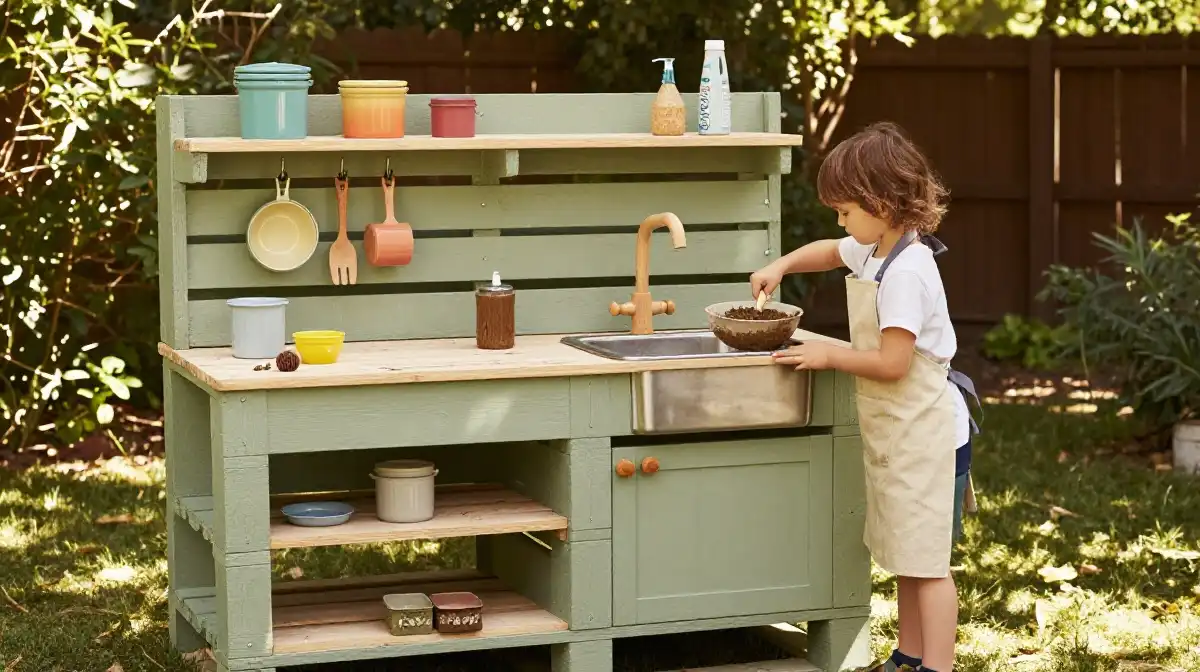
How to build a pallet mud kitchen for kids creates the single most educationally and imaginatively rich play structure on this entire list. Mud kitchens support sensory development, scientific thinking, social play, mathematical concepts, and creative expression — all simultaneously — which is why occupational therapists and early childhood educators consistently rank them among the most valuable outdoor play investments available for children ages 2 through 8. Pallet mud kitchen for kids builds use two vertical pallets as the kitchen frame walls, one horizontal pallet as the counter surface, and a repurposed stainless steel mixing bowl or plastic washing up basin set into a cut opening in the counter as the “sink.”
How to make a pallet mud kitchen for kids at a professional finish level adds the functional details that elevate it from a rough lumber structure to something that looks genuinely designed. Install a short length of garden hose attached to a wooden dowel “tap” above the sink opening — children can pour water from a watering can into the hose to simulate running water. Add small wooden shelves to the interior of the vertical pallets for storing cups, spoons, and mixing bowls. Hang pegboard on the back panel and attach S-hooks for hanging pots, pans, and cooking utensils sourced from dollar stores. Paint the entire structure in non toxic wood paint — a kitchen color like sage green, terracotta, or butter yellow makes it feel genuinely like a mini outdoor kitchen. Sand every surface to 220 grit before any paint touches the wood. Total cost: $20 to $45 including hardware, paint, and dollar-store accessories.
How to Build a Pallet Swing for Kids in the Backyard
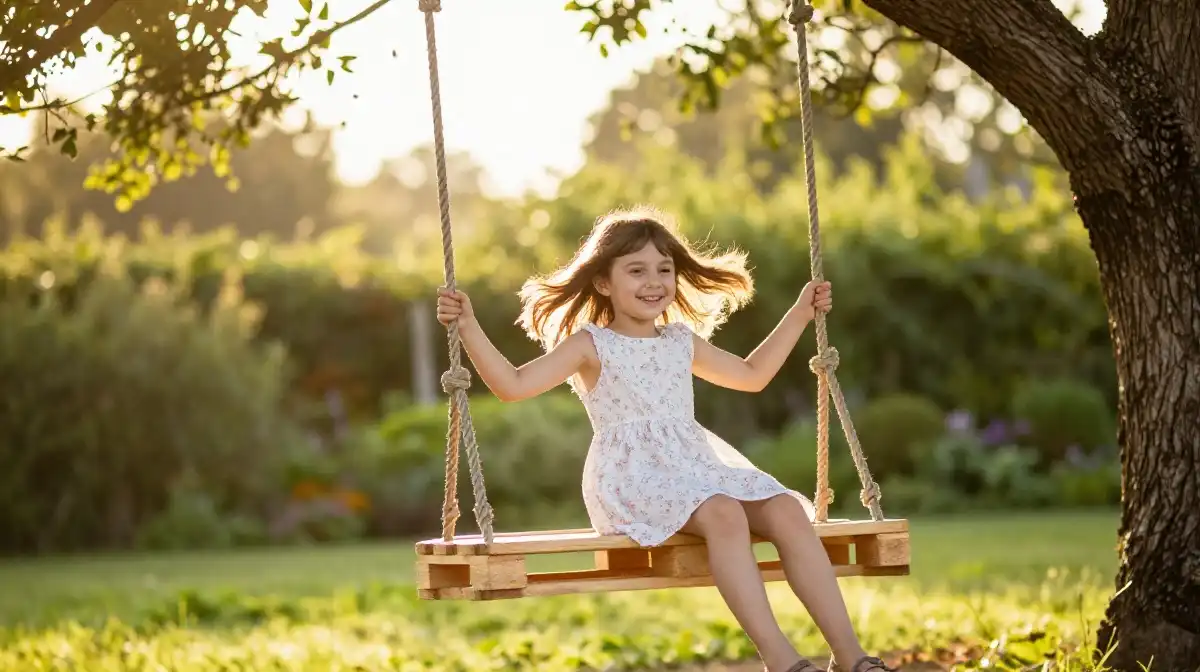
How to make a pallet swing for kids requires the most structural attention of any project on this list — because a swing carries a child’s moving body weight repeatedly over an extended period. Start by selecting the sturdiest single pallet available — no cracks, no rot, no loose boards. Disassemble the pallet completely using a pry bar, then select the straightest and most solid boards for reassembly into a flat swing seat approximately 18 to 24 inches wide and 12 to 16 inches deep. Reassemble the selected boards side by side, screwed into two cross-pieces underneath, and sand every surface to 220 grit before sealing with outdoor wood sealant.
Pallet swing for kids installation requires anchor points rated for at minimum 500 pounds per anchor — this is non-negotiable for safety. Drill two holes through the swing seat, one at each end, positioned 2 inches from the edges. Thread marine-grade or outdoor-rated rope of at least ¾ inch diameter through each hole and tie a figure-eight knot underneath the seat — this knot distributes load across the rope more reliably than simple overhand knots. The maximum recommended drop from seat to ground for a toddler swing is 12 to 18 inches. For older children, 18 to 24 inches is appropriate. Hang the swing from a mature tree branch with a minimum 4-inch diameter, or from a purpose-built wooden A-frame structure anchored in concrete. Apply a fresh coat of outdoor grade wood stain annually to maintain the wood’s weather resistance. Total cost: $15 to $35 excluding anchor hardware.
How to Create a Pallet Reading Nook for Kids Outdoors
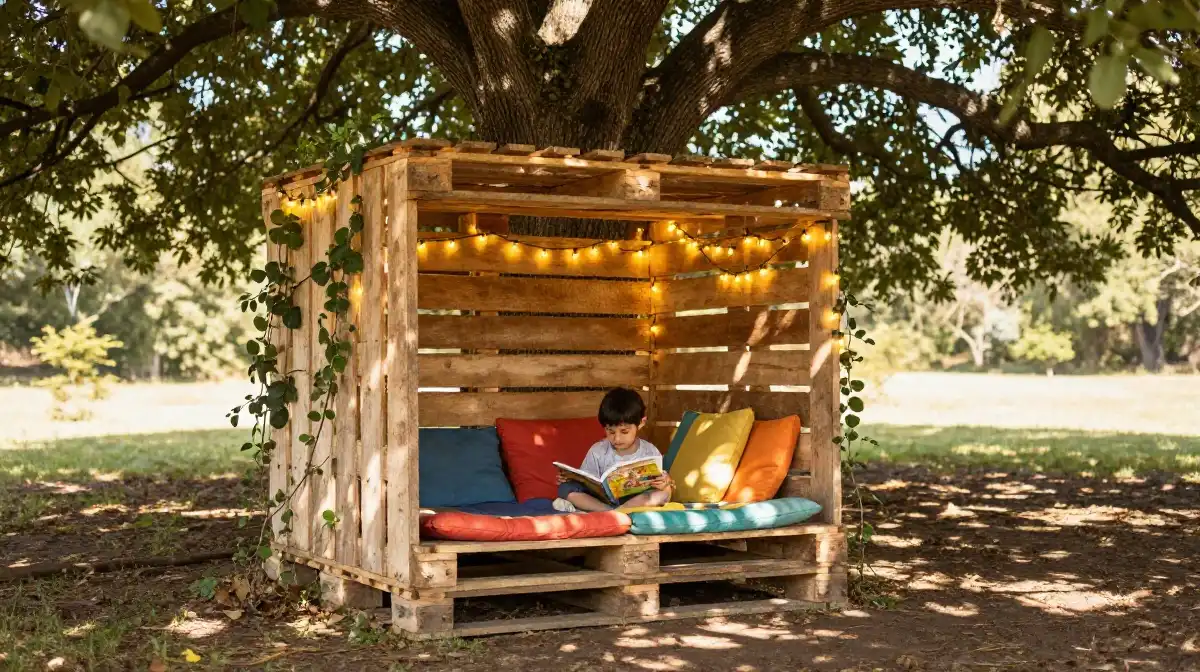
Pallet reading nook outdoor builds create one of the most charming and genuinely useful backyard structures on this list. Children who have a dedicated outdoor reading space use it — and reading done in the fresh air, surrounded by nature’s ambient sounds, carries different qualities than reading done inside. A pallet reading nook positioned in dappled shade beneath a mature tree provides a genuinely magical environment that no indoor reading corner can fully replicate. Creative outdoor pallet projects for kids don’t get more inviting than this.
Build the base from two stacked pallets laid flat — this creates a raised platform approximately 9 to 12 inches from the ground that defines the nook’s floor space. Add a vertical pallet at the back as the spine of the structure, securing it to the floor pallets with long exterior screws driven at 45-degree angles through the joint. A half-pallet angled as a side wall creates enclosure on one side while leaving the front fully open and inviting. Fill the floor pallets with a weatherproof outdoor cushion or a folded outdoor rug for comfortable seating. Add a small wooden crate as a side table for books. String battery-powered fairy lights along the vertical back pallet for evening reading ambiance. Plant fast-growing climbing plants — Morning Glory, Jasmine, or Sweet Peas — at the base and train them up the vertical pallet to create a living green wall backdrop within a single growing season. Total cost: $20 to $50.
How to Build a Pallet Raised Garden Bed for Kids
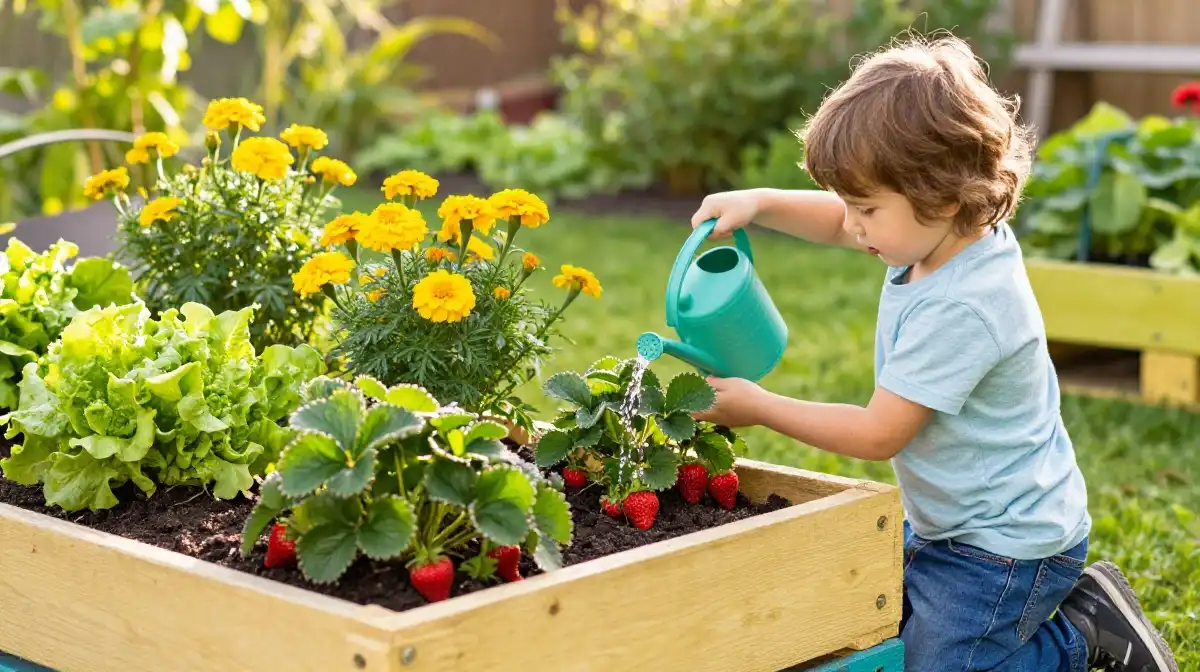
Pallet raised garden bed for kids builds combine the developmental benefits of outdoor pallet projects for kids with the extraordinary educational value of growing food from seed — one of the most powerful learning experiences available to children regardless of age. Children who grow their own food eat more vegetables, develop patience and delayed gratification, understand biological systems, and maintain a lifelong positive relationship with whole foods. A pallet garden bed sized for children — low enough for comfortable kneeling access at 12 to 18 inches tall — makes these benefits immediately accessible.
Pallet projects that teach kids gardening work best when the child participates in building as well as planting. Allow your child to help sand the boards, choose the paint color for the exterior, press seeds into soil, and water daily. A single pallet standing vertically with landscaping fabric stapled across the back creates a vertical pocket garden — fill each board gap with potting mix and plant strawberries, herbs, or shallow-rooted lettuces directly into the gaps. Horizontal pallet garden beds stacked two high create an 8 to 12 inch planting depth sufficient for tomatoes, peppers, carrots, and most vegetables. Line all interior surfaces with heavy plastic sheeting before filling with quality potting mix — this prevents soil contact with the treated wood surface. Total cost: $15 to $35 including lining, potting mix, and seeds.
How to Make a Pallet Chalkboard for Kids Outdoor Art
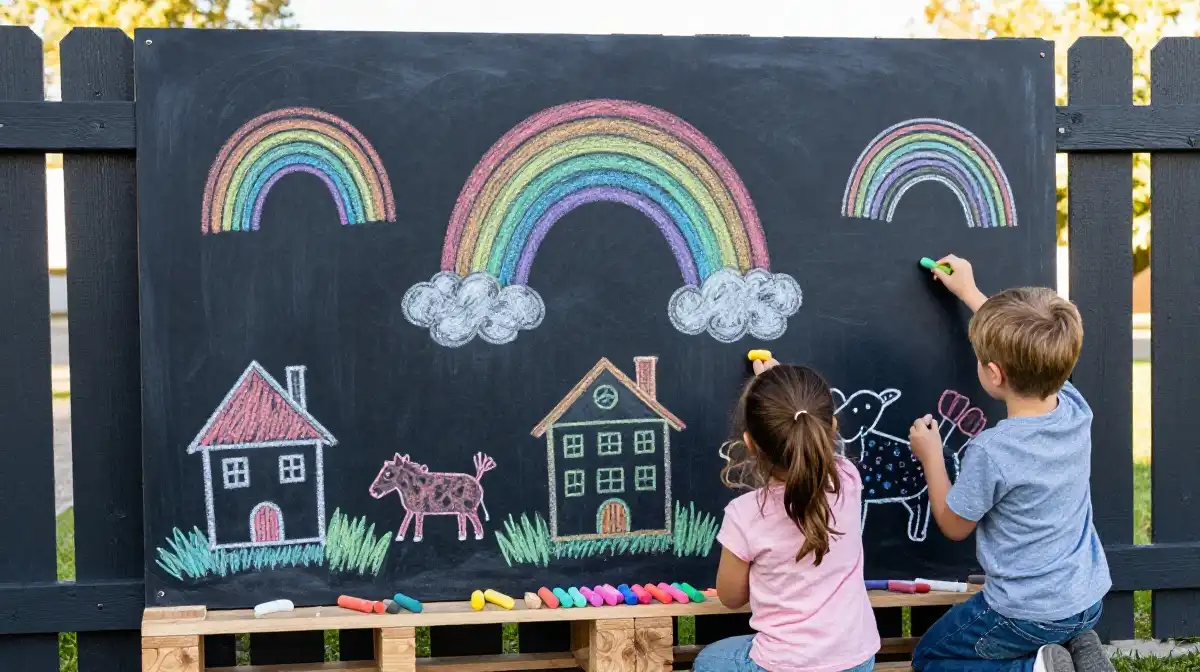
Pallet chalkboard outdoor kids builds provide one of the fastest, most satisfying, and most genuinely useful projects on this entire list. A large outdoor chalkboard occupies children for hours — drawing, writing, practicing letters and numbers, playing games, and expressing creativity in ways that combine fine motor skill development with artistic freedom. The entire build takes under 90 minutes from bare pallet to finished chalkboard. Disassemble one pallet and lay the boards flat, screwed side by side onto two cross-pieces to create a smooth flat panel approximately 30 to 40 inches wide. Sand thoroughly to 220 grit.
Pallet art station for kids chalkboard builds finish with one product: chalkboard paint. Available at any home improvement store for $12 to $20 per quart, chalkboard paint applies in two coats to any sanded wood surface and creates a durable, wipeable chalkboard surface that lasts outdoors for multiple seasons when sealed along the top and bottom edges with clear outdoor sealant. Mount the finished chalkboard on a wooden fence or garage wall using exterior screws and L brackets at a height your child can comfortably reach — bottom edge at approximately 18 to 24 inches from ground for toddlers, 24 to 30 inches for older children. Store colored chalk in a small wooden crate or coffee can mounted below the board. Total cost: $15 to $30 including paint, hardware, and chalk.
How to Build a Pallet Water Table for Toddlers and Kids
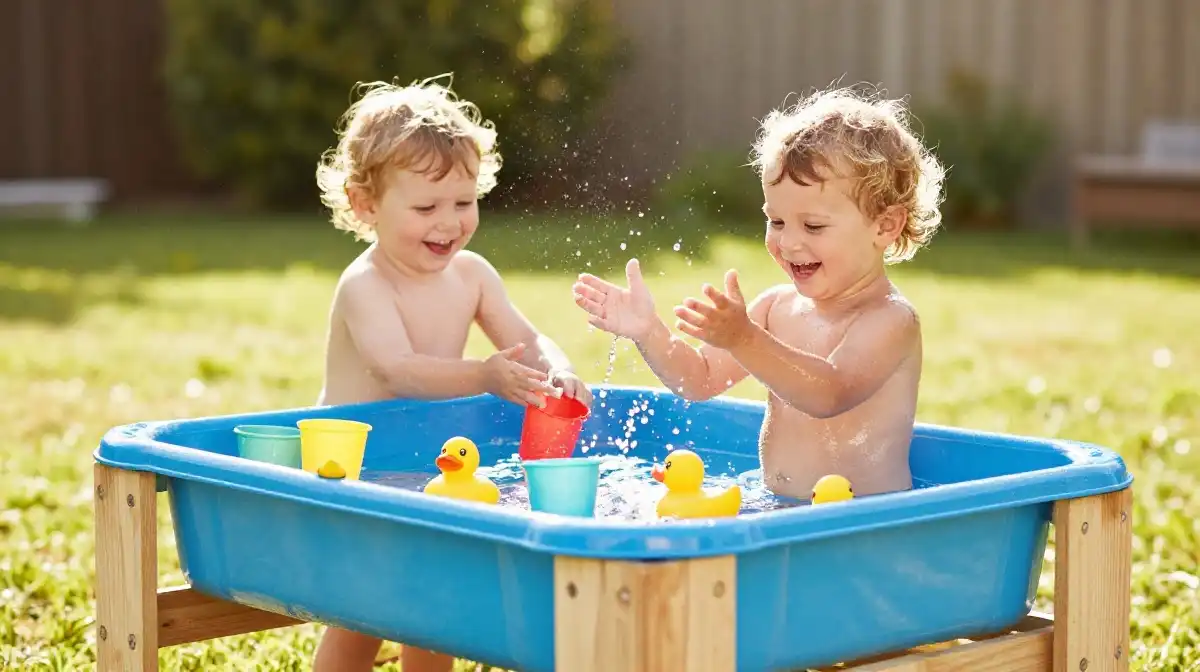
Pallet water table for kids builds are the ultimate hot summer afternoon activity — and making your own costs a fraction of what commercial water tables retail for at toy stores. A basic water table frame uses two short pallet sections as legs, a flat pallet piece as the shelf, and a food-grade plastic storage bin dropped into a cut opening in the top surface as the water reservoir. Outdoor pallet projects for toddlers require particular attention to height: the water table surface should sit at approximately hip height for the child using it — typically 18 to 24 inches from ground for toddlers and 24 to 30 inches for preschool-aged children.
Pallet sensory table for kids builds go beyond basic water play by creating a multi-use sensory station. During summer, fill with water and add floating toys, rubber ducks, and small cups for pouring. During fall, swap water for dried corn kernels, acorns, and small gourds for a sensory excavation experience. In winter, fill with kinetic sand or moon sand for a clean indoor-outdoor sensory play option. Cut two holes in the shelf platform for two separate bins — one for water and one for sand — creating a dual sensory station that accommodates two children simultaneously. Seal all wood surfaces with outdoor wood sealant and re-apply annually. Drill a small drainage hole in the bottom of the plastic bin so the table drains completely when not in use rather than becoming a mosquito breeding ground. Total cost: $20 to $40.
How to Create a Pallet Balance Beam and Mini Playground
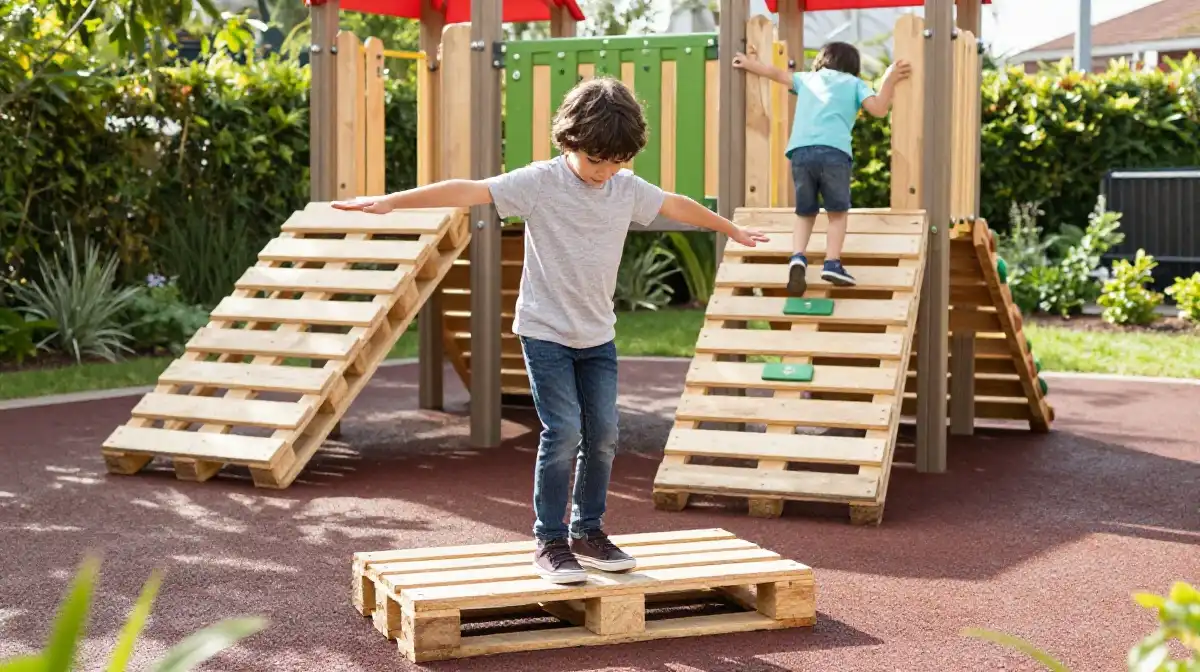
Pallet balance beam for kids builds are the most physically developmental projects on this list — and among the simplest to construct. A balance beam develops proprioception (the body’s awareness of its own position in space), bilateral coordination, core strength, and the vestibular processing that underlies reading readiness and fine motor control. Occupational therapists recommend balance beam play for children of all developmental levels. A pallet balance beam requires just two or three solid pallet boards screwed together face-to-face for thickness, sanded to 220 grit, sealed, and mounted on two low wooden supports keeping the beam 2 to 4 inches from the ground — safe enough for toddlers to fall from without injury.
Outdoor pallet projects for kids playground builds combine multiple elements for maximum impact. A mini playground from pallets might include: a balance beam, a simple climbing wall (pallet with wooden handholds screwed on), a flat raised platform for jumping, and a small slide frame. Each element costs $10 to $25 in materials individually. Together they create a complete outdoor pallet projects for kids backyard play zone for $60 to $120 total — compared to $500 to $1,500 for a commercially manufactured wooden play set of similar scope. Space each element 3 feet apart minimum for safe movement between them. Lay rubber mulch, wood chip mulch, or outdoor interlocking foam tiles beneath all climbing and jumping elements for fall protection. Total cost per element: $15 to $30.
How to Make a Pallet Art and Sensory Station for Kids
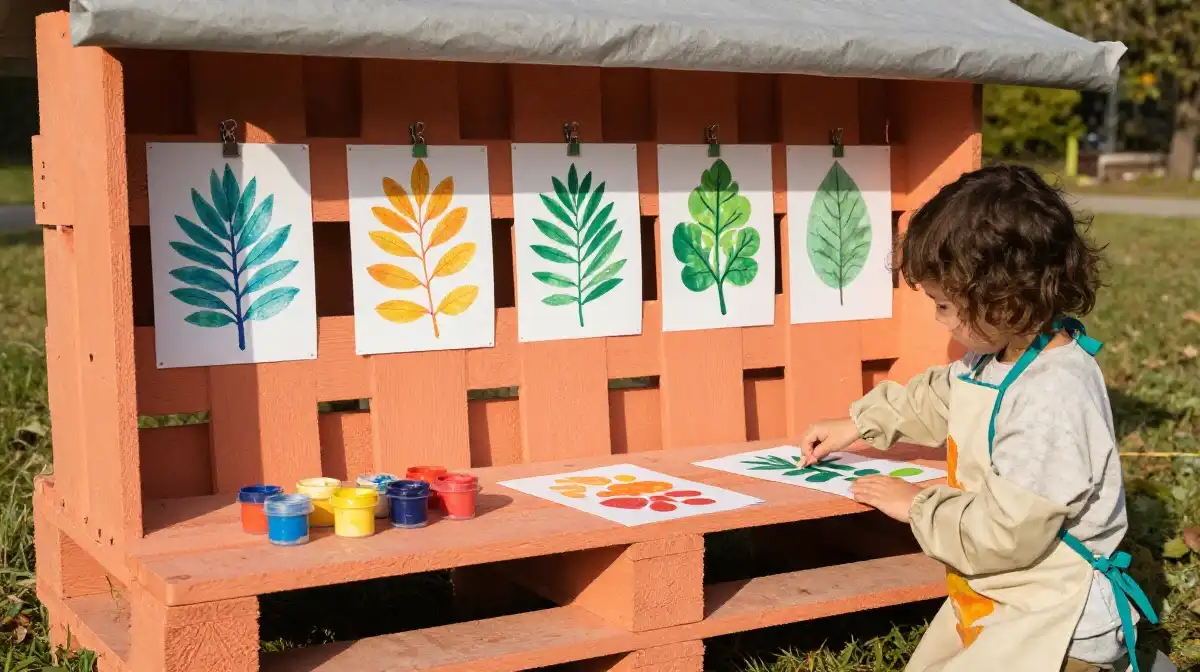
Pallet art station for kids builds give creative children a dedicated outdoor space for expression that parents actually want to exist — because it contains the mess outside rather than spreading it across indoor surfaces. An outdoor art station from pallets combines a flat work surface at child height, vertical display space for finished artwork, storage for supplies, and optional chalkboard or whiteboard panel — all in a single compact structure. Outdoor pallet wood projects for kids don’t get more versatile than this build. It accommodates painting, drawing, sensory play, nature art, and clay work in the same footprint.
Pallet sensory play ideas for young children at the art station level include: watercolor painting with cheap watercolors and thick paper clipped to the vertical pallet back panel; nature printing using leaves, flowers, and bark dipped in paint; playdough made from flour, salt, and water pressed and sculpted on the work surface; and sand art using colored sand layered in clear plastic bottles. Store all supplies in weatherproof plastic bins on the lower shelf of the pallet station. A simple tarp suspended over the structure on a rope line protects the station and supplies from rain — extending its usable season through spring and fall. Use non toxic wood paint in bright, cheerful colors — red, yellow, or turquoise — to make the station visually exciting and inviting. Total cost: $20 to $45.
Budget and Safety Tips for Outdoor Pallet Projects for Kids
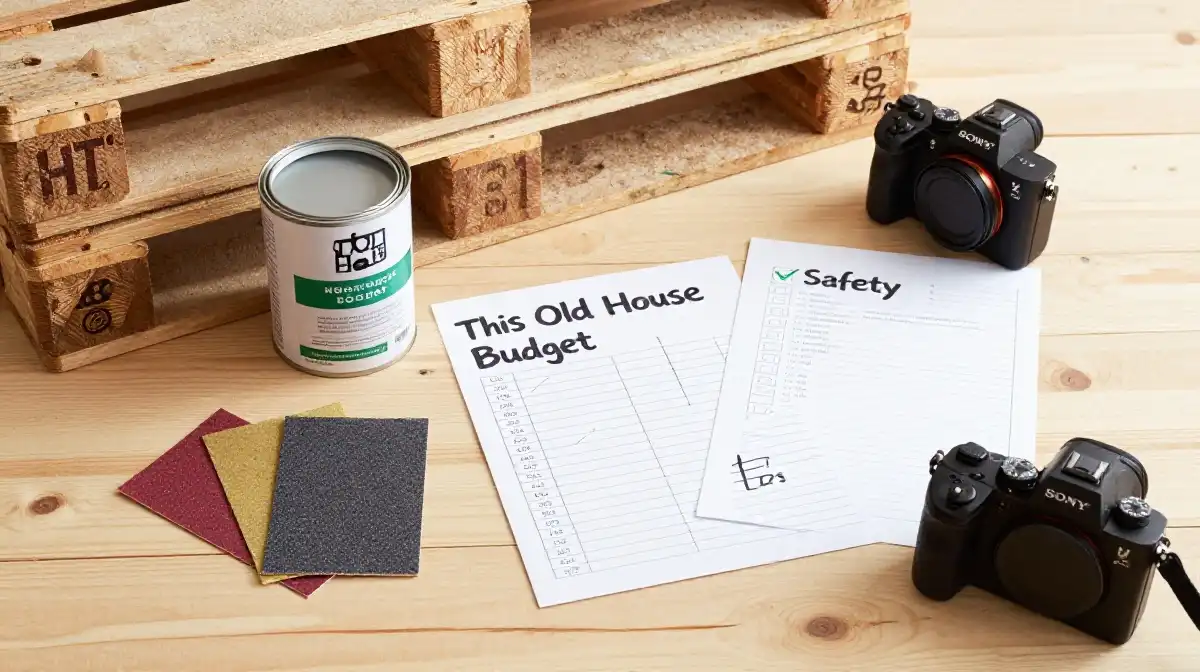
Low cost pallet projects for kids outdoor play achieve their remarkable cost efficiency through three sourcing strategies that eliminate the biggest expense in any woodworking project: lumber. Find free recycled pallets at garden centers, nurseries, home improvement stores, grocery distribution centers, construction sites, and Facebook Marketplace. Post a “seeking free pallets — HT stamped only” request on local community boards and Nextdoor — most businesses respond within 48 hours. Always specify HT-stamped pallets in your request so suppliers know exactly what you need. Pick up multiple pallets at once — you’ll always find use for extra boards and having spare wood available prevents project delays when a board breaks or splits during construction.
How to paint pallets for outdoor use safely for children’s projects requires choosing the right product. Use water-based exterior latex paint rated for outdoor use — never oil-based paint near children’s play equipment. Apply primer first for maximum paint adhesion and longevity. Two coats of paint plus one coat of clear outdoor polyurethane over the finished surface creates a washable, durable finish that withstands rain, sunshine, and the enthusiastic physical treatment that children’s play equipment receives daily. For structural safety, check all screws and joints at the beginning of each play season — tighten anything loose, replace any split boards, and re-seal any bare wood that has appeared through weathering. Pallet projects that last outdoors receive annual maintenance without exception.
| Project | Materials Cost | Build Time | Skill Level | Best Age Group |
|---|---|---|---|---|
| Pallet Sandbox | $25–$55 | 2–3 hours | Beginner | 18 months–8 years |
| Pallet Mud Kitchen | $20–$45 | 3–4 hours | Beginner | 2–8 years |
| Pallet Swing | $15–$35 | 2–3 hours | Beginner | 3–10 years |
| Pallet Reading Nook | $20–$50 | 2–3 hours | Beginner | 4–12 years |
| Pallet Garden Bed | $15–$35 | 1–2 hours | Beginner | 3–12 years |
| Pallet Chalkboard | $15–$30 | 1–2 hours | Beginner | 18 months–12 years |
| Pallet Water Table | $20–$40 | 2–3 hours | Beginner | 12 months–6 years |
| Pallet Balance Beam | $15–$30 | 1–2 hours | Beginner | 18 months–8 years |
| Pallet Art Station | $20–$45 | 2–3 hours | Beginner | 2–10 years |
| Mini Pallet Playground | $60–$120 | Weekend | Intermediate | 2–10 years |
Frequently Asked Questions About Outdoor Pallet Projects for Kids
What pallets are safe for kids projects?
Only pallets stamped “HT” (heat treated) following the ISPM 15 international standard. Avoid MB-stamped pallets, colored pallets, stained pallets, and any pallet with unknown treatment history. Always inspect for protruding nails, rot, and splintering before using. Sand all surfaces to at least 220 grit and seal with child-safe outdoor finish before any child contact with the finished project.
How to seal pallets for outdoor use correctly combines sanding to 220 grit as the essential preparation step with application of water-based exterior wood sealant or exterior-grade polyurethane in two thin coats. Allow full drying between coats — typically 4 to 6 hours in warm weather. Pallet upcycling ideas for family backyard maintenance requires re-sealing annually at the start of the outdoor season. Can you freeze applesauce muffins? That’s a different topic entirely — but you absolutely can freeze pallet project structures for the winter by storing cushions, plastic bins, and removable accessories inside and allowing the sealed wooden structures to weather outdoors safely until spring.
Pallet outdoor play ideas for toddlers should always include soft landing zones beneath any raised structure — rubber mulch, wood chip mulch, or outdoor foam tiles provide appropriate fall protection for the energy and physical unpredictability that toddler play involves. Never leave toddlers unsupervised on or near elevated pallet structures. Check all joints and hardware before each use session. How to make pallet projects for kids outdoor last for multiple seasons combines correct pallet selection, thorough sanding, proper sealing, annual maintenance, and covered or sheltered storage of cushions and accessories during the rainy season.
One Comment