
5 Easy Slow Living Habits You Can Start in 10 Minutes
Your life feels rushed. Everything moves fast. Work demands attention. Phone notifications never stop. Family needs you constantly. Yet somewhere inside, you crave something different. You want peace. You want intention. You want to live slowly without abandoning your responsibilities. The truth? You don’t need hours. You don’t need perfect conditions. You just need ten minutes. That’s it. This article reveals five easy slow living habits you can begin today. These aren’t complicated rituals requiring special knowledge. These aren’t expensive lifestyle changes. These are practical slow living habits that fit directly into your existing schedule. Each habit takes five minutes or less. Together, they create profound transformation. Your mornings will feel calmer. Your days will feel more intentional. Your stress will decrease noticeably. By the end of this guide, you’ll have a complete slow living routine ready to implement immediately.
Understanding Easy Slow Living Habits and Why 10 Minutes Matter

Easy slow living habits represent a revolution in how busy Americans approach wellness. Traditional slow living advice feels impossible for working professionals. “Wake at 5 AM and meditate for an hour.” “Spend weekends in nature.” “Eliminate all technology.” These suggestions overwhelm rather than inspire. Most people abandon them within days. However, how to start slow living habits doesn’t require dramatic transformation. It requires understanding how brief, consistent practices create exponential change. Neuroscience shows that your nervous system responds to even three minutes of focused breathing. Your brain releases calming chemicals within seconds of conscious practice. These micro-interventions accumulate throughout your day. One five-minute breathing session at 6 AM influences your entire morning’s emotional tone. This cascades into afternoon calmness. By evening, you’ve maintained equilibrium despite typical stressors. This is the power of simple slow living habits to start today.
| Timeframe | What Happens | Brain Changes | Difficulty Level |
|---|---|---|---|
| Days 1-3 | Initial excitement | Novelty stimulation | Moderate |
| Days 4-7 | Enthusiasm wanes | Pattern recognition begins | Harder |
| Days 8-14 | Consistency required | Neural pathways strengthen | Challenging |
| Days 15-21 | Habit feels easier | Automatic response develops | Easier |
| Days 22+ | Habit feels natural | Neurological integration | Automatic |
Mindful Morning Breathing: Your First Easy Slow Living Habit (5 Minutes)
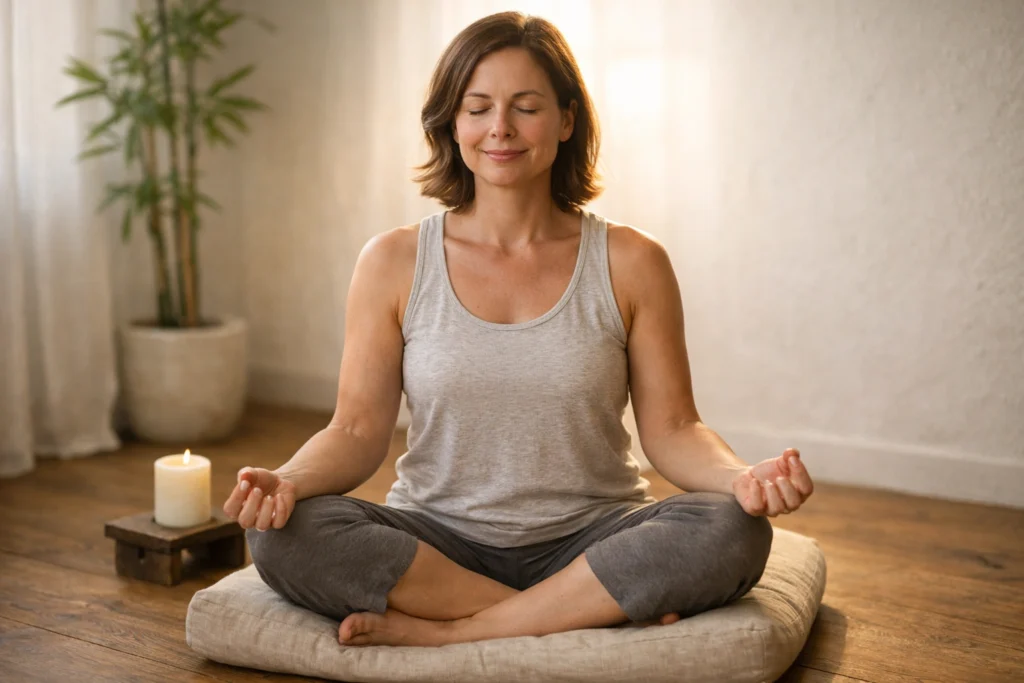
Mindful breathing is the foundation of all easy slow living habits. Breathing happens automatically. You don’t think about it. Yet conscious breathing changes everything. When you breathe deliberately, you activate your parasympathetic nervous system. This is your body’s calming system. It tells your body you’re safe. It lowers cortisol (your stress hormone). It slows your heart rate. It prepares you for a peaceful day. Most people wake up already stressed. Their first thought triggers anxiety. Their second thought involves their to-do list. By the time they’re fully awake, stress has hijacked their nervous system. How to build slow living habits begins with interrupting this pattern before it starts.
you may also like this:How to Create a Cozy Sunday Night Routine in Your Living Room
Here’s exactly how to practice easy mindful living habits. Sit comfortably when you first wake up. Your bed is fine. A chair works. Even standing by a window is acceptable. Close your eyes. Take a slow breath in through your nose for a count of four. Hold it for a count of seven. Exhale slowly through your mouth for a count of eight. This is called 4-7-8 breathing. It’s scientifically proven to activate relaxation. Do this cycle five times. That’s less than three minutes. You’ve just created a biological shift toward calm. Your amygdala (your brain’s fear center) has begun to settle. Your prefrontal cortex (your decision-making center) has activated. You’re literally more capable of handling your day. For people practicing beginner-friendly slow living habits, this single technique changes mornings immediately. You notice your shoulders aren’t tense. You don’t feel rushed. You approach your first task with clarity rather than reactivity.
Digital Detox Break: Simple Slow Living Habit for Mental Clarity (5 Minutes)

Your phone contains approximately 150 notifications waiting. Email. Text messages. Social media. News. Work messages. All of them demand attention. All of them stimulate your dopamine system. When you check your phone first thing, you’ve handed your morning agenda to dozens of people. You’re no longer directing your day. You’re reacting to others’ priorities. This is the opposite of how to develop intentional living habits. Simple slow living habits begin with reclaiming your morning attention. A digital detox doesn’t mean never using technology. It means controlling when technology uses you.
| Phone Detox Period | Benefits | Implementation Difficulty | Success Rate |
|---|---|---|---|
| 15 minutes | Modest mental clarity | Very Easy | 95% |
| 30 minutes | Clear mental shift | Easy | 85% |
| 1 hour | Significant calm | Moderate | 70% |
| 2 hours | Profound transformation | Challenging | 45% |
Intentional Tea Break: Building Sustainable Slow Living Habits Daily (3-5 Minutes)

Tea rituals represent underestimated power for building sustainable living habits. Most people drink tea while multitasking. They sip while checking email. They drink while working. The beverage becomes invisible. The moment disappears. How to incorporate slow living into daily life requires reclaiming ordinary moments through intentional attention. A tea break becomes an anchor for your entire day’s calm. When you practice this practical slow living habit, you transform a five-minute necessity into a sacred pause.
Here’s the implementation: choose your tea deliberately. Not because you grabbed whatever’s convenient. Actually choose. Maybe it’s chamomile for relaxation. Maybe it’s peppermint for clarity. Maybe it’s green tea for gentle energy. Prepare it slowly. Notice the hot water color changing as it brews. Smell the aroma. Pour it into a cup you love—not the chipped mug in the back. Sit somewhere quiet. No phone. No work. No distractions. Sip slowly. Taste the temperature. Notice the flavor evolving as it cools. Feel the warmth in your hands. This simple practice activates all five senses. Your mind can’t worry while fully engaged in sensory experience. You’ve created a genuine pause in your day. Easy ways to practice mindful living through this method prove remarkably effective. Over weeks, your nervous system learns to anticipate this calm moment. When you reach for your tea, your body begins relaxing before you even sit. This is neurological conditioning toward peace. You’re literally training your brain to recognize safety. Building sustainable lifestyle habits through small rituals like this creates lasting transformation without overwhelming effort.
Nature Connection Moment: Easy Slow Living Habit for Stress Relief (5 Minutes)

Humans evolved outdoors. Our nervous systems recognize natural environments as safe. When you step outside, something biological shifts. Your breathing deepens. Your shoulders relax. Your mind quiets. Yet modern life keeps us indoors. Artificial lighting. Conditioned air. Screens everywhere. Your nervous system never receives the signal of safety. Chronic stress results. Simple ways to slow down your life includes reconnecting with nature—even briefly. You don’t need a forest hike. Five minutes of genuine nature contact creates measurable calm.
Here’s the practice: go outside. If you live in an apartment, a window works. If possible, actually step into nature. Notice the sky. Feel the temperature on your skin. Listen to sounds. Birds. Wind. Traffic. Just notice without judgment. Touch something natural if possible. Tree bark. Grass. Soil. Feel the texture. Breathe the air. Observe something living—a plant, an insect, a bird. Studies show that even brief nature exposure reduces cortisol by 21 percent within five minutes. Your blood pressure decreases. Your immune function improves. You’ve activated what researchers call “biophilic response”—your innate connection to living things. Best easy slow living habits for beginners often start here because nature contact requires no equipment. No special knowledge. No expense. Just stepping outside intentionally. This low-effort slow living approach creates immediate benefits. You’ll notice your shoulders dropped. Your breathing deepened. Your mind quieted. In winter when outdoor access is limited, even looking at indoor plants or through a window toward nature creates measurable benefit. This demonstrates the power of easy eco-friendly living habits that align with human biology rather than fighting it.
Gratitude Journaling: Simple Slow Living Habit for Peace of Mind (5 Minutes)

Gratitude might seem simple. Perhaps even trite. Yet neuroscience proves that deliberate gratitude practice rewires your brain. Regular gratitude journaling increases happiness more effectively than most other interventions. It costs nothing. It requires five minutes. Yet its effects compound enormously. How to make slow living a habit ultimately involves directing your attention toward what genuinely matters. Gratitude journaling does exactly this. Instead of your brain defaulting to worry, it trains your mind toward appreciation. Over time, this becomes your baseline. You notice goodness more easily. You feel less anxious. You experience more contentment. This is effortless lifestyle changes in action—small practices creating profound transformation without forcing or struggling.
Here’s the practice: keep a journal by your bed. Write three specific things you’re grateful for. Not generic gratitude. Specific details. Instead of “I’m grateful for my family,” write “I’m grateful my daughter laughed at breakfast and said something funny that made me smile.” Specificity activates genuine gratitude rather than intellectual acknowledgment. Write why you’re grateful for each thing. This deepens the neural pathway. The entire practice takes five minutes. Do this every morning or evening. Research from UC Davis shows that gratitude journaling increases happiness baseline by 25 percent within three weeks. Your brain literally rewires toward positive recognition. You stop taking goodness for granted. You notice beauty you’ve overlooked. You appreciate people you love more consciously. Easy ways to live slowly through this method prove remarkably sustainable. Unlike meditation, which some find difficult, journaling feels natural to most people. You’re just writing. Yet the effects rival meditation in transforming your psychological baseline. By practicing small slow living changes that work, you create cumulative transformation. After one month, you’ll notice you’re less irritable. After two months, you handle stress better. After three months, people comment that you seem calmer. This is how to incorporate slow living into daily life most effectively—through practices so accessible that consistency becomes natural.
Why Easy Slow Living Habits Work for Busy People

Busy people assume slow living requires free time. This is backwards thinking. Slow living habits that save money while also saving time work precisely because they interrupt the busy cycle rather than requiring time removed from it. When you practice how to start slow living habits through these brief practices, you’re not adding tasks. You’re redirecting attention. You’re replacing automatic stress responses with conscious calm responses. This actually saves time because you make better decisions. You’re less scattered. You accomplish more with less effort. This is the paradox of slowing down—it increases productivity.
Consider a typical busy morning. You wake stressed. You check your phone immediately. Email creates anxiety. Social media triggers comparison. Work messages demand attention. You’ve been awake for five minutes and already feel behind. Cortisol floods your system. Your nervous system believes danger is imminent. You make reactive decisions. You snap at people. You feel overwhelmed. This stress persists all day. You accomplish less despite working harder. You come home exhausted. You have no patience for relationships. Now consider the same morning with practical slow living habits. You wake. You do four minutes of breathing. You feel calm. You skip your phone for one hour. Your mind is clear. You choose your first task intentionally. You drink tea mindfully. Your nervous system is regulated. You accomplish more because your brain functions better. You have patience for people. You end your day less depleted. Which person achieved more? The stressed person working frantically or the calm person working deliberately? Research consistently shows that sustainable habits for everyday living create better outcomes across every domain. Students with mindfulness practices earn better grades. Workers with digital detox practices are more productive. Parents with stress-relief practices have better relationships. This is why easy ways to practice mindful living work for busy people. They don’t require time. They save time by creating better outcomes.
| Busy Person Without Habits | Busy Person With Habits |
|---|---|
| Stress response: reactive | Stress response: thoughtful |
| Decision quality: scattered | Decision quality: clear |
| Productivity: lower despite more hours | Productivity: higher with same hours |
| Energy level: depleted | Energy level: sustained |
| Relationship quality: strained | Relationship quality: warm |
| Illness frequency: higher | Illness frequency: lower |
| Life satisfaction: low | Life satisfaction: high |
10-Minute Daily Routine: Combining All 5 Easy Slow Living Habits Together
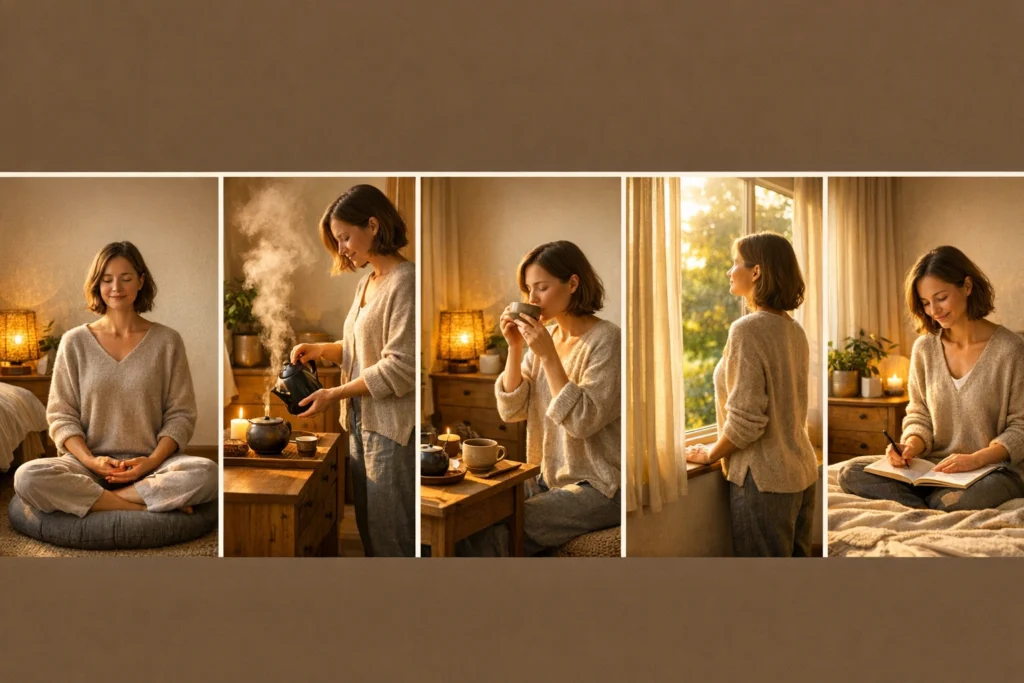
You’ve learned each habit individually. Now combine them. Here’s exactly how to create your complete 10-minute slow living routine. This is how to build slow living habits into comprehensive daily practice. The sequence matters. You’re building from foundation to sophistication.
Minutes 0-4: Mindful Morning Breathing Before anything else, practice your 4-7-8 breathing. Five cycles. Three minutes. Your nervous system activates calm mode. Your body recognizes safety. This is your foundation.
Minutes 4-5: Digital Detox Commitment Acknowledge you’re not checking your phone right now. You’re protecting this sacred time. This conscious choice matters psychologically. You’re asserting control over technology rather than technology controlling you.
Minutes 5-8: Tea Ritual Prepare and sip your intentional tea. Taste the temperature. Notice the flavor. Feel the warmth. You’re engaging all senses, anchoring yourself in the present moment.
Minutes 8-9: Nature Connection Look outside. Feel the air. Notice sky or plants or weather. If weather permits, step outside briefly. Touch something natural. Activate your biophilic response.
Minutes 9-10: Gratitude Journaling Write three specific things you’re grateful for. Write why. Complete this ancient practice with modern specificity. Your brain has now experienced calm, focus, sensory engagement, and appreciation.
This routine becomes your daily reset button. Each element takes minimal time. Together, they create profound impact. After one week, you’ll notice you’re calmer. After three weeks, simple sustainable living practices feel automatic. After two months, you won’t recognize your former rushed self. People ask what changed. You seem different. Happier. More present. This is how to develop intentional living habits that actually integrate into real life rather than remaining theoretical.
Benefits of Practicing Easy Slow Living Habits Daily
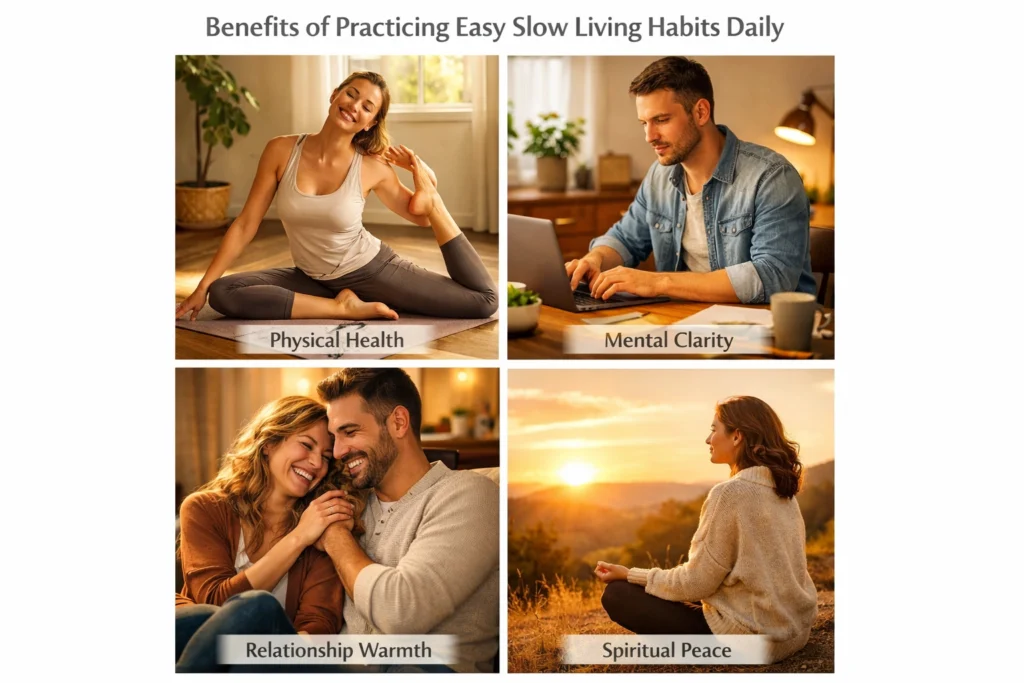
What actually happens when you practice easy daily habits for slow living consistently? The benefits extend across every life domain. Physically, you’ll notice better sleep. Your nervous system, regularly regulated through these practices, sleeps more deeply. Your immune function improves. Chronic inflammation decreases. You get sick less frequently. Your digestion improves because stress no longer dominates your gut. Mentally, you experience less anxiety. Your racing thoughts quiet. You can focus for longer periods. Memory actually improves because stress no longer clouds your cognition. You make better decisions. Emotionally, you feel more stable. Daily frustrations that once triggered anger now create minor irritation you handle calmly. You have patience for people you love. Relationships improve dramatically. Your partner notices you’re kinder. Your children see you’re more present. Your friends observe you seem happier. This is sustainable habits for everyday living impacting your entire relational world.
| Timeline | Physical Changes | Mental Changes | Emotional Changes |
|---|---|---|---|
| Week 1 | Slight sleep improvement | Modest focus increase | Curiosity about practice |
| Week 2-3 | Better sleep quality | Decreased racing thoughts | Initial emotion regulation |
| Week 4-6 | Noticeable health improvement | Clearer thinking | Significant anxiety reduction |
| Month 2-3 | Immune strengthening | Enhanced memory | Relationship improvements |
| Month 4-6 | Chronic issue improvement | Deep focus capability | Genuine happiness increase |
H2: FAQ: Questions About Easy Slow Living Habits and 10-Minute Practices
Q: How long before slow living habits become truly automatic?
After approximately 21 days of consistent practice, your habits begin feeling automatic. After 66 days, they’re deeply integrated. Individual variation exists. Some people integrate faster. Others need more time. Consistency matters more than speed. Once integrated, these practices require no willpower. Your brain executes them automatically.
Q: What if I don’t have 10 consecutive minutes?
You don’t need 10 consecutive minutes. You can split them. Practice breathing at 6 AM. Tea ritual at lunch. Gratitude journaling at 9 PM. The practices compound regardless of timing. Even scattered practice creates benefit. Something is always better than nothing.
Q: Can I practice slow living on a tight budget?
Absolutely. These practices cost almost nothing. Breathing is free. Digital detox is free. Tea can cost $5 per month. Nature is free. Journaling requires paper you likely already have. Slow living habits without spending money are entirely possible. You’re investing time, not money.
Q: What if meditation or journaling doesn’t resonate with me?
Skip those practices. Choose others that appeal to you. How to build slow living habits requires choosing practices you actually enjoy. Forced practices aren’t sustainable. Pick what genuinely calls to you.
Q: How do I maintain consistency when life gets chaotic?
Reduce your practice temporarily rather than abandoning it. If your normal 10 minutes becomes impossible, do 5 minutes. Or just breathing. Short practice maintains momentum. Perfect practice abandoned is worthless. Imperfect practice maintained is invaluable.
H2: Final Thoughts: Making Easy Slow Living Habits Part of Your Life
You came here believing you didn’t have time for slow living. You’ve just learned that how to start slow living habits requires only ten minutes daily. Ten minutes transforms everything. Your nervous system shifts toward regulation. Your mind shifts toward clarity. Your relationships shift toward warmth. Your life shifts toward meaning. This isn’t dramatic transformation requiring dramatic change. It’s gentle transformation through consistent practice. How to make slow living a habit simply means showing up repeatedly and letting small actions compound into major change.
The practices you’ve learned work because they align with human biology rather than fighting it. Breathing activates your nervous system’s calming capacity. Digital detox honors your brain’s need for focus. Tea ritual engages your senses. Nature contact recognizes your biological need for natural environments. Gratitude rewires your brain toward happiness. These aren’t trendy self-help practices. They’re ancient practices supporting human wellbeing across cultures and centuries. You’re not trying something new. You’re remembering what humans have always known about creating peaceful, intentional lives. Making easy slow living habits part of your life means giving yourself permission to slow down for ten minutes daily. Permission to prioritize your own peace. Permission to live intentionally. Permission to notice goodness. This is your true work. Not everything external. This internal shift toward presence and calm. That’s everything.
Start today. Not tomorrow. Today. Choose one habit. Practice it for three weeks. Then expand. Watch your life transform. Watch yourself become calmer, kinder, more present. Watch your relationships improve. Watch your work improve. Watch your health improve. Watch yourself recognize that you don’t need to abandon your busy life. You just need to shift how you move through it. Easy slow living habits make this possible. They’re accessible. They’re sustainable. They’re transformative. Your journey toward peaceful, intentional living starts now. Just ten minutes daily. That’s all you need. That’s everything you need.





One Comment