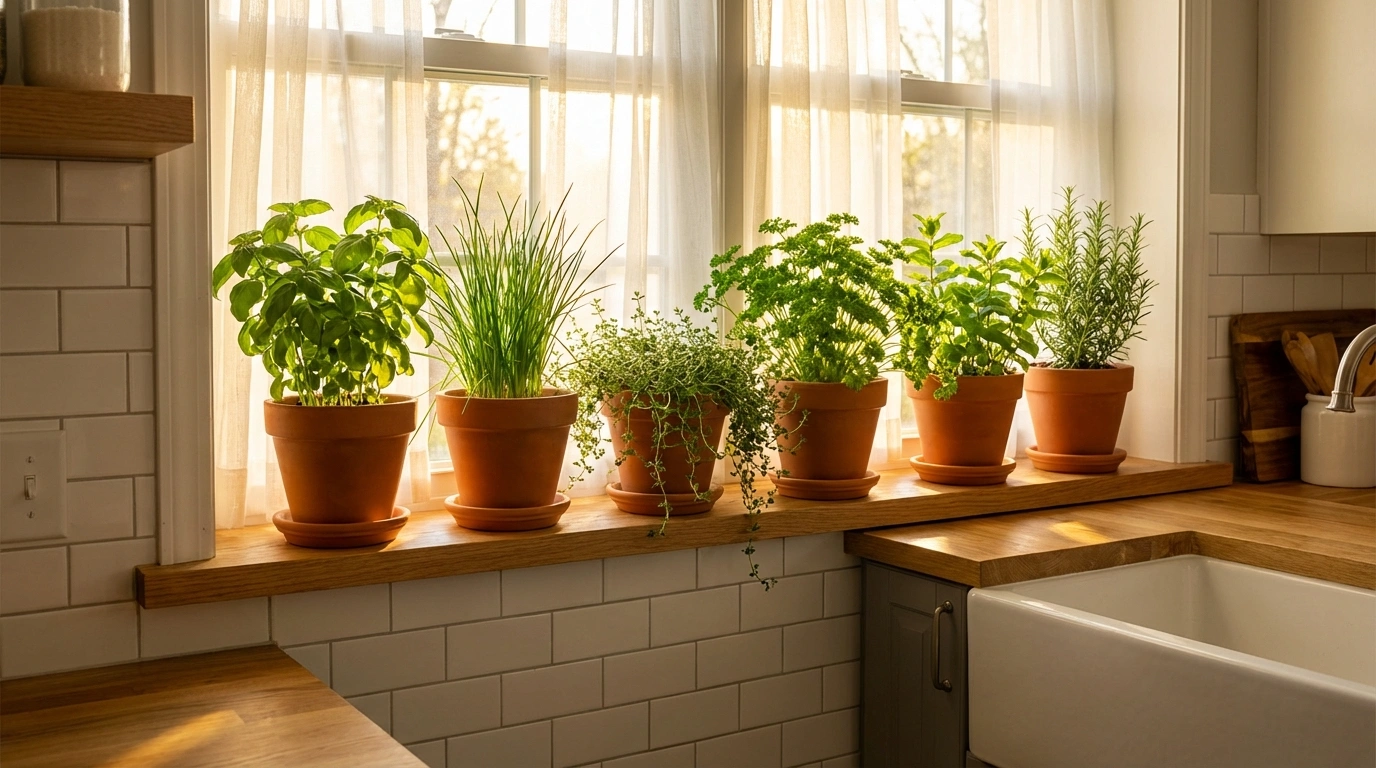
How to Grow Herbs Indoors Successfully Even If They Keep Dying
Every herb gardener has a graveyard story. The optimistic basil purchase that turned yellow within two weeks. The mint that somehow managed to die despite mint’s legendary indestructibility. The rosemary that slowly, silently gave up over three months of increasingly desperate intervention. If your indoor herbs keep dying you’re not cursed and you’re not a bad plant parent — you’re simply missing a few critical pieces of knowledge that nobody bothered to tell you when you bought that cheerful little pot of parsley at the farmers market. Learning how to grow herbs indoors successfully is genuinely achievable for anyone and this guide covers every mistake, every fix, and every strategy you need to finally get it right.
Why Most People Fail at Growing Herbs Indoors and How to Fix It
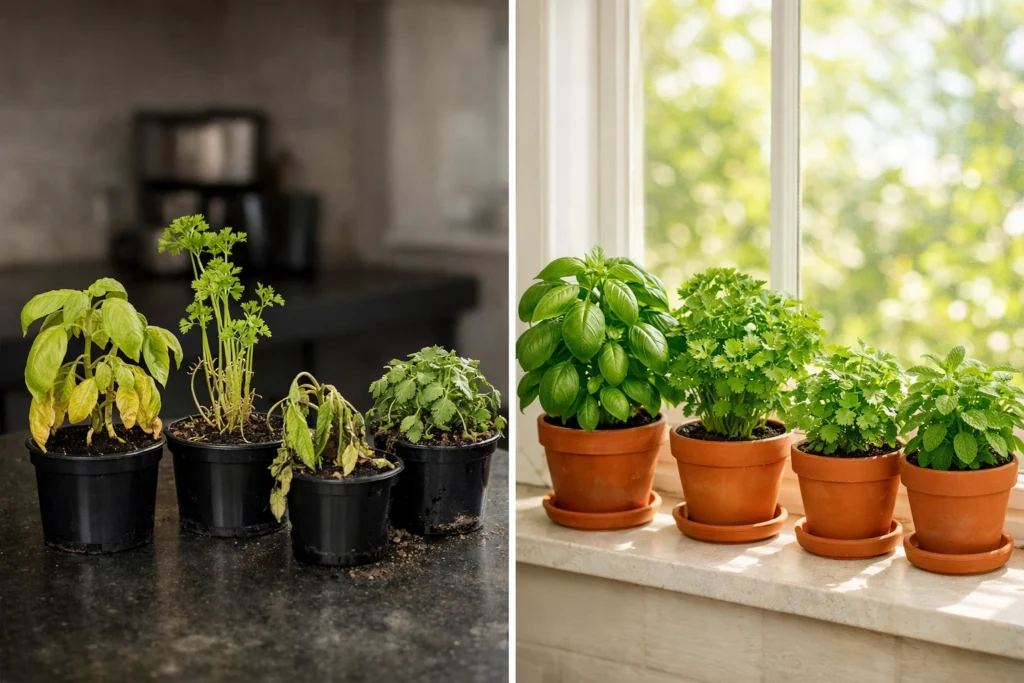
The indoor herb mortality rate in American homes is genuinely staggering — and the reasons are almost always the same four mistakes repeated over and over by well-intentioned but misinformed gardeners. Why are my indoor herbs dying and how to fix it almost always comes down to one or more of these four fundamental errors — overwatering that drowns roots in waterlogged soil, insufficient light that slowly starves plants of the energy they need to photosynthesize, wrong soil that either holds too much moisture or provides too little nutrition, and pots without adequate drainage that create the perfect conditions for root rot regardless of how carefully you water. Understanding these four failure points transforms your entire approach to indoor herb growing from hopeful guessing into confident systematic success.
The single most important mindset shift for indoor herb garden for beginners is recognizing that supermarket herb plants — those dense, lush, multi-stemmed pots of basil and cilantro sold for $3.99 in the produce section — are not designed to live in your home. They’re grown in commercial greenhouse conditions with precise humidity, optimal light, and hydroponic nutrition systems that your kitchen windowsill cannot replicate. Those plants are essentially cut flowers in disguise — harvested at peak and intended to provide a week or two of fresh herbs before declining. How to start an indoor herb garden from scratch that actually thrives means either buying proper garden center transplants with established root systems, starting from seed with appropriate patience, or repotting supermarket herbs immediately into proper soil and containers the moment you bring them home.
Choose the Right Herbs to Start Your Indoor Garden Successfully
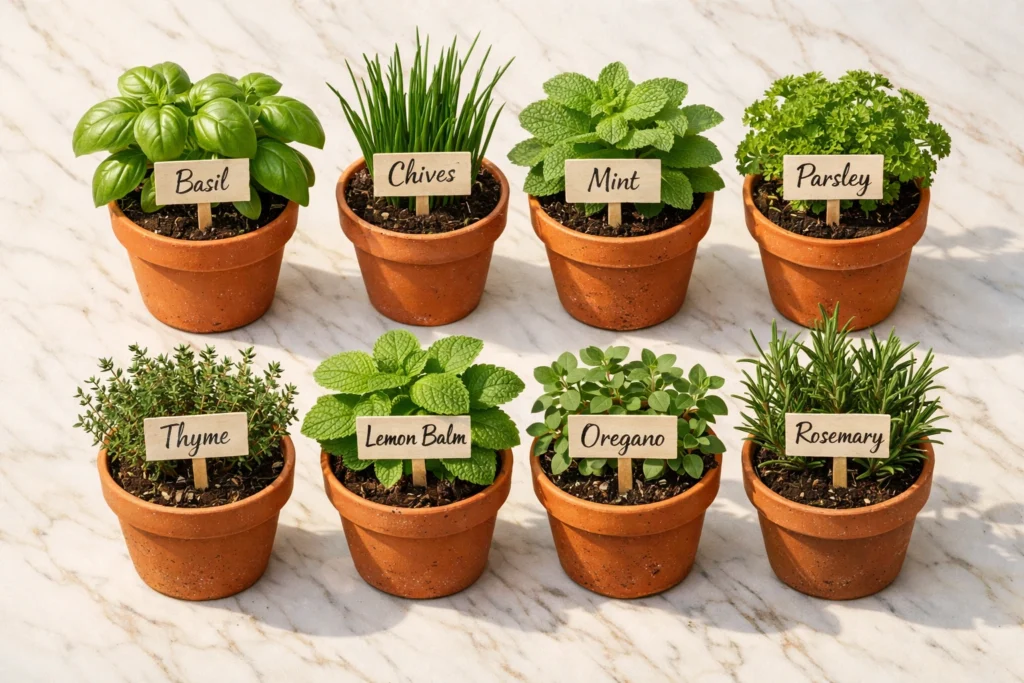
Not all herbs are created equal when it comes to indoor growing success and starting with the wrong species is one of the fastest paths to the herb graveyard. Best herbs to grow indoors that consistently succeed for American home gardeners include basil, chives, mint, parsley, thyme, lemon balm, and oregano — all of which tolerate the imperfect light and humidity conditions of typical American homes with significantly more grace than their more demanding cousins. Best herbs for indoor kitchen garden success specifically depends on your kitchen’s light conditions — if you have a bright south or west-facing window basil and parsley thrive beautifully, while chives and mint handle the dimmer east or north-facing windows that defeat more light-hungry varieties.
Herbs that grow well indoors on the other end of the difficulty spectrum include cilantro, dill, and fennel — all of which bolt rapidly indoors, develop weak leggy growth in anything less than full sun conditions, and generally frustrate indoor gardeners with their insistence on outdoor garden conditions. Low maintenance indoor herbs that genuinely deserve that description include chives — virtually unkillable, happy in lower light, and producing continuously for months — mint, which grows with almost aggressive enthusiasm given adequate moisture, and lemon balm, which tolerates a remarkable range of light and temperature conditions. Starting your indoor herb garden ideas journey with these forgiving varieties builds the confidence and observational skills you need before attempting the more demanding species.
Pick the Perfect Spot and Window for Your Indoor Herbs
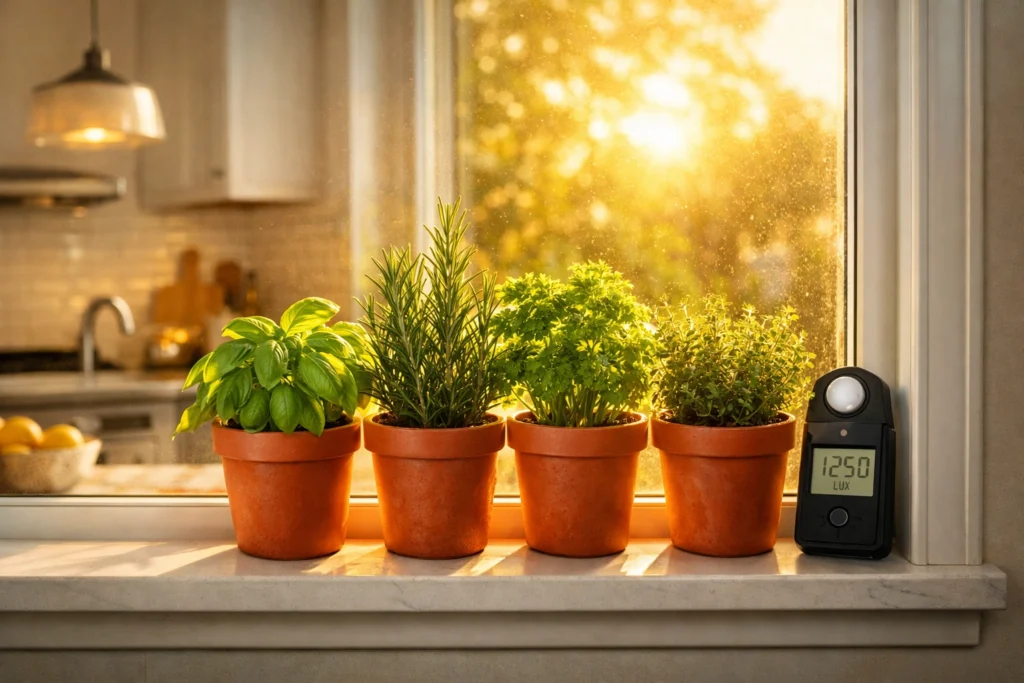
Light is the single most non-negotiable requirement for growing herbs indoors in pots successfully and getting your placement right before you pot a single herb saves you from the most common and most heartbreaking failure mode in indoor herb growing. Best window for growing herbs indoors depends entirely on which direction that window faces — south-facing windows receive the most intense and longest-duration direct sunlight throughout the day and suit the most light-demanding herbs including basil, rosemary, and thyme perfectly. East-facing windows receive gentle morning sun that suits medium-light herbs including parsley, chives, and mint beautifully. West-facing windows deliver strong afternoon sun that works well for most culinary herbs. North-facing windows receive the least light and suit only the most shade-tolerant herbs including chives, mint, and lemon balm.
you may also like this:How to Create a Beautiful Outdoor Dining Area for Spring and Summer
| Window Direction | Daily Sun Hours | Best Herbs | Avoid |
|---|---|---|---|
| South-facing | 6-8 hours | Basil, rosemary, thyme | Nothing |
| West-facing | 4-6 hours | Parsley, oregano, sage | Rosemary |
| East-facing | 3-4 hours | Chives, mint, parsley | Basil, rosemary |
| North-facing | 0-2 hours | Chives, mint, lemon balm | Most herbs |
Use the Right Soil Mix to Give Your Herbs the Best Start
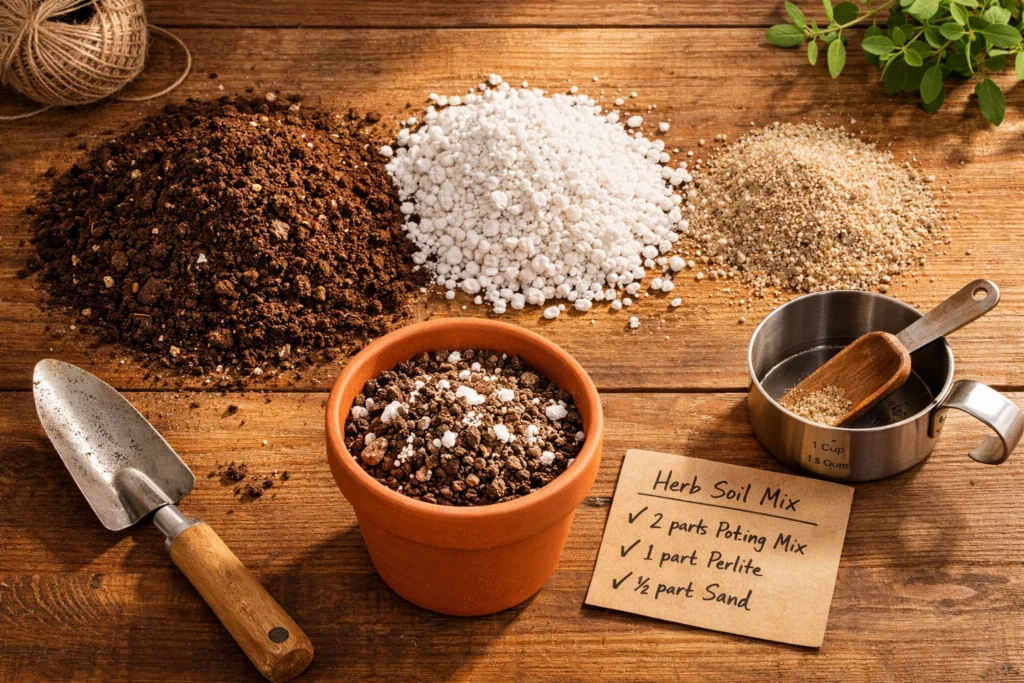
Soil is where most indoor herb gardens fail silently and invisibly — the problem hidden beneath the surface where you can’t see it until the damage is already done. Best soil for growing herbs indoors is emphatically not the standard all-purpose potting soil that most beginner gardeners use by default. Standard potting mixes retain too much moisture for most Mediterranean herbs like rosemary, thyme, and oregano that evolved in well-draining rocky soils and actively suffer in the perpetually damp conditions that standard potting mix creates in a container environment. Best soil mix for growing herbs indoors combines three components in specific proportions — 60% quality potting mix providing the organic nutrition base, 30% perlite providing the critical drainage and aeration that prevents waterlogging, and 10% coarse horticultural sand providing additional drainage texture that mimics the rocky soils Mediterranean herbs prefer.
How to grow organic herbs indoors at home through soil selection means choosing OMRI-listed certified organic potting mixes — brands like FoxFarm Ocean Forest, Espoma Organic Potting Mix, and Dr. Earth Pot of Gold are all available at major USA garden centers and online retailers and provide the balanced organic nutrition that supports healthy herb growth without synthetic chemical inputs. Growing herbs indoors from seeds requires a different soil approach — a dedicated seed starting mix with finer texture, superior moisture retention, and lower nutrient concentration than standard potting mix provides the sterile, loose growing medium that tiny herb seedlings need to germinate successfully and establish their first root systems before being transplanted into the standard herb soil mix formula described above.
Choose the Right Containers and Pots for Healthy Herb Growth
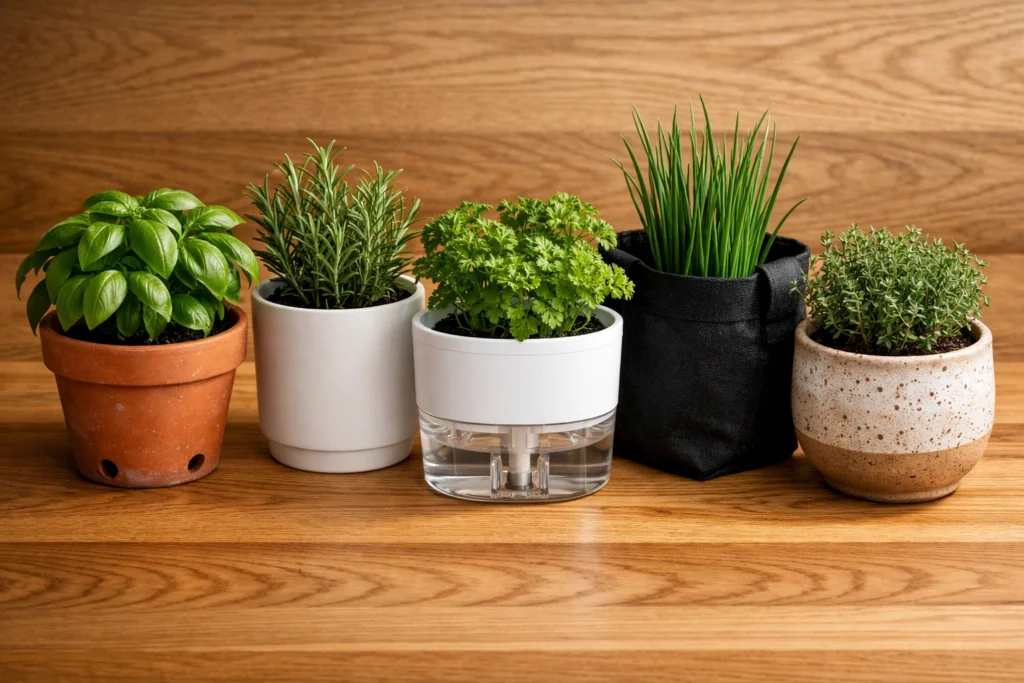
The container you choose for your indoor herbs matters far more than most gardeners initially appreciate — and the single most important feature of any indoor herb container has nothing to do with aesthetics, size, or material. It’s the drainage hole. A pot without a drainage hole is a death sentence for virtually every culinary herb regardless of how carefully you water because water inevitably accumulates at the bottom of drainageless containers creating an anaerobic waterlogged zone that destroys roots through oxygen deprivation and fungal rot within weeks. Best pots for growing herbs indoors must have at least one drainage hole — preferably multiple holes — and must be used with a saucer rather than a decorative cachepot that traps drainage water beneath the pot.
Best containers for growing herbs indoors by material each deliver distinct advantages and disadvantages that suit different herb varieties and growing contexts. Terracotta’s natural porosity allows air and moisture exchange through the pot walls — a property that benefits moisture-sensitive Mediterranean herbs like rosemary and thyme enormously by preventing the soil saturation that plastic containers create. However terracotta also dries out faster than plastic requiring more frequent watering for moisture-loving herbs like basil and parsley. Indoor herb garden container ideas for contemporary kitchens increasingly favor self-watering containers — a particularly elegant solution for basil, parsley, and chives that maintains consistent soil moisture through a reservoir system that eliminates the feast-or-famine watering cycle that stresses most indoor herbs.
Master the Art of Watering Indoor Herbs Without Overwatering
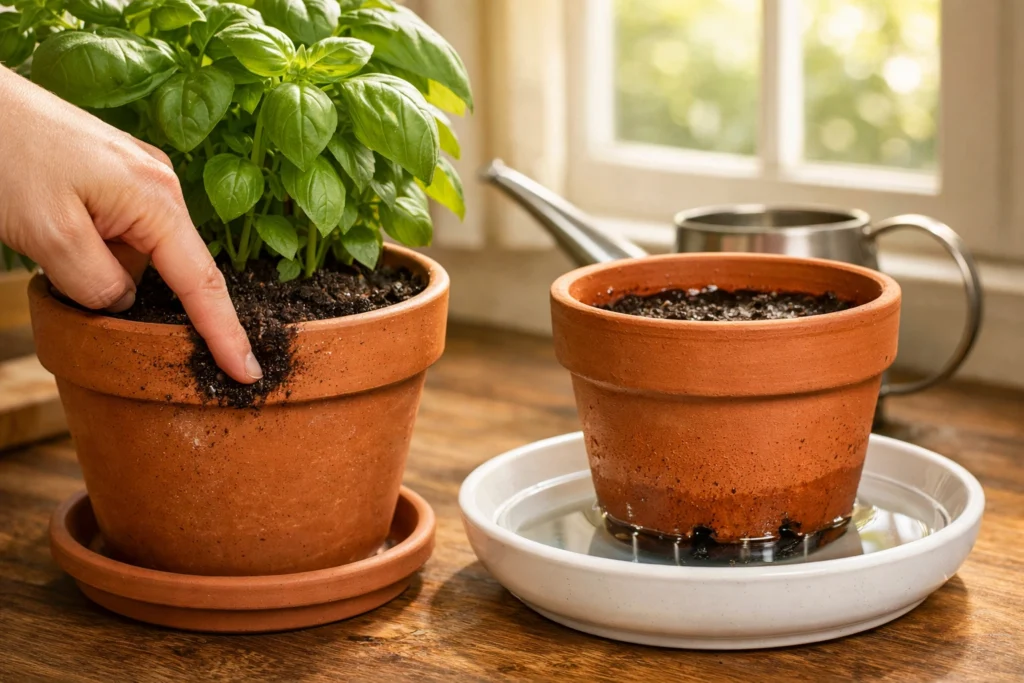
Overwatering kills more indoor herbs than every other cause combined — and the insidious thing about overwatering is that it looks exactly like underwatering in its early stages. Wilting, yellowing leaves, and general plant decline all occur with both too much and too little water making visual diagnosis genuinely difficult for beginner gardeners. Watering indoor herbs correctly starts with one non-negotiable practice — always check the soil moisture before adding any water regardless of how long it’s been since the last watering. Push your finger one inch deep into the soil and only water if that inch of soil feels dry. If it still feels damp at one inch depth the herb doesn’t need water yet regardless of how many days have passed since you last watered.
| Herb | Watering Frequency | Soil Check Depth | Warning Signs |
|---|---|---|---|
| Rosemary | Every 10-14 days | 2 inches dry | Yellowing, dropping needles |
| Thyme | Every 7-10 days | 1-2 inches dry | Wilting, grey leaves |
| Basil | Every 3-5 days | Top inch dry | Wilting, black stems |
| Mint | Every 3-4 days | Top inch dry | Dry crispy leaves |
| Chives | Every 5-7 days | Top inch dry | Yellowing tips |
| Parsley | Every 4-6 days | Top inch dry | Limp drooping leaves |
Feed Your Indoor Herbs With the Right Fertilizer at the Right Time
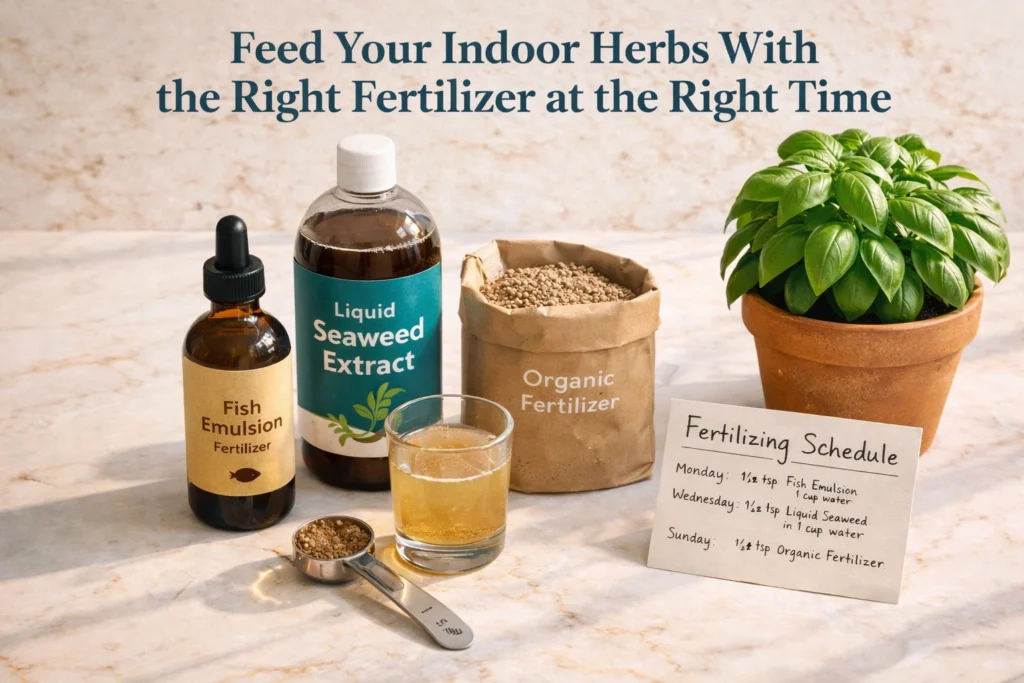
Container-grown herbs deplete their soil nutrients significantly faster than garden-grown herbs because regular watering continuously leaches soluble nutrients through the drainage holes — a process that leaves the soil nutritionally exhausted within six to eight weeks of initial potting regardless of how premium the original soil mix was. Best fertilizer for indoor herbs for most American home gardeners is a balanced liquid fertilizer with an NPK ratio close to 5-5-5 or 10-10-10 that provides equal amounts of nitrogen for leaf growth, phosphorus for root development, and potassium for overall plant health and disease resistance. How to fertilize indoor herbs naturally using organic options means choosing fish emulsion, liquid seaweed extract, or worm casting tea — all available at USA garden centers and online — which provide complete nutrition profiles along with beneficial microorganisms that improve soil health over time rather than simply adding synthetic salt-based nutrients.
The fertilizing frequency that indoor culinary herb garden ideas specialists recommend varies critically by season and growth stage — herbs growing actively during spring and summer need fertilizing every two weeks with a half-strength liquid fertilizer solution, while herbs in their slower winter growth period need fertilizing only once monthly at quarter strength to avoid the salt buildup in soil that damages roots and causes leaf tip burn. Signs of over-fertilizing in indoor herbs include brown leaf tips, white crusty deposits on soil surface and pot edges from salt accumulation, and paradoxically reduced growth as excessive fertilizer salts create osmotic stress that prevents roots from absorbing water effectively. Signs of under-fertilizing include pale yellowing leaves, stunted growth, and reduced aromatic intensity in the harvested herbs — that flat-tasting basil that lacks the punchy fragrance of the stuff at your local Italian restaurant is almost certainly an under-fertilized plant crying out for nutrition.
Use Grow Lights to Grow Herbs Indoors Without Sunlight
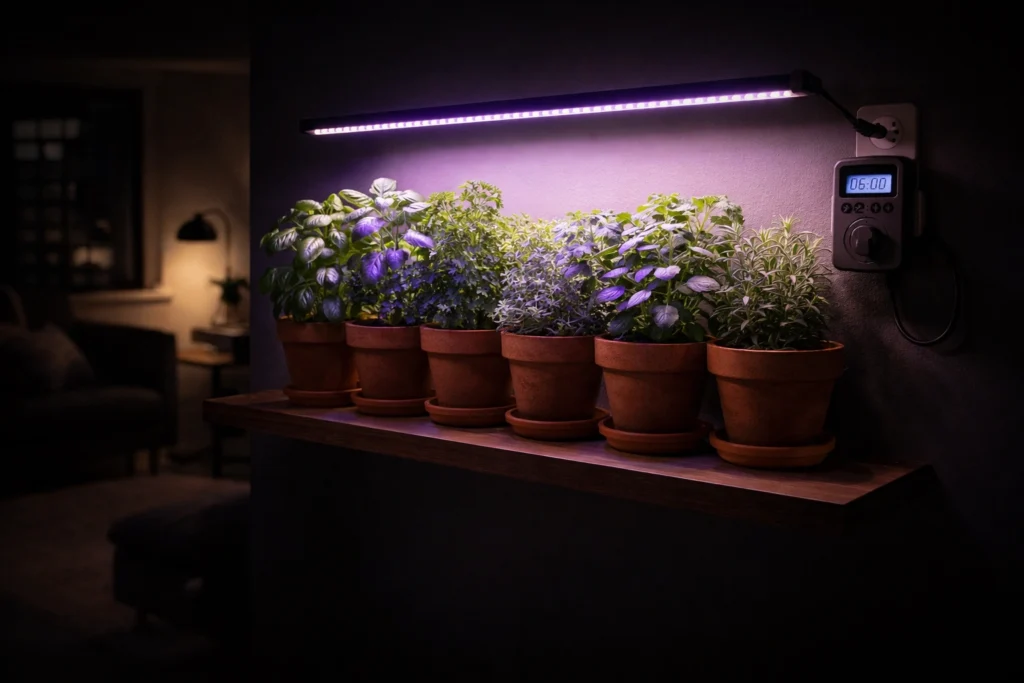
Grow lights are the single most transformative technology available for American apartment dwellers and anyone whose home lacks adequate natural light for successful growing herbs indoors without sunlight. The physics of indoor plant growing are unforgiving — herbs need between six and eight hours of bright light daily for healthy growth and most American apartments, particularly those in urban high-rises surrounded by other tall buildings, simply cannot deliver that light intensity through windows alone regardless of orientation. Indoor herb garden with grow lights eliminates this fundamental limitation completely — a quality full-spectrum LED grow light positioned four to six inches above herb foliage and operating on a timer for fourteen to sixteen hours daily provides light intensity and spectral quality that actually exceeds what herbs receive through most residential windows.
How to use grow lights for indoor herb garden setups most effectively means understanding the critical importance of light spectrum — herbs require both blue spectrum light around 450 nanometers that drives compact vegetative growth and red spectrum light around 660 nanometers that promotes flowering and fruiting, making full-spectrum LED grow lights that cover the complete photosynthetically active radiation range from 400 to 700 nanometers the clear superior choice over older single-spectrum fluorescent alternatives. How to grow herbs indoors under grow lights on a budget is genuinely achievable — quality full-spectrum LED grow lights suitable for a kitchen herb garden are available on Amazon from brands like Barrina, Roleadro, and Spider Farmer for $20 to $50, representing one of the highest-return investments any indoor herb gardener can make. Set your grow light on a timer for 14 hours on and 10 hours off to simulate optimal growing season day length regardless of the actual season or your apartment’s window situation.
How to Harvest Indoor Herbs Without Killing Your Plants
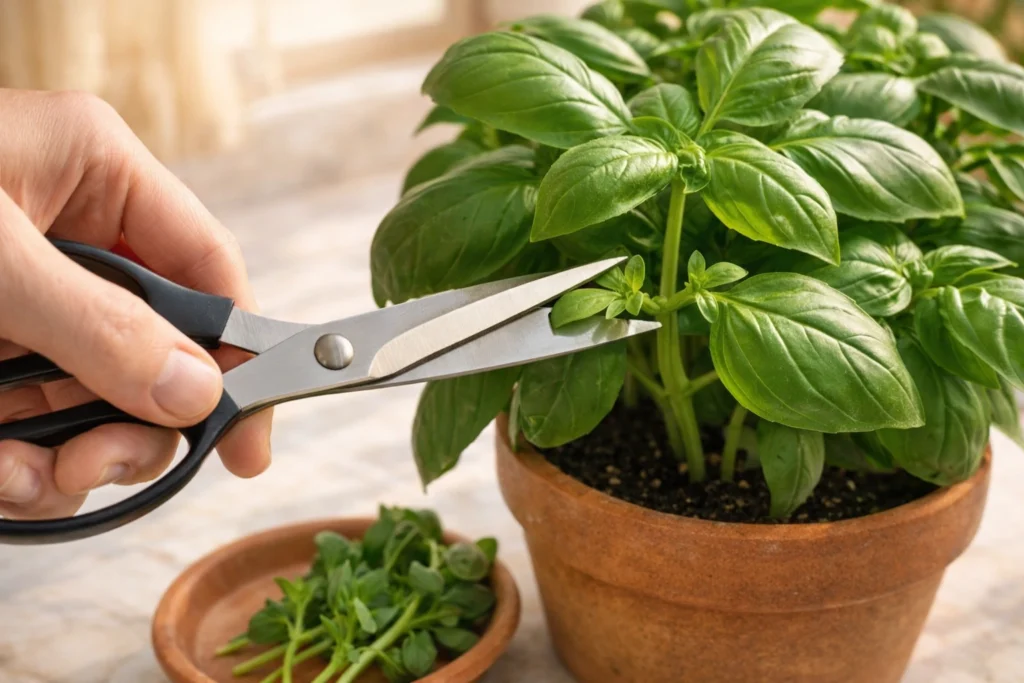
Harvesting is where even experienced indoor herb gardeners make mistakes that slowly debilitate their plants — and the consequences of incorrect harvesting technique accumulate invisibly over weeks before the plant suddenly collapses in what appears to be a mysterious decline. Harvesting indoor herbs properly requires understanding one foundational botanical principle — herbs grow from their growing tips and removing those tips correctly triggers branching that produces fuller, bushier, more productive plants while removing them incorrectly produces leggy, sparse, weakened plants that gradually decline toward death. How to harvest indoor herbs without killing the plant means never removing more than one-third of the plant’s total foliage volume in any single harvest regardless of how much herb you need — the remaining two-thirds of foliage represents the plant’s photosynthetic capacity and removing more than one-third compromises its ability to produce the energy needed for healthy regrowth.
The specific harvesting technique varies critically between herb species and getting it right for each variety makes an enormous difference to long-term plant productivity. Basil should always be harvested by pinching stems just above a leaf node — the point where two leaves emerge from the stem — which triggers the plant to produce two new growing tips from that node rather than one, progressively doubling its branching density with each correct harvest. Mint and lemon balm can be harvested more aggressively — cutting stems back to one to two inches above the soil surface triggers vigorous regrowth from the base. Chives are harvested by cutting individual leaves to one inch above the soil level with clean scissors. Rosemary and thyme should be harvested by snipping only the soft green growing tips rather than cutting into the older woody stem sections that don’t regenerate reliably.
Prevent and Treat the Most Common Indoor Herb Problems
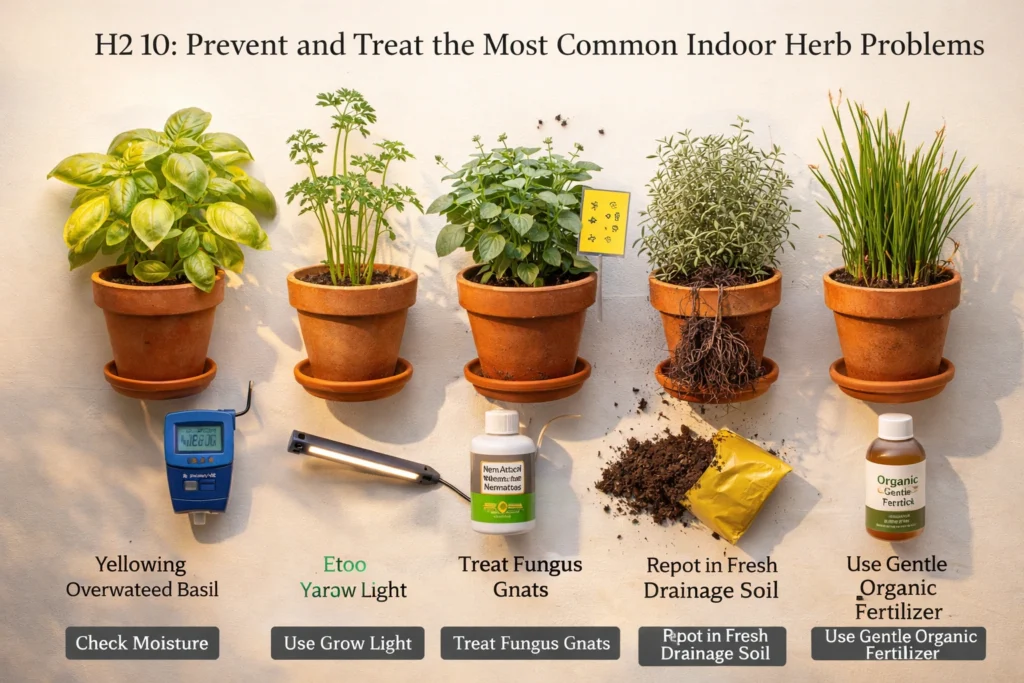
Indoor herb problems follow predictable patterns that experienced gardeners learn to recognize and address before they become terminal — and most problems are significantly easier to prevent than to cure once they’ve established. How to prevent pests on indoor herb plants starts with the most common indoor herb pest — fungus gnats, the tiny black flies that emerge from perpetually moist soil surfaces and whose larvae feed on herb roots in the top inch of soil. Prevention is straightforward — allow the soil surface to dry completely between waterings, apply a one-inch layer of horticultural sand to the soil surface which the adult gnats find inhospitable for egg-laying, and use sticky yellow traps to catch adult gnats before they breed. Treatment of established infestations uses beneficial nematodes — microscopic soil organisms that feed specifically on fungus gnat larvae — applied to moist soil according to package directions.
| Problem | Cause | Prevention | Treatment |
|---|---|---|---|
| Fungus gnats | Overwatering, moist surface | Let soil dry, sand mulch | Yellow traps, nematodes |
| Root rot | Overwatering, poor drainage | Correct watering, drainage holes | Remove, cut roots, repot |
| Leggy growth | Insufficient light | Bright window or grow light | Move closer to light |
| Yellow leaves | Overwatering or nutrient deficiency | Check moisture, fertilize | Adjust watering, feed |
| Brown leaf tips | Over-fertilizing or low humidity | Half-strength fertilizer | Flush soil, mist leaves |
Grow Herbs Indoors Successfully in Small Apartments and Kitchens
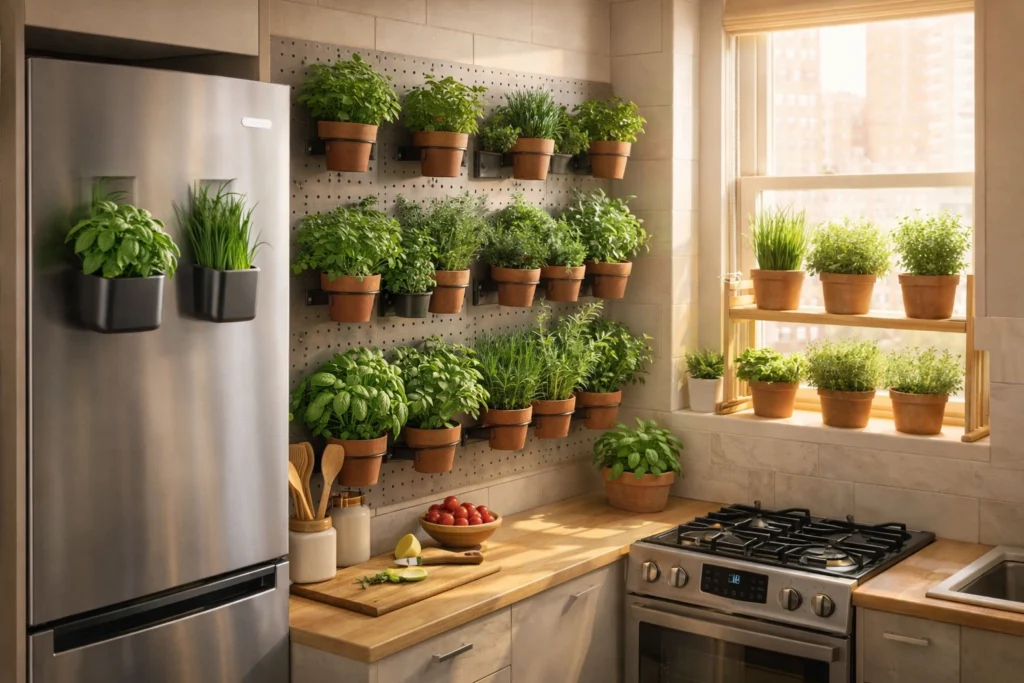
Small apartments don’t have to mean small herb harvests — and indoor herb garden apartment ideas that maximize limited space through intelligent vertical and compact design can produce as much fresh herb as a much larger dedicated garden space. How to grow herbs indoors in small apartments most effectively uses the kitchen as the primary growing zone — the kitchen offers the combination of proximity to cooking use, access to natural light from kitchen windows, and the humidity generated by cooking and dishwashing that benefits moisture-loving herbs like basil and parsley. Indoor herb garden kitchen ideas for small spaces include magnetic herb pod systems that attach directly to refrigerator doors, wall-mounted tiered planter systems that use vertical wall space rather than precious counter space, and compact self-watering window box systems that fit neatly on narrow kitchen windowsills.
Indoor herb garden wall ideas represent perhaps the most spatially efficient approach to apartment herb growing — a vertical wall-mounted planter system using pocket planters, pegboard-mounted pot holders, or modular magnetic containers can grow ten to fifteen herb varieties in the wall space equivalent of a single shelf unit. The IKEA GRUNDTAL kitchen rail system adapted for herb growing, the Umbra Trigg wall mounted planter, and the Outland Living vertical herb planter are all excellent options available across the USA that transform blank kitchen walls into productive growing surfaces. Best home fragrance ideas for small apartments that incorporate herbs specifically include growing lavender, lemon balm, and rosemary near kitchen air circulation — cooking heat gently activates the aromatic oils in these herbs releasing their fragrance throughout the apartment as a natural, chemical-free air freshener.
Grow Herbs Indoors Year Round With These Simple Seasonal Tips
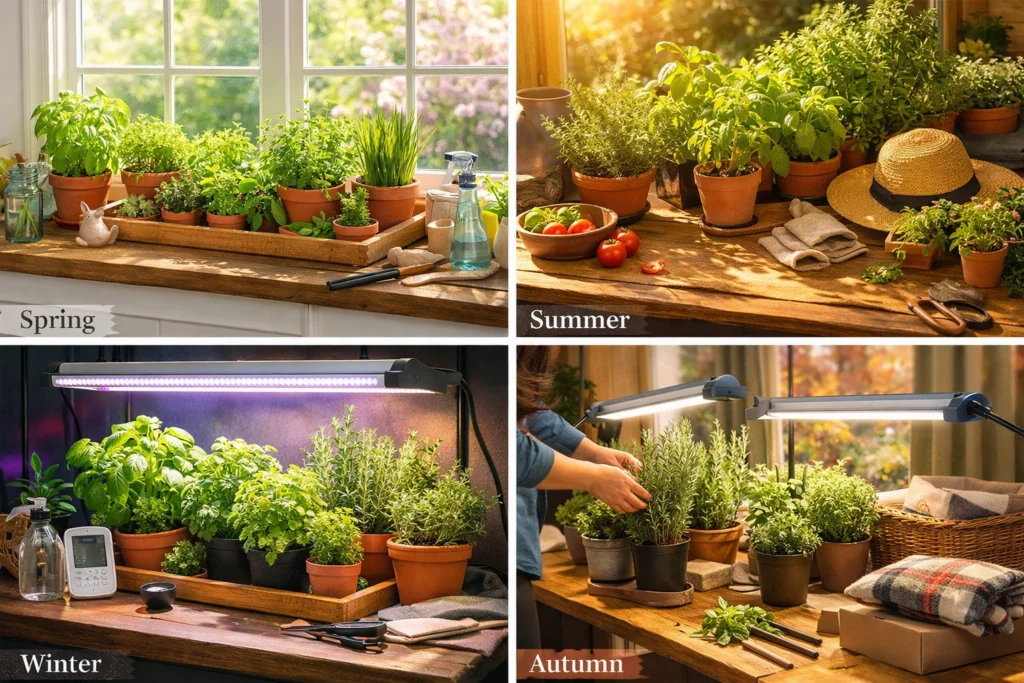
The indoor herb growing year follows a rhythm that mirrors the outdoor growing calendar even when your herbs never see outdoor conditions — and adapting your care approach to each season dramatically improves year-round success. Growing herbs indoors in winter presents the greatest challenge because reduced daylight hours decrease the light intensity available through windows by up to 70% compared to summer peak light levels, slower growth reduces water and nutrient requirements significantly, and central heating systems create dry indoor air conditions that stress moisture-loving herbs. How to grow herbs indoors in winter successfully means supplementing natural light with grow lights during the short December and January days, reducing watering frequency by approximately 30% to match the plant’s slower metabolism, cutting fertilizing to once monthly at quarter strength, and grouping herb pots together to create a local humidity microclimate through collective transpiration.
Herbs that grow indoors year round without seasonal adjustments include chives — which maintain steady if somewhat slower growth through all four seasons — mint, which benefits from an occasional cutting back to two inches above soil to refresh its growth, and thyme, which actually prefers the cooler temperatures of winter and often grows more vigorously in autumn and winter than during hot summer months. How to grow herbs indoors year round through seasonal transitions specifically means moving herbs away from window glass during cold winter months where glass surface temperatures can drop below freezing and damage cold-sensitive herbs, and conversely moving south-facing window herbs to east or west windows during peak summer to prevent the leaf scorch that direct summer sun through glass can cause in herbs that normally enjoy full sun conditions outdoors but find the concentrated heat through glass overwhelming.
Best Herb Combinations to Grow Together Indoors Successfully
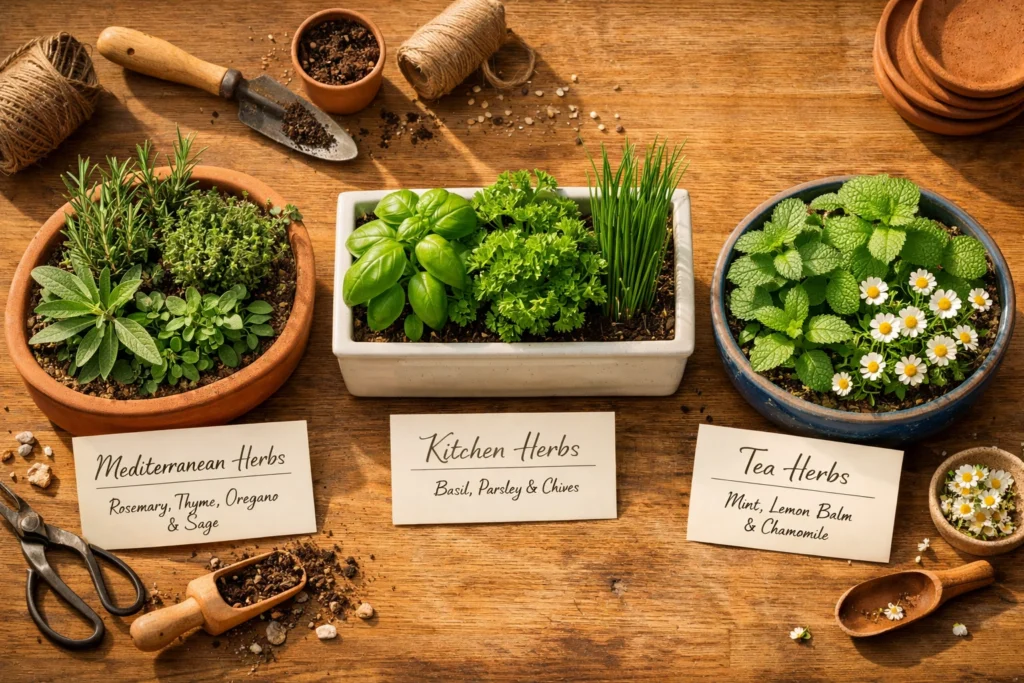
Growing multiple herbs together in a single container is one of the most appealing ideas in indoor herb gardening — and one of the most reliably unsuccessful approaches when herb compatibility is ignored. Best herb combinations to grow together indoors must account for three critical compatibility factors — matching water requirements so that watering one herb correctly doesn’t simultaneously over or underwater its container companion, matching light requirements so that all container residents receive their optimal light exposure, and matching growth rate and root system aggressiveness so that one herb doesn’t crowd out and suppress its companions. Best herb combinations to grow together indoors that consistently succeed group herbs with genuinely similar cultural requirements rather than simply combining whatever herbs you happen to use most frequently in cooking.
| Combination | Herbs Included | Container Size | Light Need | Water Need |
|---|---|---|---|---|
| Mediterranean | Rosemary, thyme, oregano, sage | 12″+ diameter | Very high | Very low |
| Fresh kitchen | Basil, parsley, chives | 10″+ diameter | High | Medium |
| Tea herbs | Mint, lemon balm, chamomile | 8″+ diameter | Medium | Medium-high |
| Italian cooking | Basil, oregano, parsley | 10″+ diameter | High | Medium |
| Calming herbs | Lavender, chamomile, lemon balm | 10″+ diameter | High | Low-medium |
Conclusion
Growing herbs indoors successfully transforms from a cycle of repeated disappointment into a genuinely rewarding and productive daily practice the moment you understand what herbs actually need rather than what seems intuitively logical. Correct light placement, proper drainage, disciplined watering, appropriate soil, and correct harvesting technique — these five principles underpin every strategy in this guide and applying them consistently turns your kitchen windowsill into a thriving, productive, beautiful herb garden that delivers fresh flavors to your cooking every single day. Start with one herb this weekend. Chives if you’re nervous. Basil if you’re ambitious. Either way you’ll be growing herbs indoors successfully before you know it.
Frequently Asked Questions
Q1: What is the easiest herb to grow indoors?
Chives are universally considered the easiest herb for indoor herb garden for beginners — they tolerate lower light than most herbs, require infrequent watering, regrow rapidly after harvesting, and resist the pests and diseases that challenge more sensitive varieties like basil and cilantro.
Q2: Why do my indoor herbs keep dying?
Why are my indoor herbs dying and how to fix it almost always comes down to overwatering combined with inadequate drainage — the most common and most deadly combination in indoor herb growing. Check that your pots have drainage holes and always test soil moisture before watering.
Q3: How much light do indoor herbs need?
Most culinary herbs need six to eight hours of bright light daily. Best light for growing herbs indoors comes from south-facing windows for sun-loving varieties like basil and rosemary or from full-spectrum LED grow lights for apartments without adequate natural light.
Q4: Should I use potting soil for indoor herbs?
Standard potting soil retains too much moisture for most herbs. Best soil mix for growing herbs indoors combines 60% quality potting mix with 30% perlite and 10% coarse sand — a well-draining blend that prevents the waterlogging that kills most indoor herbs.
Q5: How often should I water indoor herbs?
How to water indoor herbs correctly means checking soil moisture before every watering rather than following a schedule — push your finger one inch into the soil and water only when that inch feels completely dry. Most herbs need watering every four to seven days depending on the season and pot material.