The Complete Home Decluttering Guide: How To Finally Let Go and Live With Less
There’s a particular kind of tired that comes from living with too much stuff. Not physical exhaustion — something quieter and more persistent. It’s the low-level mental hum of too many objects competing for your attention, too many surfaces covered, too many closets you don’t want to open. You feel it most on Sunday evenings when the week ahead feels heavy before it’s even begun. That feeling has a name. It’s clutter. And home decluttering is one of the most transformative things you can do about it.
Why Home Decluttering Is One of the Most Powerful Acts of Self-Care

Home decluttering and mental health are linked far more directly than most people realize. Princeton University Neuroscience Institute research confirms that visual clutter actively competes for cognitive attention — keeping your brain in a persistent state of low-grade alertness even during rest time. Every visible object out of place asks your brain for a micro-dose of processing energy. In a cluttered home, that tax never stops. Home decluttering motivation starts the moment you understand that your stuff is costing you mental energy you didn’t agree to spend.
UCLA’s Center on Everyday Lives of Families linked cluttered home environments to measurably elevated cortisol — the primary stress hormone — in female homeowners throughout the entire day. The emotional liberation that follows a genuine decluttering session isn’t imaginary. It’s physiological. Home decluttering ideas that reduce visual noise directly reduce your body’s stress load. Clearing a single cluttered surface can produce an immediate and measurable shift in how calm and in control you feel. That’s not interior design. That’s neuroscience.
The Real Reason Your Home Keeps Getting Cluttered Again and Again

Clutter returns because the root cause is never addressed — volume consistently exceeds available storage and designated homes. The average American brings approximately 65 new items into their home every year according to research published by the Los Angeles Times. Most of those items never receive a designated home. They land on counters, on chairs, on the floor beside the door. Home decluttering systems that don’t address incoming volume will always be overwhelmed by accumulation within weeks of implementation.
The second root cause is emotional. Objects carry memories, identities, and obligations. The gift you feel guilty donating. The jeans you’ll fit into someday. The hobby supplies for the hobby you haven’t touched in four years. Emotional home decluttering tips begin with honest acknowledgment of why certain objects are genuinely hard to release — and then address that emotional attachment directly rather than organizing around it. How to motivate yourself to declutter your home starts with understanding that your clutter isn’t a character flaw. It’s a completely human response to a culture that constantly encourages you to acquire more.
The Best Home Decluttering Methods That Actually Work for Real People
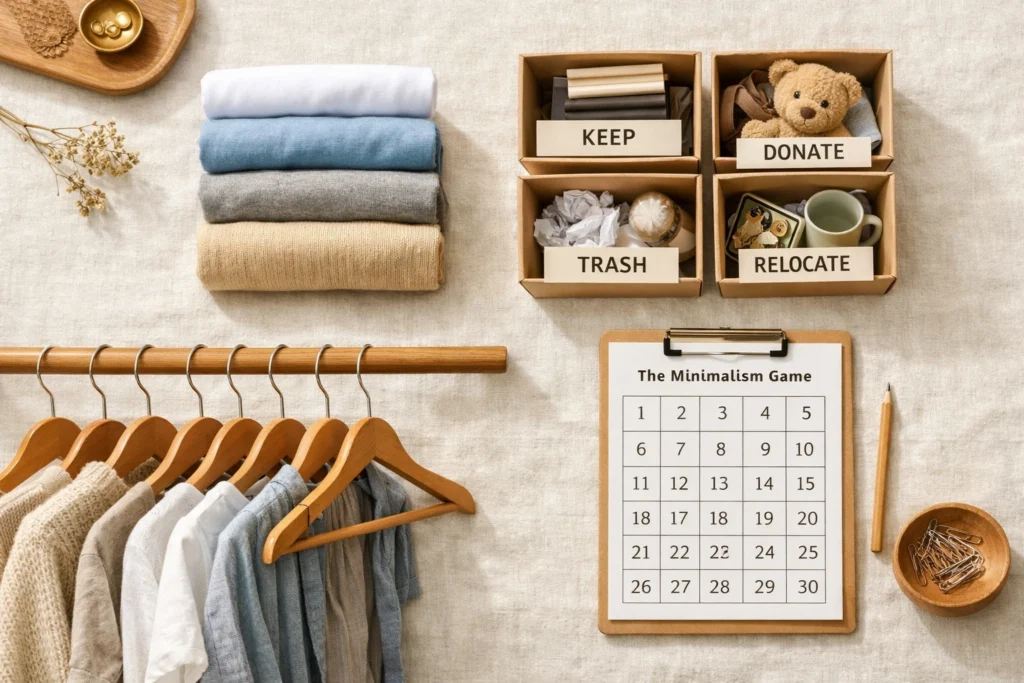
What is the best method for home decluttering? The honest answer is: the one you’ll actually finish. Four methods consistently deliver results for real people living real lives. The KonMari Method — developed by Marie Kondo — asks you to hold each object and keep only what genuinely sparks joy. The Four Box Method uses four boxes labeled keep, donate, trash, and relocate — simple enough for anyone to execute immediately. The 90-Day Rule asks a ruthlessly practical question: have you used this in the last 90 days? If not, it goes. Best home decluttering methods that actually work match the method to your personality and available time.
you may also like this:13 Bathroom Color Trends: The Ultimate Guide to a Stylish and Modern Bathroom
| Method | Best For | Time Required | Difficulty |
|---|---|---|---|
| KonMari Method | Emotional declutterers, clothing | Full weekend | Medium |
| Four Box Method | Beginners, any room | 1–2 hours per room | Easy |
| 90-Day Rule | Practical thinkers, kitchen/garage | Ongoing | Easy |
| Minimalism Game | Motivation-challenged, slow declutterers | 30 days, 10 min daily | Easy |
| One Bag a Day | Busy households, gentle pace | 30 days, 5 min daily | Very easy |
How To Start Decluttering When You Feel Completely Overwhelmed

How to start decluttering when overwhelmed requires one compassionate rule — start smaller than you think you should. Not the whole kitchen. Not the whole bedroom. One drawer. One shelf. One corner. The 10-minute rule breaks the paralysis beautifully: set a timer for 10 minutes and commit to doing nothing but decluttering until it rings. Ten minutes is short enough that resistance dissolves. And almost nobody stops when the timer goes off because momentum has already taken over. Home decluttering for beginners always starts with the smallest, least emotionally charged area available.
What should I declutter first in my home? Start with trash — obvious garbage that requires zero decision-making. Expired food. Empty bottles. Broken objects beyond repair. Removing garbage first creates immediate visible progress without the emotional cost of keep-or-donate decisions. Then tackle the easiest category in the most cluttered visible room. How to declutter a hoarder home uses this same principle scaled up — start with trash bags only for the first session and introduce decision-making only after the volume has reduced enough to feel manageable.
How To Declutter Your Home Room by Room Without Losing Momentum

How to declutter your home room by room without losing momentum requires completing each space fully before moving to the next. Half-decluttered rooms are more demoralizing than undecluttered ones — they create the visual chaos of decluttering without the reward of completion. Choose your starting room based on emotional motivation rather than logical priority. The room that bothers you most delivers the strongest motivational reward when finished. Start there. Home decluttering room by room using completion as your daily target rather than time spent keeps energy and motivation consistently high.
| Room | Priority | Estimated Time | Biggest Win |
|---|---|---|---|
| Kitchen | 1st | 3–4 hours | Counters cleared, expired food removed |
| Bedroom | 2nd | 2–3 hours | Surfaces clear, clothing edited |
| Bathroom | 3rd | 1–2 hours | Expired products removed |
| Entryway | 4th | 1 hour | Drop zone eliminated |
| Living room | 5th | 2 hours | Surfaces and shelves cleared |
| Closet | 6th | 2–3 hours | Unworn clothing donated |
| Garage/storage | Last | 4–6 hours | Volume dramatically reduced |
How To Declutter Your Kitchen for Calm and Effortless Daily Function
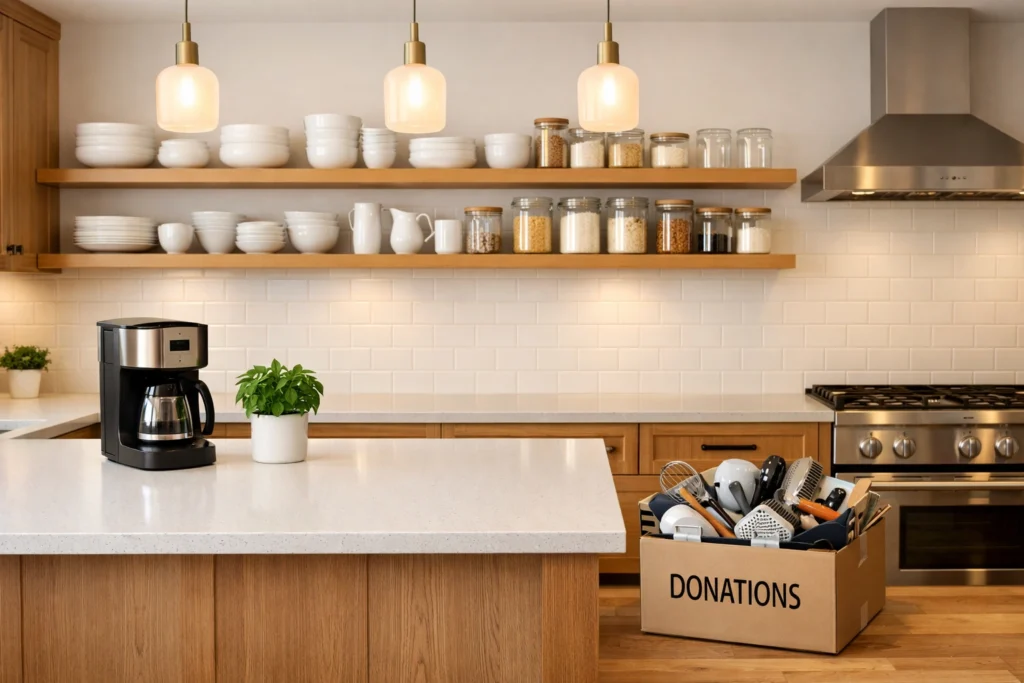
The kitchen is where home decluttering delivers its most immediate daily impact — because a cluttered kitchen creates friction with every single meal you prepare. Start with the countertops. Remove everything. Then add back only the items you use every single day. The coffee maker stays. The blender you use twice a year goes into a cabinet or donation box. Home decluttering tips for the kitchen always address counters first because clear counters create an immediate visual calm that motivates continued decluttering throughout the rest of the space.
The one-duplicate rule transforms kitchen organization. Keep one of each tool unless you genuinely and regularly cook for large groups. One good chef’s knife is more useful than four mediocre ones. Deep home decluttering tips for the kitchen include checking expiry dates on every pantry item, every spice jar, and every condiment. Most American households contain an average of $500 worth of expired food according to USDA research. Removing expired items alone clears significant physical and visual space — and it’s completely decision-free.
Bedroom Decluttering Tips That Support Better Sleep and Mental Clarity
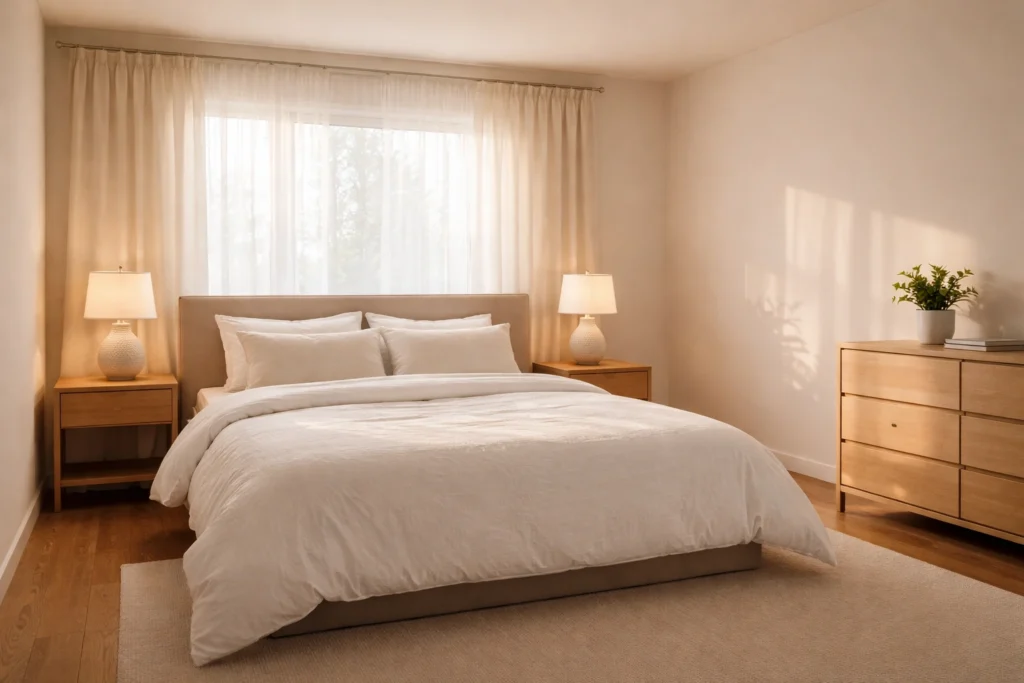
Home decluttering for mental clarity delivers its most direct benefits in the bedroom — the room where your nervous system attempts its deepest nightly recovery. Research from the American Academy of Sleep Medicine links cluttered bedroom environments to higher rates of sleep difficulty and elevated cortisol upon waking. Home decluttering tips that actually work in the bedroom prioritize surface clarity above everything else. Clear both nightstands completely. Clear the dresser top. Clear the floor. Visual calm in the bedroom directly translates to faster sleep onset and more restful nights.
Declutter your bedroom in sequence: surfaces first, floor second, under-bed storage third, and clothing last. The backwards hanger method identifies unworn clothing with clinical objectivity — turn all hangers backwards today and flip them forward only when worn. After six months, donate everything still hanging backwards without deliberation. Seasonal home decluttering tips for clothing suggest doing this twice per year — once in spring and once in autumn — to keep your wardrobe matched to your actual current life rather than the life you used to live or hope to live someday.
How To Declutter Your Bathroom and Keep It Clutter-Free for Good
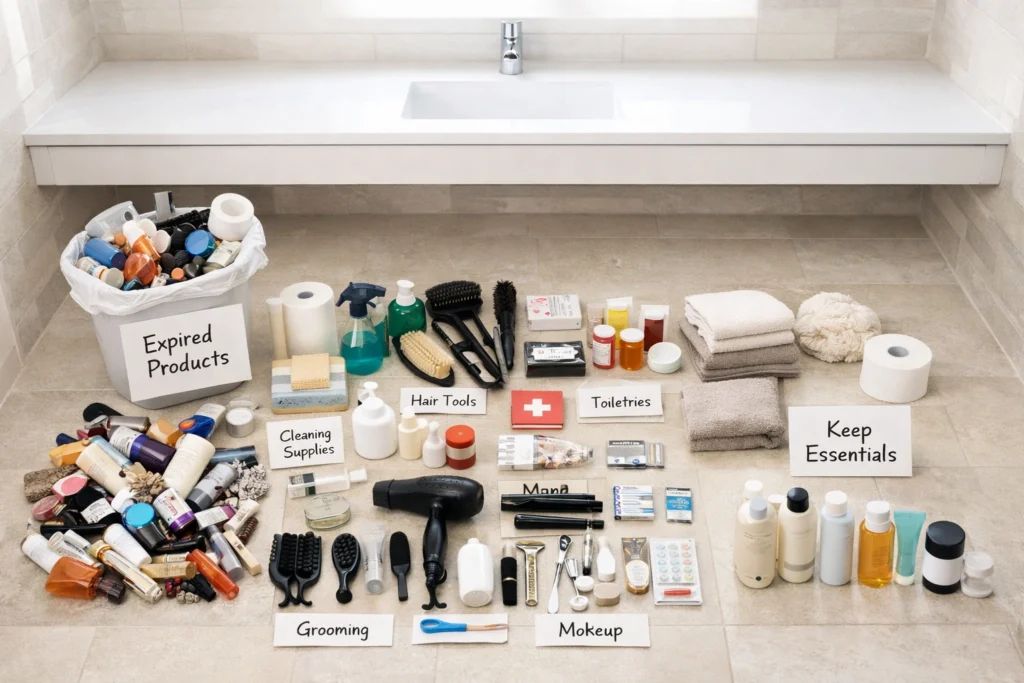
Bathrooms re-clutter faster than any other room because they receive a constant stream of small impulse purchases, hotel samples, and products that seemed like a good idea at the time. Home declutter checklist for the bathroom starts with one non-negotiable step: pull everything out completely before organizing a single item. Everything. Under the sink, inside the medicine cabinet, off the counter, out of the shower. Then check every expiry date, every product level, and every honest use frequency before a single item goes back. How to declutter your home bathroom section genuinely benefits from this complete clear-out approach because the volume reduction alone is often 40–50%.
The quarterly bathroom purge is a non-negotiable maintenance ritual for any bathroom that stays consistently clutter-free. Home declutter checklist for beginners for the bathroom: keep only products currently in use, products with less than one month until expiry go immediately, and no backup products allowed unless the primary is completely finished. Declutter and organize home bathroom philosophy means accepting that a bathroom with 12 products is more functional, more visually calm, and easier to clean than one with 60.
Closet Decluttering Ideas That Free Up Space and Simplify Your Mornings

A decluttered closet returns 15–20 minutes to your morning by eliminating decision fatigue and the frustration of searching through items you don’t wear for the items you do. Home decluttering ideas for the closet start with the backwards hanger method followed by the 12-month rule — if you haven’t worn it in a full year across all seasons, it leaves. No negotiation. No “but what if.” How to declutter your home without feeling guilty in the closet means reframing donation: your unworn clothing isn’t wasted when donated — it’s transferred to someone who will actually wear it and love it.
Declutter by category rather than by location — all tops together regardless of which drawer or hanger they live on, all bottoms together, all shoes together. This category-based approach mirrors the KonMari method and makes the volume of any single category shockingly visible. How to declutter your home before selling always starts with the closet because real estate agents consistently identify clutter-free closets as one of the highest-impact pre-sale improvements available at zero cost. A decluttered closet communicates storage abundance to potential buyers and photographs significantly better than a stuffed one.
How To Declutter Sentimental Items Without Guilt or Regret

How to declutter sentimental items at home is the most emotionally complex category in any home decluttering project — and the most commonly avoided. Professional organizers consistently recommend tackling sentimental items last, after decluttering decision-making muscles are fully developed through weeks of practice on less emotionally charged objects. The fundamental reframe that makes sentimental decluttering possible is this: the memory lives in you, not in the object. Donating your grandmother’s extra china doesn’t erase her from your life. It honors her by letting someone else use and love what she valued.
Practical strategies for sentimental items include photographing objects before releasing them — the photograph preserves the visual memory without the physical storage requirement. Create a memory box with a strict physical size limit — one shoebox, one storage bin — and keep only what fits. Pass items to family members who will genuinely use them rather than store them. Emotional home decluttering tips always acknowledge that releasing sentimental objects feels like loss in the moment but almost universally feels like liberation within weeks of doing it.
How To Declutter Your Home Fast When Time Is Limited

How to declutter your home fast without sacrificing meaningful results requires targeting high-visibility areas first. The 20-20-20 method works beautifully for busy schedules: 20 minutes of decluttering, 20 items removed, 20 items returned to their proper homes. This 60-minute weekly session maintains momentum without demanding the kind of uninterrupted hours that most Americans genuinely can’t commit to on a regular basis. Fast home decluttering tips consistently recommend this method because it produces visible results quickly enough to sustain motivation week after week.
| Fast Method | Daily Time | Items Removed | Best For |
|---|---|---|---|
| 20-20-20 Method | 60 minutes weekly | 20+ items per session | Busy professionals |
| One Bag a Day | 5 minutes daily | 300–500 per month | Families, beginners |
| 10-Minute Timer | 10 minutes daily | 10–15 items | Overwhelmed starters |
| Speed Round | 15 minutes | 27 items in 27 minutes | Motivation boosters |
Sustainable Home Decluttering Ideas That Are Good for You and the Planet
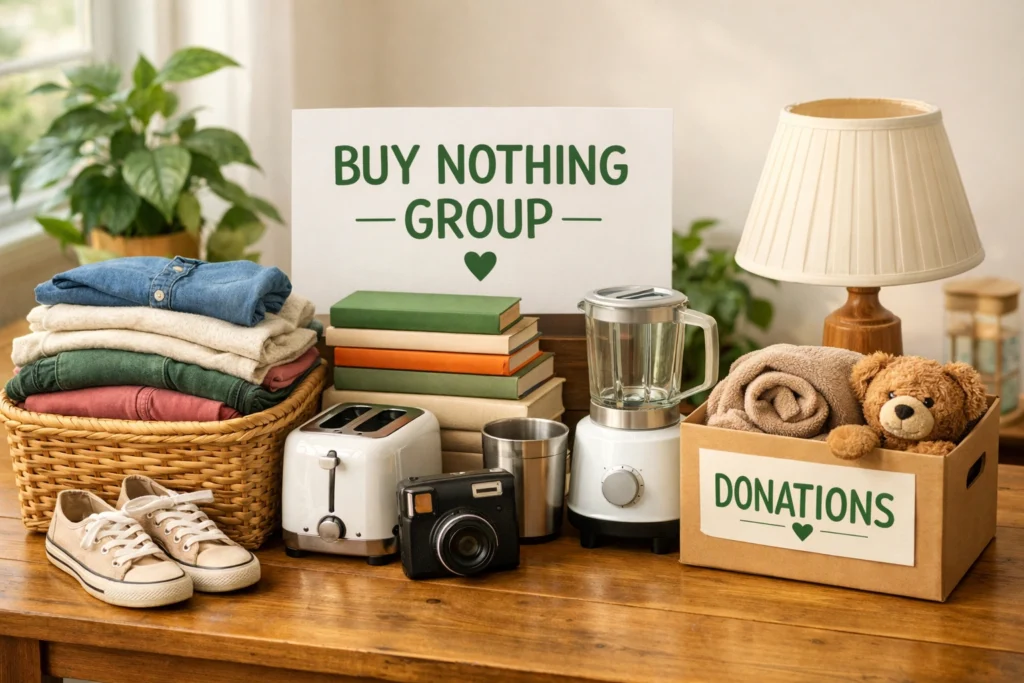
Sustainable home decluttering ideas recognize that where your items go after they leave your home matters as much as the act of releasing them. Landfill isn’t the only destination — and shouldn’t be the default one. Declutter home on a budget of environmental impact means choosing donation routes thoughtfully: local thrift stores, Habitat for Humanity ReStores for furniture and building materials, textile recyclers for clothing beyond wearable condition, and e-waste programs for electronics. How to declutter every room in your home sustainably means planning the destination of your items before starting each session.
Community redistribution platforms make sustainable decluttering genuinely easy. Buy Nothing groups on Facebook allow you to offer items directly to neighbors who need them — your unwanted bookshelf becomes exactly the piece someone nearby has been searching for. Freecycle, Nextdoor, and local community boards serve the same function. House decluttering guide recommendations for sustainability: donate before discarding, recycle before landfilling, and offer locally before shipping nationally. The most sustainable decluttering decision you can make long-term is simply to bring fewer new items into your home in the first place.
How To Maintain a Decluttered Home Long Term Without Burnout
How to maintain a decluttered home long term without exhausting yourself requires two systems working simultaneously: the one-in-one-out rule and the daily 10-minute reset. The one-in-one-out rule is the single most powerful anti-clutter maintenance strategy available — for every new item that enters your home, one existing item leaves. Applied consistently, this rule makes it physically impossible for clutter to accumulate beyond your current decluttered baseline. Home decluttering systems that incorporate this rule maintain themselves rather than requiring periodic emergency sessions.
The daily 10-minute reset prevents the gradual accumulation that makes weekly cleaning feel overwhelming. Every surface returned to baseline before bed. Every object returned to its designated home. Dishes cleared. Clothes off the chair. The reset takes 10 minutes when done daily and three hours when done monthly — the math alone makes the case for consistency. Seasonal home decluttering tips add one quarterly pass through the home — 30 minutes per room, one box to donate — to prevent seasonal accumulation from compounding into the kind of clutter that requires a full weekend to address.
Home Decluttering and Mental Health — The Powerful Connection

The relationship between clutter and mental health is bidirectional and thoroughly documented. Cluttered environments increase anxiety, reduce focus, impair decision-making capacity, and elevate cortisol measurably. How to declutter your home for mental clarity addresses this at the environmental level — changing the physical space to change the neurological and emotional experience of inhabiting it. Research published in the Personality and Social Psychology Bulletin found that people who described their homes as cluttered reported significantly higher levels of fatigue and depression than those who described their homes as restful and restorative.
Home decluttering and mental health also share a challenging bidirectional dynamic — depression causes clutter accumulation and clutter worsens depression symptoms, creating a cycle that’s genuinely difficult to interrupt. Emotional home decluttering tips for people experiencing mental health challenges always recommend starting extremely small — one drawer, one shelf, one surface — and building slowly from that first tiny win. Progress, however small, is neurologically rewarding. Each completed decluttering task releases a small dose of dopamine that makes the next task feel more achievable. Home decluttering for beginners experiencing this cycle should treat each small win as a genuine victory rather than evidence of how much remains undone.
Final Thoughts — How To Make Home Decluttering a Lifelong Practice
Home decluttering is not a project you complete once and never revisit. It’s a practice — an ongoing, evolving relationship with the objects in your life and the space you inhabit. The complete framework is simple: own less than your storage capacity, designate a home for everything you keep, maintain daily through micro-habits, and revisit seasonally to prevent gradual re-accumulation. How to declutter your home as a lifelong practice means treating every new purchase as a deliberate choice rather than a reflexive response to availability or marketing.
Start today. Not with the whole house. Start with one drawer, one shelf, or one grocery bag. Remove what doesn’t serve you. Feel the immediate shift in your space and your nervous system. Then do it again tomorrow. Home decluttering tips that actually work always begin with this same quiet, honest, single step. Living with less isn’t deprivation — it’s clarity. It’s spaciousness. It’s the daily experience of a home that holds exactly what you need and nothing that weighs you down. That home is already yours. You just need to uncover it.