7 Easy Ways to Make Your Living Room Feel Peaceful and Relaxing
Your living room should restore you. Not drain you. Not stress you. Not make you feel vaguely uncomfortable every time you sit down. Yet for millions of Americans, the living room has quietly become another source of visual noise — cluttered surfaces, harsh overhead lighting, scratchy synthetic fabrics, and a general sense of accumulated chaos that the brain registers as low-level threat all day long. A peaceful living room isn’t a luxury reserved for interior designers and Pinterest boards. It’s something genuinely achievable in any home, at any budget, with the right sequence of intentional changes. These 7 strategies will show you exactly how to get there.
1. Why a Peaceful Living Room Is Essential for Your Daily Wellbeing
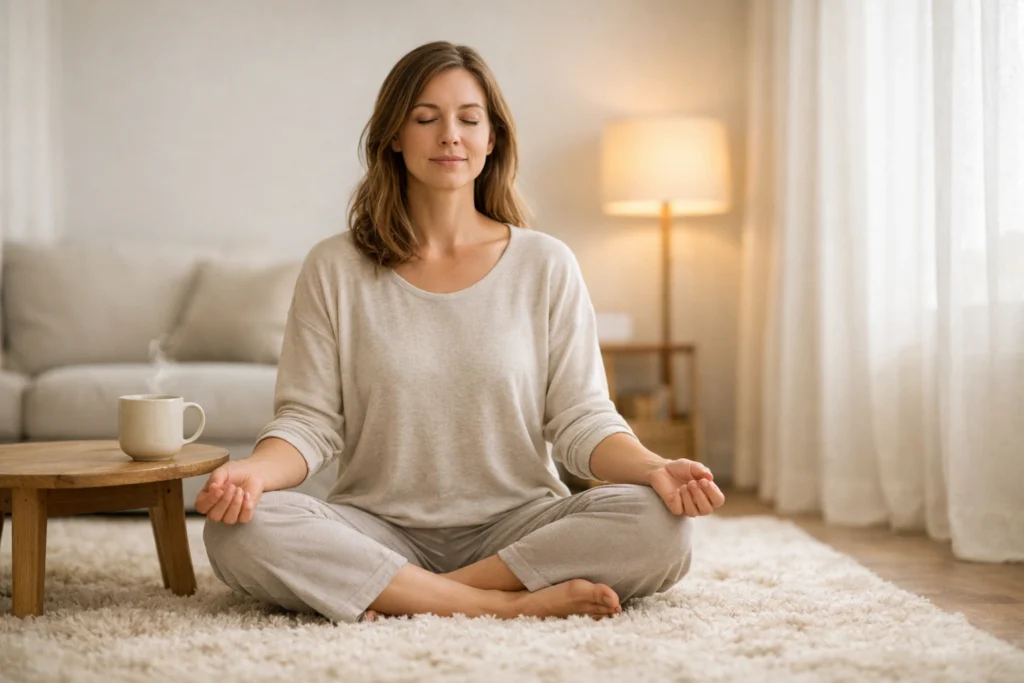
The living room carries enormous emotional weight in the American home. It’s where families decompress after work, where children play, where weekends begin and end, where the day’s stress either dissolves or accumulates depending entirely on the environment you’ve created. What makes a living room feel peaceful isn’t one single element — it’s the combined sensory experience of light, color, texture, sound, and spatial organization working together to tell your nervous system that everything is okay. According to the American Psychological Association, 77% of Americans regularly experience physical symptoms from stress and the home environment either amplifies or absorbs that stress depending on how it’s designed. Peaceful living room interior design isn’t decoration — it’s a daily mental health intervention hiding in plain sight.
The neuroscience behind environmental calm is more straightforward than most people realize. Your brain constantly scans your surroundings for threat signals — visual clutter, harsh light, discordant colors, and hard synthetic surfaces all register as mild stress inputs that compound over hours of exposure. How to create a peaceful living room fundamentally means removing those stress signals one by one and replacing them with inputs the nervous system interprets as safety — warm light, natural materials, soft textures, clear surfaces, and living plants. Calm living room decor ideas that address these inputs don’t require expensive renovations or complete refurnishing. They require intention, sequencing, and the willingness to subtract before you add. The payoff is a living room that genuinely restores you every single time you walk into it.
2. Choose a Calming Color Palette That Instantly Soothes Your Senses
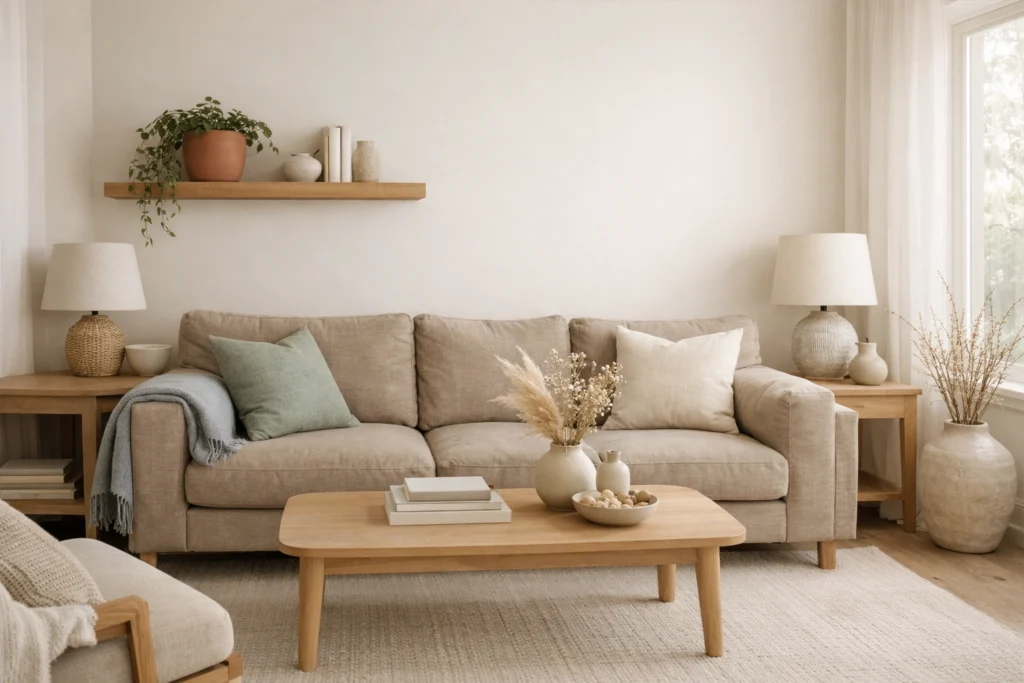
Color reaches the brain faster than almost any other environmental input. Before you consciously register what’s in a room, your nervous system has already processed its dominant colors and begun adjusting your physiological state accordingly. Best colors for a peaceful living room cluster consistently in the same family across neuroscience research and interior design practice alike — warm whites, dusty sage green, soft blue-grey, warm taupe, and muted terracotta. These hues share a common quality: they’re desaturated enough to feel restful rather than stimulating. Peaceful living room color palette ideas built around these tones create what designers call visual breathing room — a quality that makes a space feel larger, calmer, and more welcoming simultaneously. Bright saturated colors like bold red, neon yellow, or electric blue create subconscious urgency — beautiful in small doses but exhausting as dominant room tones.
| Color | Family | Best Use | Mood Created |
|---|---|---|---|
| Warm white | Neutral | Walls, large furniture | Open, clean, airy |
| Dusty sage green | Muted green | Cushions, throws, accent wall | Calm, natural, grounded |
| Warm taupe | Neutral brown | Sofas, rugs, curtains | Cozy, earthy, welcoming |
| Soft blue-grey | Cool neutral | Walls, cushions | Serene, quiet, restful |
| Muted terracotta | Warm earth | Pots, small accessories | Warm, organic, grounding |
3. Switch to Warm Layered Lighting That Melts Away Stress and Tension
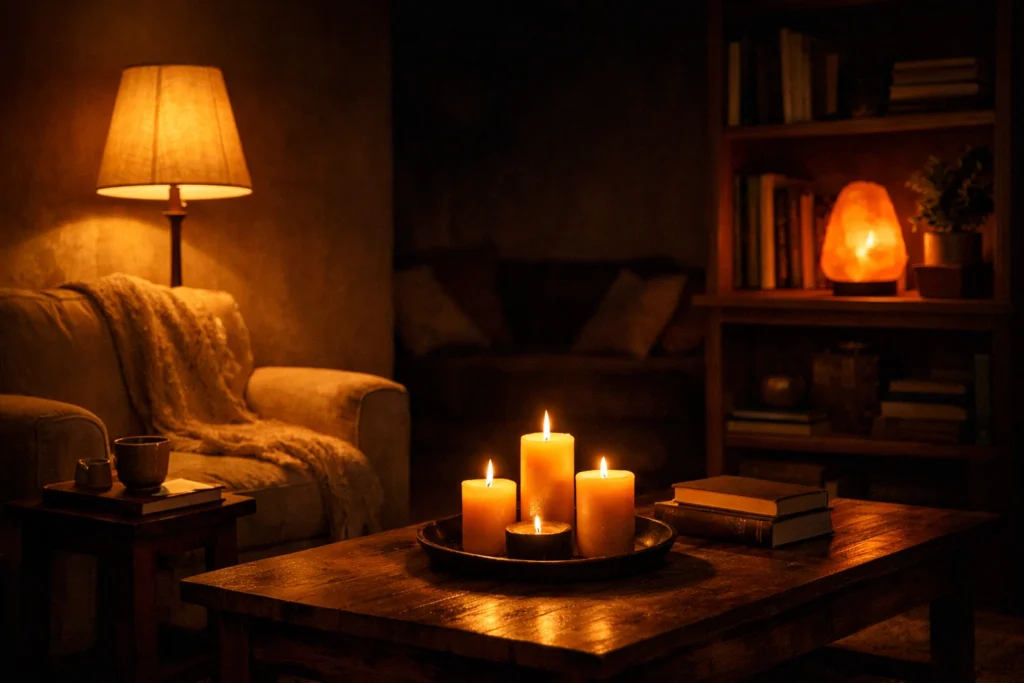
Overhead lighting is the living room’s most underestimated enemy. Bright white ceiling fixtures emit blue-spectrum light that suppresses melatonin production and triggers cortisol release — your body’s primary stress hormone — for as long as you sit beneath them. What lighting is best for a peaceful living room isn’t complicated: warm, layered, and low. Warm LED bulbs in the 2700K color temperature range tell the brain a fundamentally different story than cool white 5000K overhead lights — one of safety, rest, and the natural winding-down that follows sunset. How to use lighting to create a peaceful living room starts with a single dimmer switch installed on your overhead fixture — a $15 hardware store investment that gives you complete control over the room’s atmosphere at any moment. Relaxing living room interior design built around layered warm lighting immediately feels more expensive and more intentional than any furniture purchase could deliver.
you may also like this:How To Create a Peaceful Home That Supports Nervous System Regulation
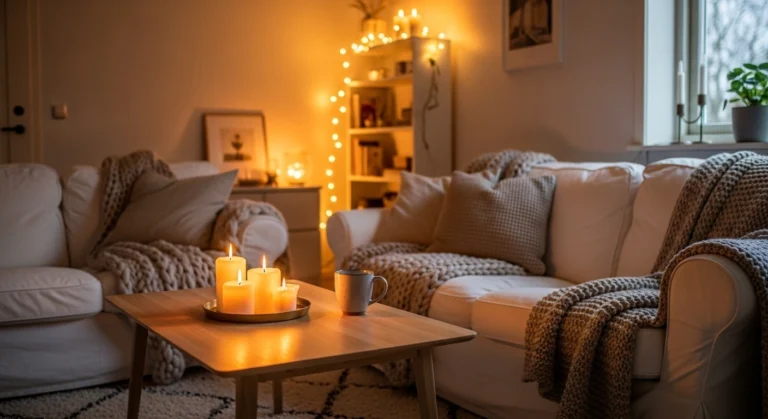
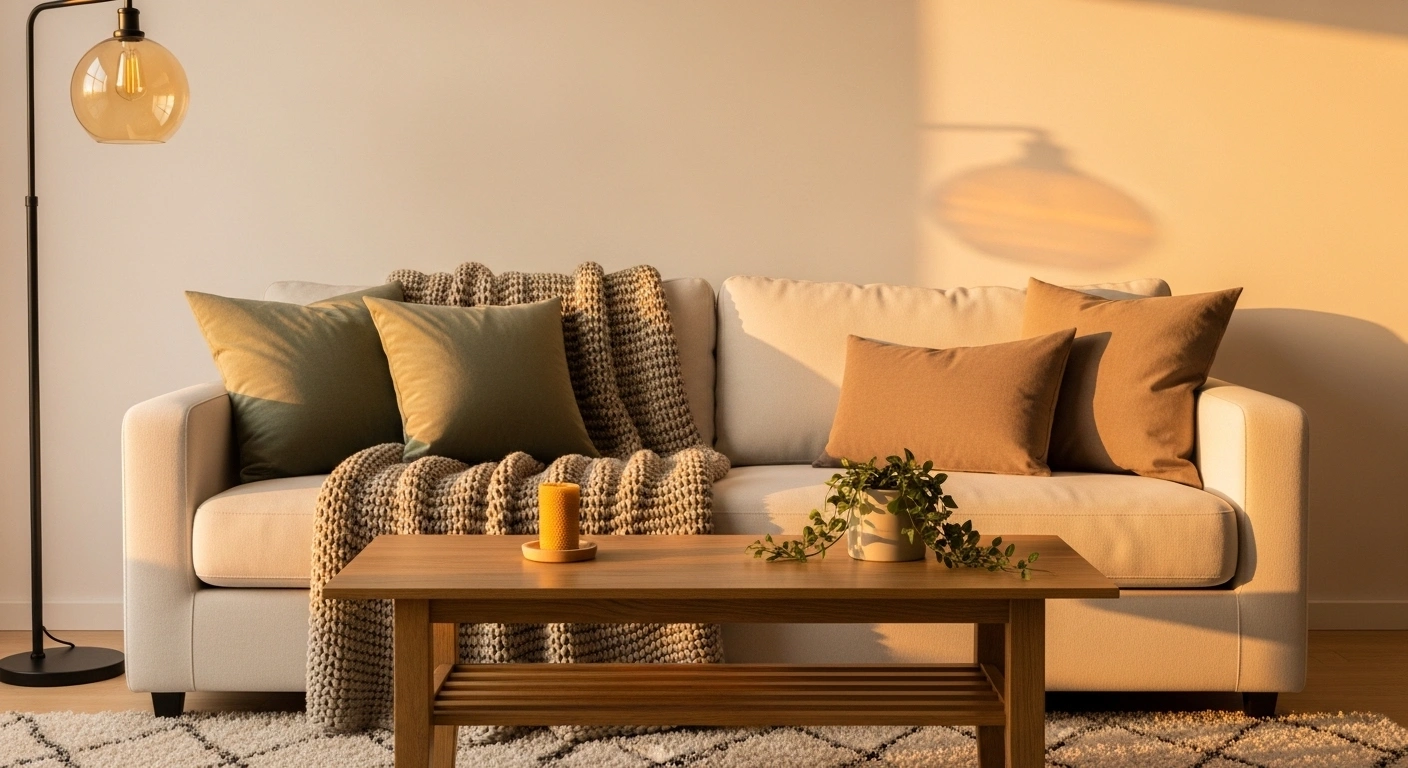
The three-layer lighting approach transforms living rooms more completely than any other single design strategy. Ambient lighting comes from floor lamps and table lamps positioned at eye level rather than overhead — a warm circle of light that doesn’t flood the entire room with uniform brightness. Task lighting handles practical needs like reading and working. Accent lighting from beeswax candles, fairy lights draped along a bookshelf, and a Himalayan salt lamp adds the final atmospheric depth layer that makes a room feel genuinely magical in the evening hours. Cozy peaceful living room aesthetic is built on this lighting architecture — the interplay of warm light sources at different heights and intensities creating a dimensional warmth that flat overhead lighting categorically cannot produce. Replace your living room’s overhead bulbs with 2700K warm LEDs this weekend and feel the difference within the first evening.
4. Bring in Natural Materials That Ground Your Body and Calm Your Mind
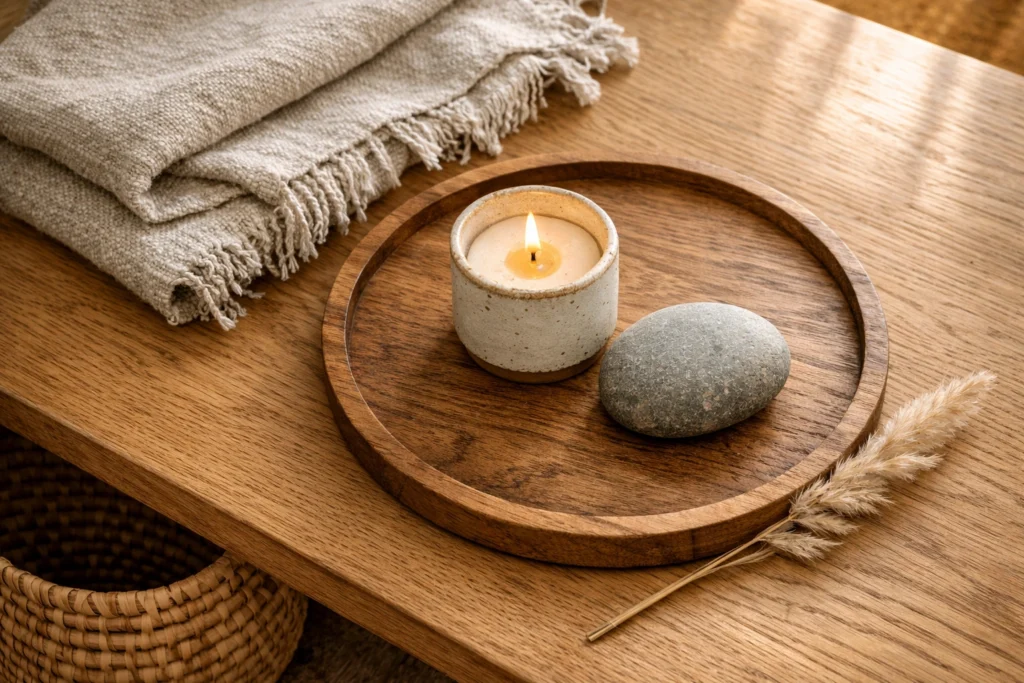
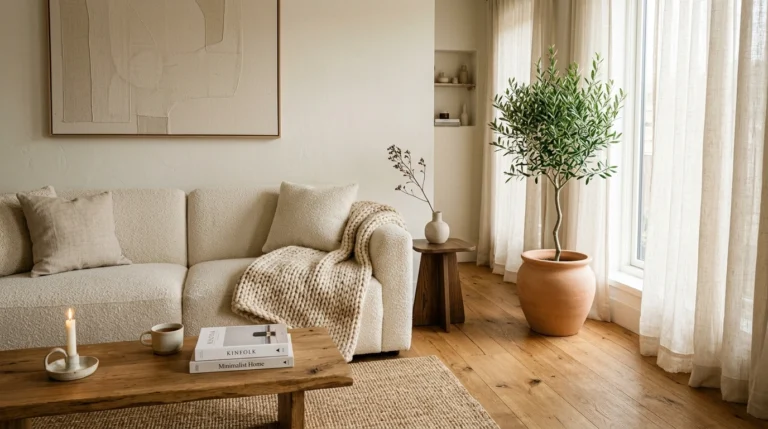
Biophilic design — the science-backed practice of connecting interior spaces to the natural world — explains why natural materials calm the nervous system in ways that synthetic alternatives simply cannot replicate. Humans evolved in environments made entirely of natural materials and the brain retains a deep recognition of and affinity for wood, stone, natural fiber, and organic texture that no manufactured substitute triggers. How to style a peaceful living room with natural materials means making deliberate choices at every material touchpoint in the room — the rug underfoot, the table surface, the basket in the corner, the throw on the sofa. Nature inspired living room decor doesn’t require expensive furniture replacement. A wooden tray on the coffee table, a jute rug replacing a synthetic one, a rattan basket holding blankets, a linen throw replacing polyester — each swap shifts the room’s sensory register measurably toward calm.
Earthy peaceful living room design built on natural materials also benefits from the practical longevity of those materials. Solid wood furniture ages beautifully. Linen softens with every wash. Wool rugs resist staining and bounce back from compression. Rattan weathers use with increasing character. The hidden dividend of natural materials is that they make rooms feel more expensive and more considered as they age rather than cheaper and more tired like synthetic alternatives. Thrift stores and estate sales supply magnificent natural wood pieces, woven baskets, and ceramic objects at a tiny fraction of retail cost making peaceful living room on a budget achievable through patient sourcing rather than expensive purchasing. Harmonious living room design ideas emerge naturally when natural materials from the same organic family share space — the visual coherence is built into the materials themselves.
5. Layer Soft Textures That Make Your Living Room Feel Safe and Inviting

Texture is the living room’s secret emotional language. Before you touch a single object in a room, your eyes register texture and your nervous system makes immediate comfort assessments based entirely on what it sees. A room filled with hard, flat, shiny surfaces reads as cold and unwelcoming regardless of its color scheme or furniture quality. What textures make a living room feel peaceful are consistently soft, layered, and varied — chunky knit throws, plush linen cushions, high-pile rugs, woven wall hangings, and velvet accent pieces working together to create what the Danes call hygge — a physical sense of enclosed, protected warmth. How to mix soft textures in a peaceful living room follows a simple formula: choose three to four textures from different material families and repeat them throughout the space in different scales and positions.
The practical texture layering formula starts with the floor — a natural fiber or wool rug provides the room’s tactile foundation. Layer a softer sheepskin or high-pile accent rug on top for immediate additional warmth. The sofa receives three to five cushions in mixed materials — smooth linen beside chunky knit beside velvet — in the room’s neutral palette. One generous throw draped naturally over the sofa arm completes the seating texture. Soft neutral living room design emerges from this process naturally — the neutral color palette creates cohesion while the varied textures prevent the space from feeling flat or one-dimensional. Tranquil living room styling built on layered soft textures consistently photographs better, feels better in person, and requires remarkably little financial investment given the dramatic impact it delivers. Target, IKEA, and HomeGoods all carry excellent texture options under $40 per piece.
6. Add Calming Plants That Breathe Life Into Your Peaceful Living Room
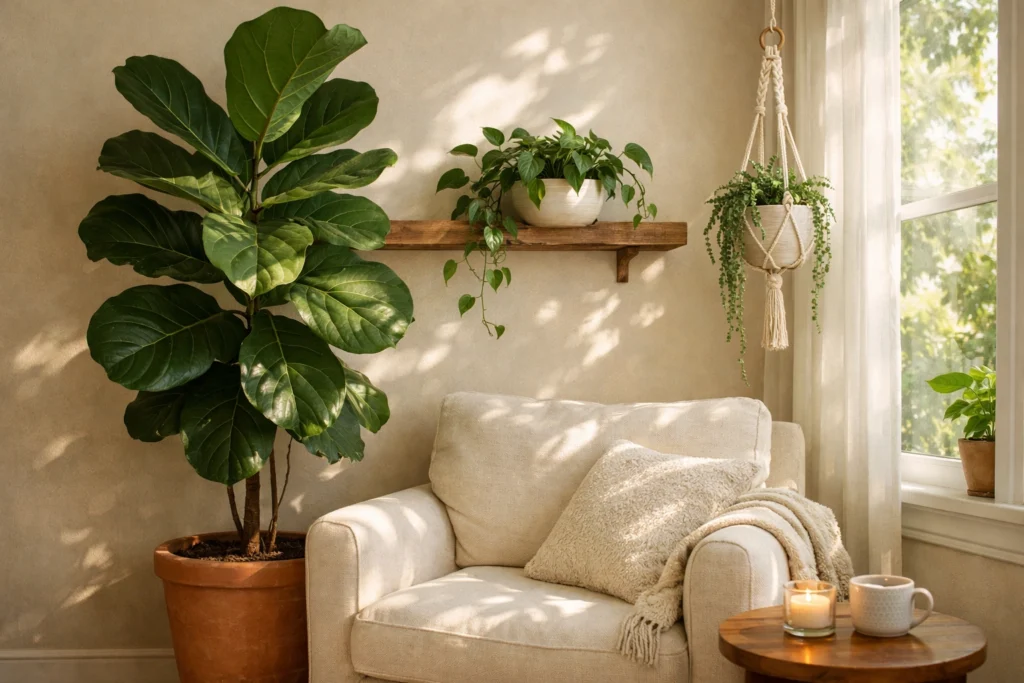
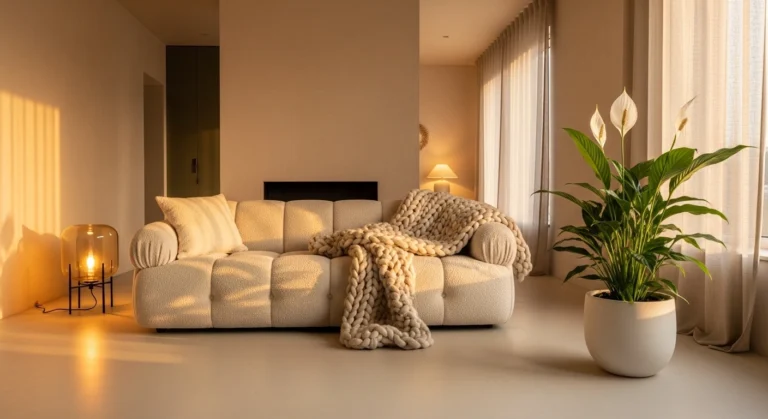
Plants do something no other decorative element can — they’re alive. They move. They grow. They respond to light and care in ways that create a genuine relationship between the living room and its inhabitants. Best plants for a peaceful living room share specific qualities: low maintenance demands, air-purifying properties, and visual softness that complements neutral palettes beautifully. The NASA Clean Air Study identified snake plants, pothos, peace lilies, and spider plants as among the most effective air-purifying indoor plants — removing formaldehyde, benzene, and carbon monoxide from indoor air measurably. Peaceful living room ideas on a budget built around plants deliver exceptional value — a $12 pothos in a $4 terracotta pot contributes more life and calm to a room than a $200 decorative object.
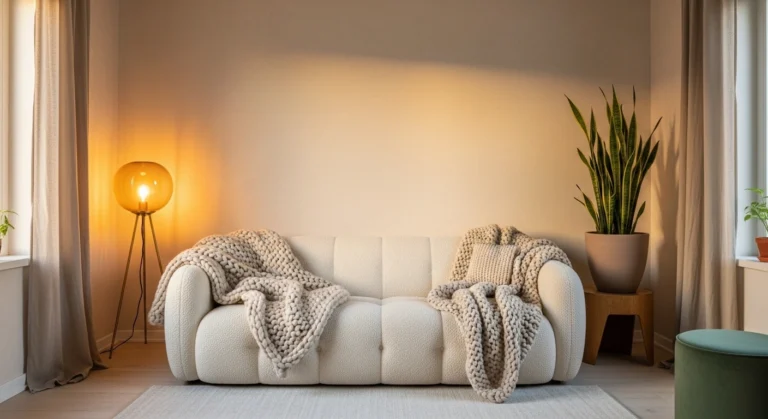
How to make a living room feel calm and serene through plants requires thinking in terms of scale, placement, and grouping rather than just acquiring individual specimens. A single large floor plant — a fiddle leaf fig, a monstera, or a tall snake plant — in a bare corner immediately gives that corner purpose, scale, and organic character. Grouping three smaller plants at different heights on a shelf creates a miniature living installation that draws the eye pleasantly. Trailing plants like pothos and string of pearls hung in macrame hangers add vertical dimension to walls that would otherwise feel flat and static. Quiet living room interior ideas that incorporate living plants consistently feel more human, more cared-for, and more genuinely restful than those without — a quality that photographs, guests, and daily occupants all register immediately and positively.
7. Declutter Intentionally To Create Visual Calm and Mental Clarity
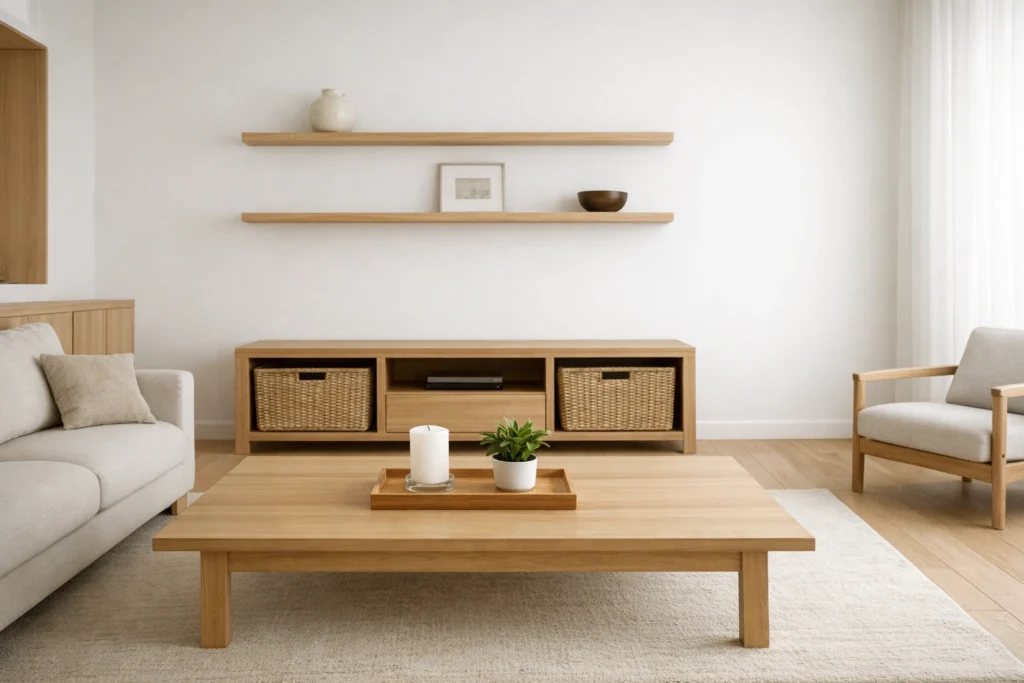
Clutter is physiologically expensive. Princeton University’s Neuroscience Institute published research demonstrating that physical objects in your visual field actively compete for your brain’s limited processing capacity — even objects you’re not consciously looking at. Every pile of magazines, every collection of remote controls, every decorative object purchased without clear purpose costs your nervous system a continuous micro-dose of cognitive energy. Minimalist peaceful living room design addresses this directly by creating visual silence — surfaces so clear and intentional that the eyes rest rather than scan. How to make a small living room feel peaceful relies almost entirely on decluttering because spatial calm comes from what’s absent as much as what’s present. The one-surface-at-a-time declutter method works best — spend 15 focused minutes on one surface or area daily rather than attempting a comprehensive overhaul that exhausts the motivation before it’s complete.
The one-in-one-out rule sustains the simple peaceful living room decor standard once you’ve established it. Every new object that enters the living room requires one existing object to leave — a discipline that forces genuine evaluation of each item’s worth and prevents the gradual re-accumulation of clutter that defeats most decluttering efforts within weeks. Beautiful woven storage baskets handle the practical reality of everyday objects — remote controls, phone chargers, children’s small items — while maintaining the visual calm that defines a mindful living room decor style. Zen living room design ideas from Japanese interior philosophy consistently emphasize ma — the concept of negative space as an active aesthetic element rather than simply an absence of objects. Apply that principle to your living room and the result is a space that feels genuinely luxurious without adding a single new purchase.
8. Create a Cozy Rest Corner That Your Nervous System Loves
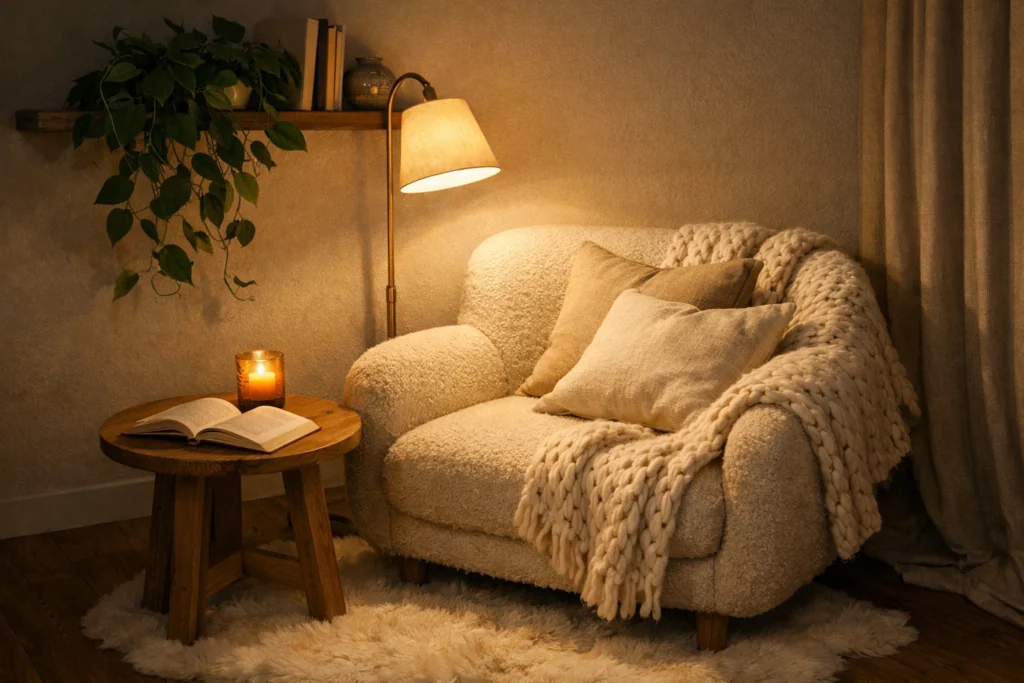
Every peaceful living room needs one intentional rest corner — a dedicated physical pocket of calm that silently grants permission to every person who enters to slow down, decompress, and simply exist without purpose or productivity. How to add warmth to a peaceful living room through a rest corner requires only four elements: a comfortable seat, warm light, a small side table, and a throw within reach. An armchair angled slightly away from the television and toward a window or plant creates a completely different relationship with the room’s space — one that prioritizes rest over entertainment in a way the nervous system immediately recognizes and responds to. Cozy peaceful living room aesthetic corners built this way become the most-used spot in the entire home within days of creation because they serve a need that most modern living rooms never consciously address.
Best rugs for a peaceful living room rest corner anchor the space with warmth and tactile invitation — a sheepskin or high-pile wool rug beneath the armchair creates a defined cozy zone that feels intentionally separate from the rest of the room. Add a small wooden side table for a candle and a mug. A floor lamp positioned at the perfect reading height completes the functional setup. A trailing plant on a nearby shelf adds living energy to the corner without demanding attention. The total cost of a well-built rest corner using Amazon, thrift store, and IKEA combinations runs under $100 in most cases — a remarkable return on investment for something that delivers daily nervous system restoration. Soothing living room decor tips almost universally point to the dedicated rest corner as the single highest-impact addition to any living room redesign.
Final Thoughts — How To Keep Your Living Room Feeling Peaceful Every Day
Seven strategies. Each one affordable. Each one backed by genuine research and real human experience. Together they build something that no single purchase or trend can manufacture — a living room that actively restores rather than passively exists. Peaceful living room interior design isn’t achieved in a single weekend overhaul and then maintained effortlessly forever. It requires small daily habits that protect the calm environment you’ve intentionally created. Five minutes of surface clearing each evening. Switching overhead lights off at a consistent time. Returning throws to their designated place. Keeping the rest corner clear and accessible. These micro-habits compound into a living room that feels reliably peaceful day after day rather than only immediately after a major cleaning session.
Choose one strategy from this guide and implement it fully this weekend before moving to the next. Peaceful living room decor built one intentional layer at a time feels permanent in a way that wholesale room makeovers rarely achieve. Start with lighting if you want the fastest result — swap one overhead bulb for a warm floor lamp tonight and feel the difference by this evening. Start with decluttering if visual chaos is the dominant problem — clear one surface and experience the immediate psychological relief that follows. Relaxing living room interior design is less about acquiring the right objects and more about creating the right conditions for your nervous system to exhale. Your living room can be that place every single day. It starts with one small intentional choice made right now.