
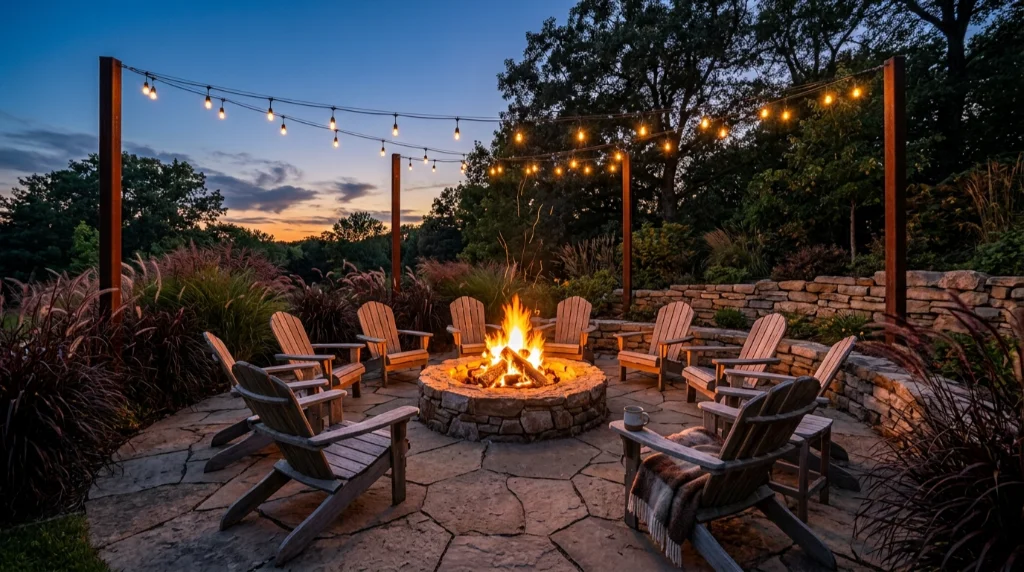
17 Fire Pit Landscaping Ideas to Create a Cozy Backyard Gathering Spot
A backyard without a fire pit is just a yard. Add the right fire pit with intentional landscaping around it and suddenly the space becomes somewhere people actually want to be — at 10pm on a Tuesday, in October, when no rational person would otherwise step outside. Fire pit landscaping ideas are one of the highest-return outdoor investments an American homeowner can make. Not just aesthetically but functionally, socially and even financially. Studies consistently show that well-designed outdoor living areas add significant property value and fire pit zones rank among the most desired features in buyer surveys. This guide covers every style, every budget and every backyard challenge with genuine depth.
The Backyard Moment That Changes Everything Begins With the Right Fire Pit Zone
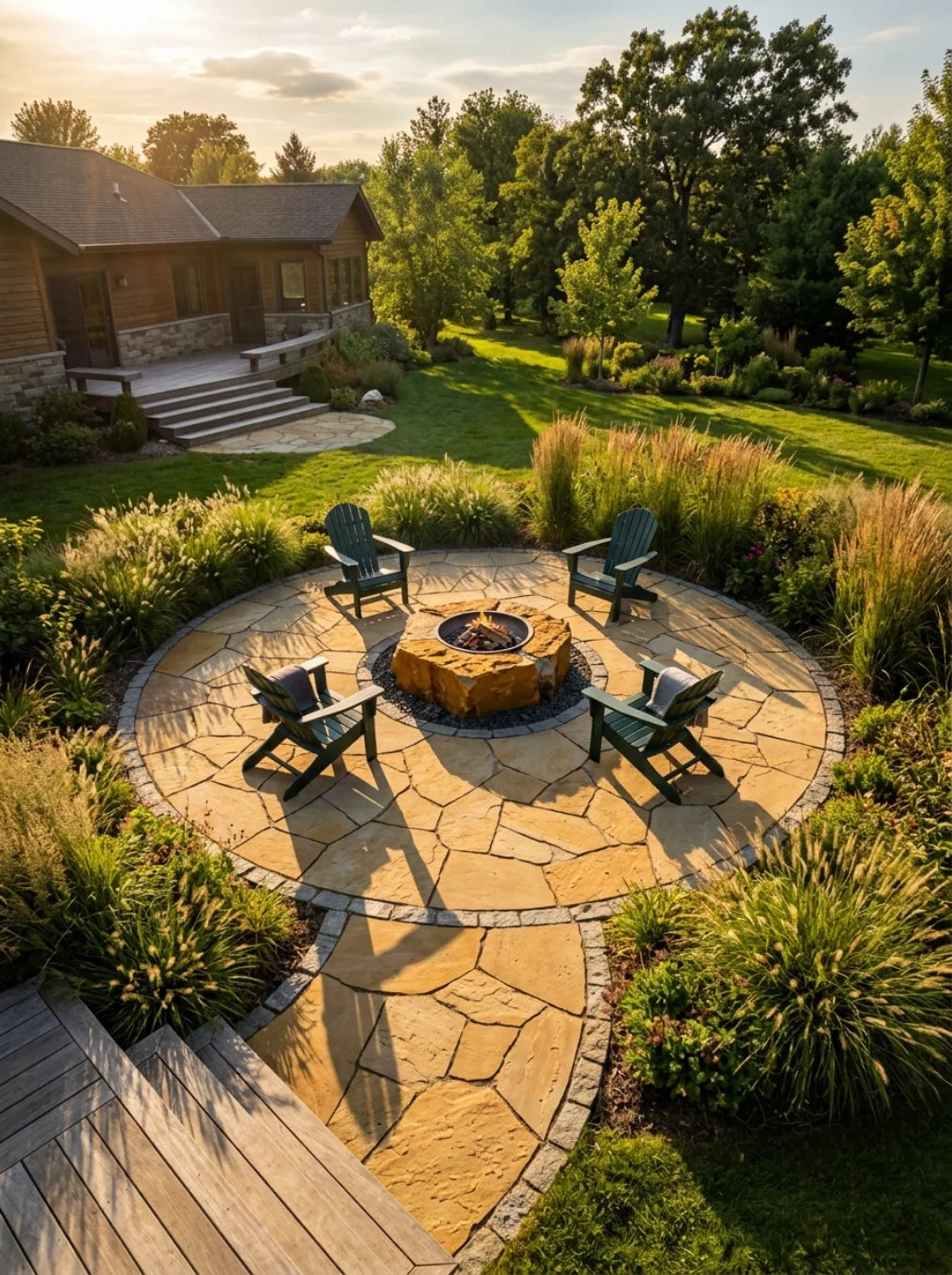
The first decision in any fire pit landscaping design isn’t which stone to use or which plants to place — it’s where the fire pit lives and how it relates to everything around it. Placement drives everything else. A fire pit positioned too close to the house creates safety concerns. Too far from the back door and nobody uses it because the walk feels like a commitment rather than an invitation. Backyard gathering area concept design starts with understanding how people actually move through the yard and where they naturally want to gather.
Outdoor living space design ideas built around fire pit zones should account for wind direction, existing utility lines, drainage patterns and the relationship between the fire feature and the home’s primary indoor living areas. Most landscape architects recommend positioning the fire pit 10 to 15 feet from the house at minimum — with seating arranged so guests face the fire and their backs face either a privacy feature or a pleasant secondary view. Fire feature garden design executed with this spatial awareness creates zones that feel purposely designed rather than accidentally assembled.
Fire Pit Landscaping Ideas Built Around Natural Stone and Raw Earthen Beauty
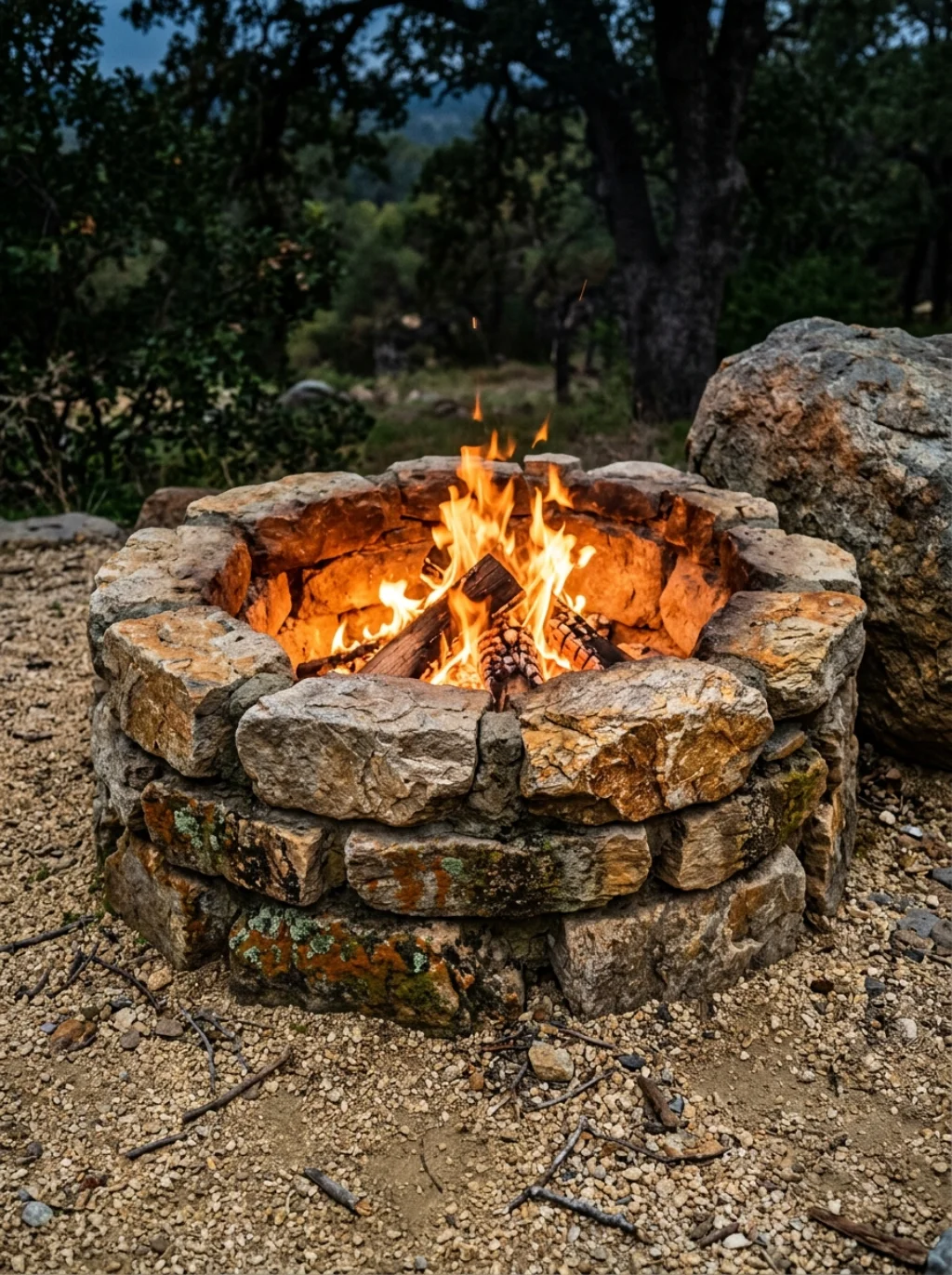
Fire pit stone landscaping ideas draw from one of the oldest and most visually satisfying design languages available — raw natural stone carries a visual authority that manufactured materials simply cannot replicate. Natural stone outdoor design ideas around a fire pit communicate permanence, craftsmanship and a connection to the earth that composite and plastic alternatives consistently fail to achieve. Fieldstone, limestone, slate and bluestone each bring distinct texture, color and character that suits different regional landscapes.
Fire pit landscaping ideas with stone work best when the stone selected appears elsewhere in the property’s existing hardscape — matching the driveway’s edging stone or the front walkway material creates visual coherence that makes the fire pit zone feel integrated rather than added as an afterthought. Backyard focal point design using natural stone as the primary material creates what designers call a material anchor — a visual and tactile foundation that grounds every other element in the landscape. The stone’s natural variation in color and texture also means no two installations look identical.
Circular Paver Designs That Create a Fire Pit Zone With Genuine Architectural Weight
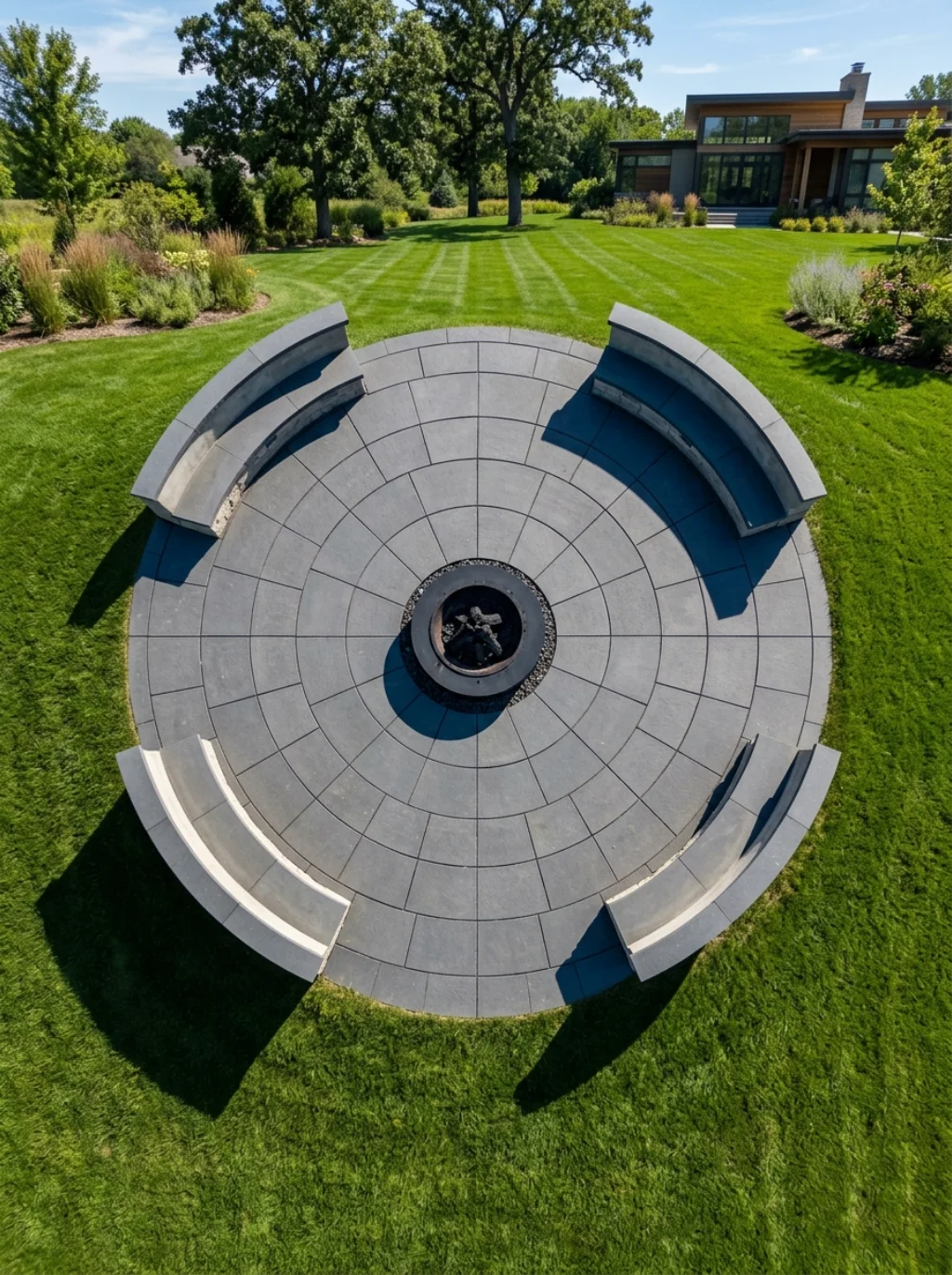
Fire pit circular paver design creates the clearest spatial definition available in outdoor landscaping — a circle drawn in pavers around the fire pit communicates exactly where the gathering zone begins and ends, creating a room without walls in the most elegant possible way. Fire pit landscaping ideas circular layouts position the fire pit at the geometric center and extend the paver radius to at least 8 feet in all directions — enough space for comfortable seating clearance and safe ember management.
Fire pit area paver design material selection significantly affects both the look and the longevity of the installation. Concrete pavers offer the widest color and texture range at the most accessible price point. Tumbled natural stone pavers provide the aged organic look that suits rustic and cottage-style gardens. Flagstone set in a circular pattern creates an irregular, artisanal quality that the perfectly aligned brick cannot match. Regardless of material, ensure a 2-inch compacted gravel base beneath the paver installation for drainage and frost stability in northern climates.
| Paver Material | Cost Per Sq Ft | Durability | Best Style |
|---|---|---|---|
| Concrete Pavers | $3 to $8 | High | Modern, Contemporary |
| Natural Flagstone | $8 to $20 | Very High | Rustic, Cottage |
| Tumbled Brick | $4 to $10 | High | Traditional, Farmhouse |
| Bluestone | $10 to $25 | Very High | Modern, Formal |
| Crushed Limestone | $1 to $3 | Medium | Casual, Budget |
Gravel and Decomposed Granite Grounds That Anchor Every Fire Pit Space Perfectly
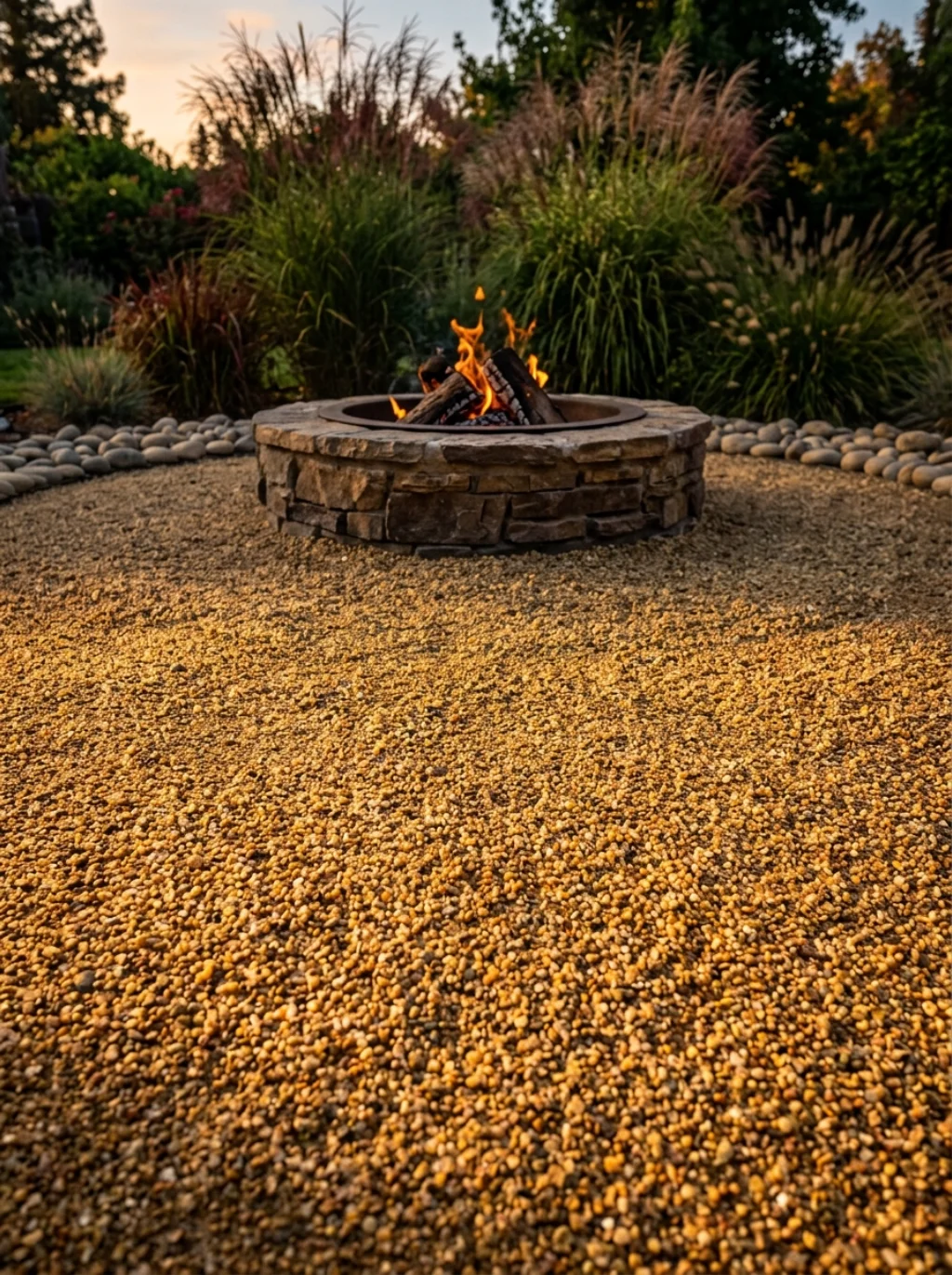
Landscaping around fire pit gravel is one of the most practical and visually effective approaches available — gravel and decomposed granite are fire-safe, permeable, weed-suppressing and low-maintenance in ways that wood chips, mulch and organic ground covers are not. Fire pit gravel area ideas work particularly well in arid and Mediterranean climate zones where the warm golden tones of decomposed granite harmonize naturally with drought-adapted plants and the ambient color palette of dry summer landscapes.
Fire pit mulch landscape design is explicitly not recommended within the immediate fire zone — organic mulch presents a combustion risk that gravel eliminates entirely. A 6-foot diameter of gravel or decomposed granite immediately surrounding the fire pit creates a fire-safe zone that also serves as a visual transition between the hard surface and the planted perimeter. Backyard ambiance design ideas using river rock as a secondary gravel layer — larger stones creating a decorative edging ring around the inner decomposed granite field — add textural interest and clear visual definition to the fire zone’s boundary.
Retaining Walls That Solve Slopes and Create Drama in the Same Stroke
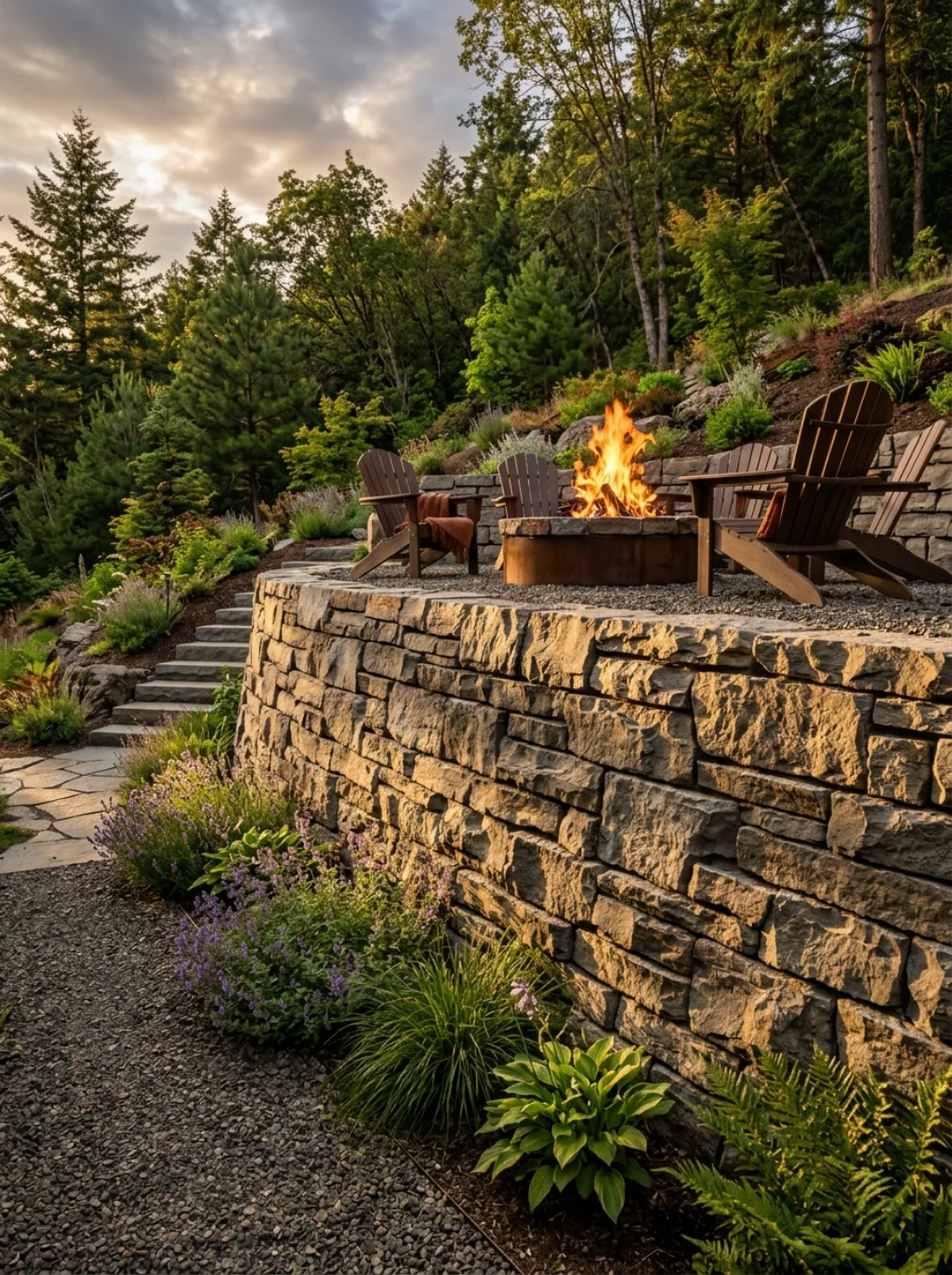
Fire pit retaining wall landscape design solves one of the most common backyard challenges — the sloped yard that makes level outdoor living areas feel impossible. A terraced landscape with a retaining wall creating a level fire pit platform on an otherwise unusable slope transforms a liability into one of the most dramatic and distinctive landscape features available. Fire pit slope landscaping using retaining wall terracing adds architectural structure to yards that flat landscapes simply cannot achieve.
Fire pit landscaping ideas with retaining wall construction should use materials consistent with the fire pit structure itself — a stone fire pit surrounded by a matching stone retaining wall creates material unity that looks intentional and resolved. Retaining wall heights above 4 feet typically require engineered design and permits in most American municipalities so plan accordingly. Fire pit landscaping ideas on a slope that incorporate tiered retaining wall terracing also create natural seating opportunities — the wall cap serves as casual extra seating when adirondack chairs are already full during a larger gathering.
Fire Pit Landscaping Ideas That Make Privacy Feel Like a Design Feature
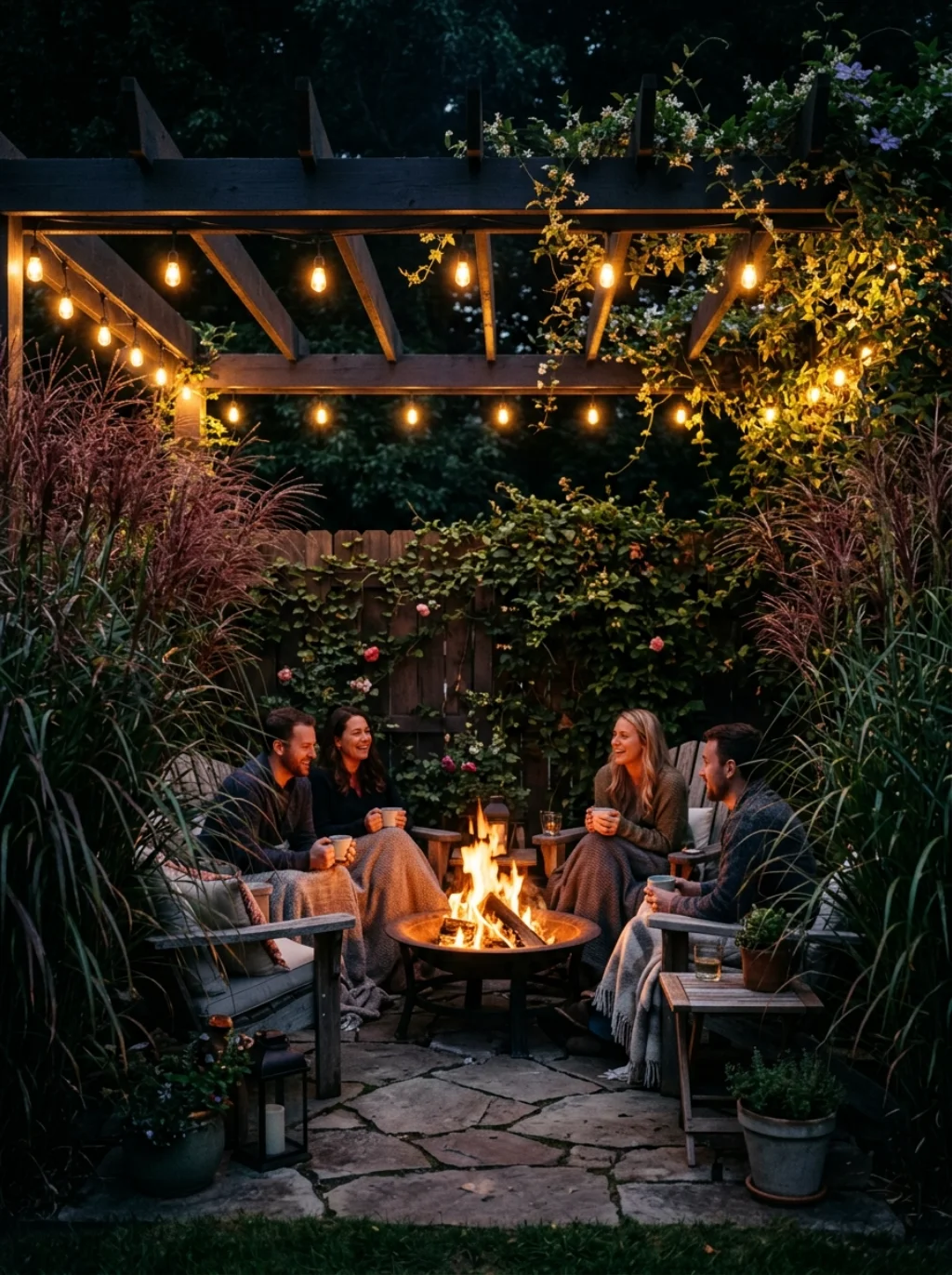
Fire pit privacy landscape design transforms the functional need for screening into an aesthetic opportunity — plants, fencing, pergolas and boulders positioned around the fire pit perimeter can create an intimate enclosed atmosphere that increases the sense of destination and refuge without making the space feel confined. Fire pit landscaping ideas privacy approaches that use living plant screens are almost always preferable to hard fencing because plants soften the enclosure and create beauty that fence panels cannot provide.
Fire pit privacy landscaping concept executed with ornamental grasses creates particularly dynamic privacy screening — tall grasses like Miscanthus, Karl Foerster or switchgrass move in the wind, filter rather than block the view and provide four-season visual interest that deciduous shrubs cannot match. A pergola positioned behind or adjacent to the fire pit adds overhead definition and creates an attachment point for string lights and climbing plants that amplify the privacy enclosure’s beauty significantly. Fire pit landscaping ideas privacy using a combination of a privacy fence structure with planted foundation beds at its base creates layered depth that solid fencing alone lacks.
Seating Walls That Replace Chairs and Give the Fire Pit Area Real Structure
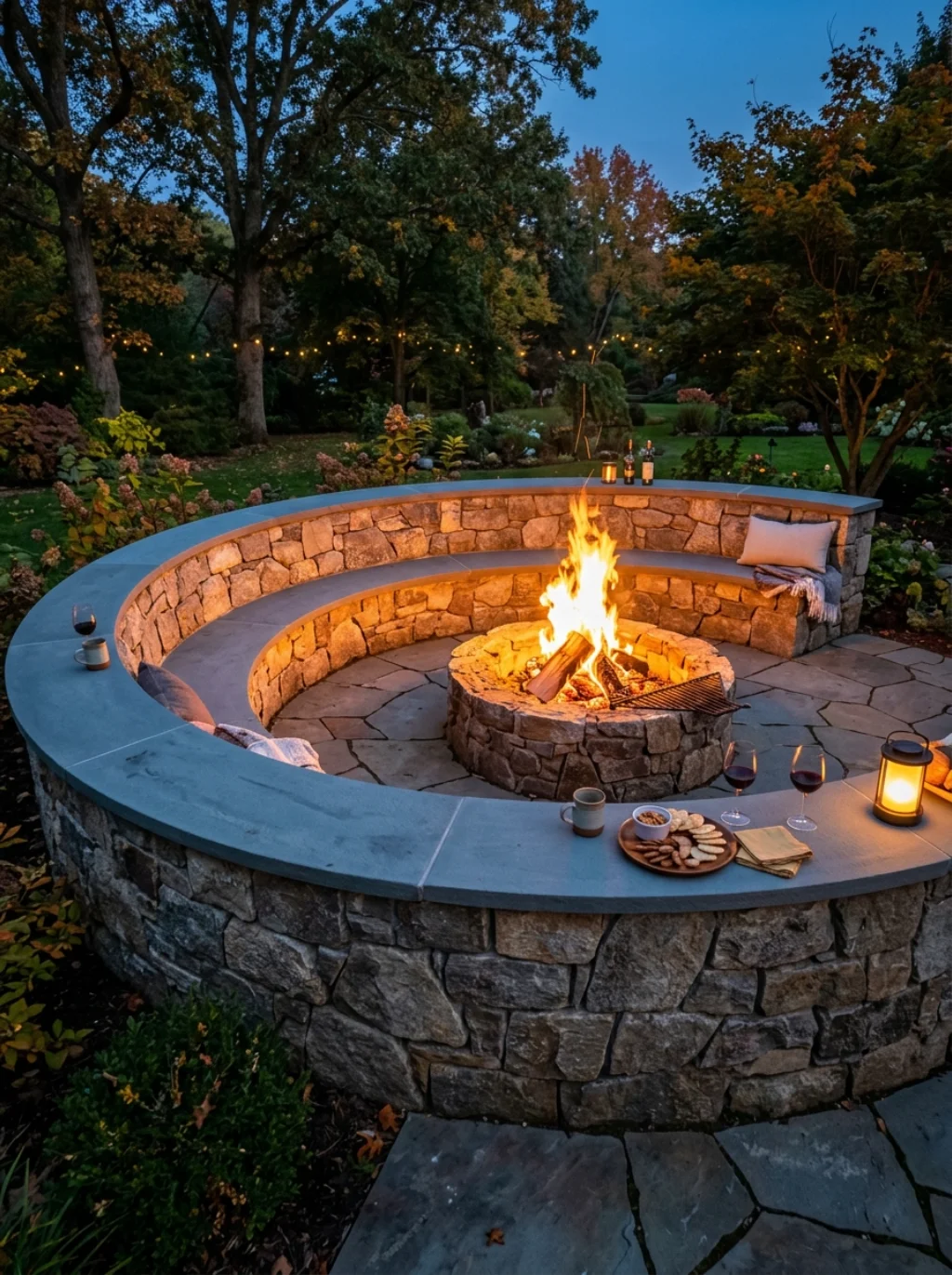
Fire pit seating landscape ideas reach their most architecturally refined expression in the built-in seating wall — a permanent low masonry wall surrounding part or all of the fire pit perimeter that provides seating without the visual clutter and storage demands of outdoor furniture. Seating wall construction typically ranges from 18 to 22 inches in height with a 12 to 14-inch cap depth — dimensions calibrated for comfortable adult seating without back support, similar to a dining bench height.
you may also like this: 17 Spring Patio Ideas to Transform Your Outdoor Space This Season
Backyard gathering area concept design using a seating wall around the fire pit zone creates generous seating capacity that moveable adirondack chairs cannot match — a 20-foot diameter circular seating wall accommodates 12 to 15 seated adults comfortably. The wall’s interior face toward the fire also reflects radiant heat back toward occupants in cool weather, creating a warmer microclimate within the fire zone. Cap the seating wall with flagstone, smooth concrete pavers or bull-nosed brick for a finished surface that protects the wall structure from water infiltration and provides a comfortable seat surface.
Plants and Ornamental Grasses That Soften Hard Edges Around Any Fire Feature
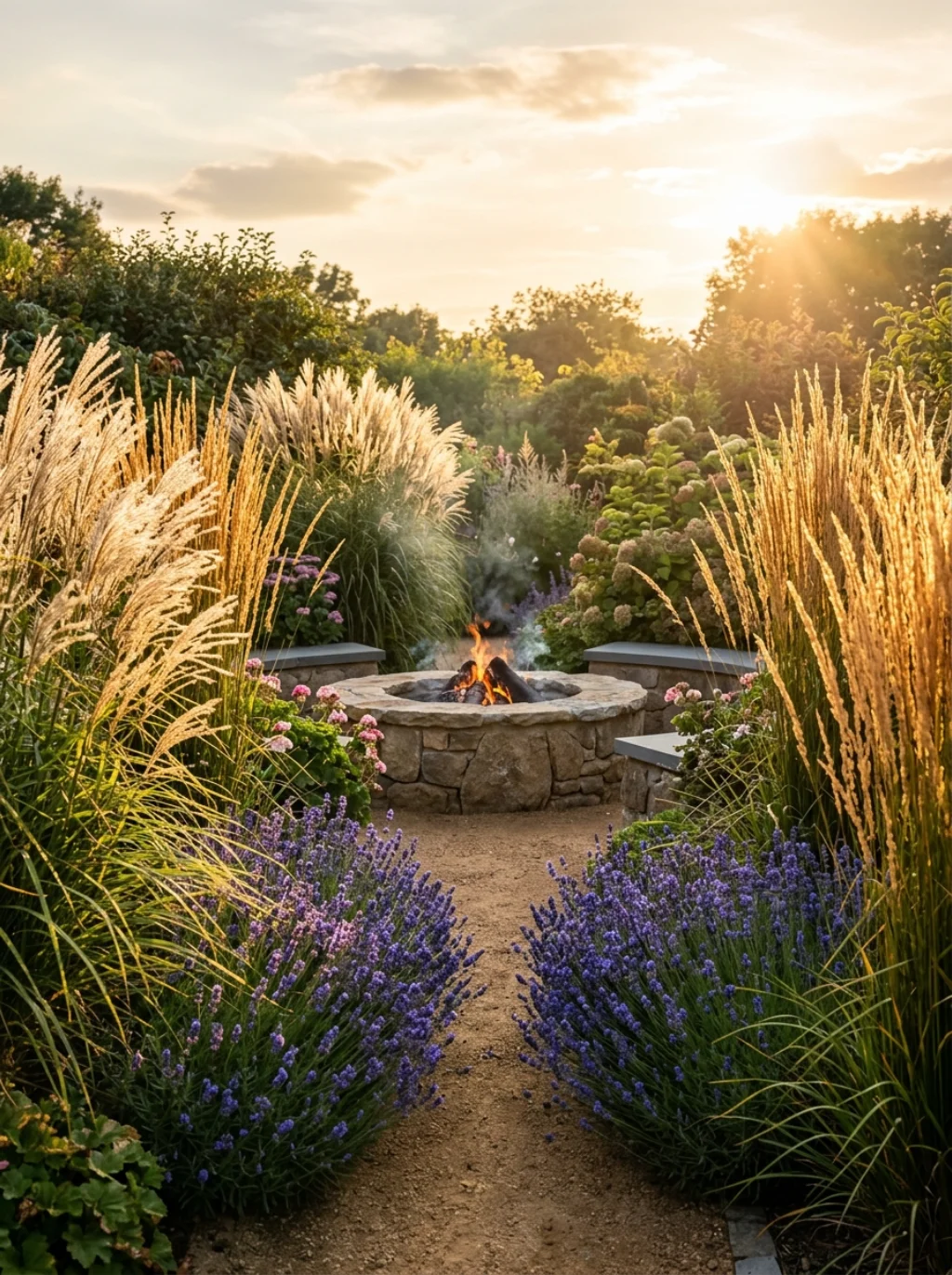
Fire pit landscaping plants selection requires balancing aesthetic ambition with genuine fire safety awareness — plants positioned within 6 feet of an active fire pit should be drought-tolerant, low-resin and inherently fire-resistant species rather than highly flammable conifers or aromatic herbs with volatile oil content. Fire pit with plants ideas that succeed long-term choose plants for their perimeter positioning rather than their proximity to the flame.
Fire pit ornamental grass landscape design uses tall grasses at the outer perimeter — 8 feet or more from the fire pit — where their movement and texture add drama without creating combustion risk. Lavender at the mid-distance creates fragrance that drifts through the gathering space on warm evenings while its dense woody base resists ignition. Drought tolerant plants like agave, sedum, Russian sage and catmint suit the dry conditions that gravel ground cover creates around fire pit zones while providing seasonal color and pollinator value. Hardscape and softscape integration in fire pit landscaping works best when plant beds occupy the perimeter while the immediate zone remains in non-combustible hard materials.
Flagstone Paths and Stepping Stones That Lead Guests Toward the Flame
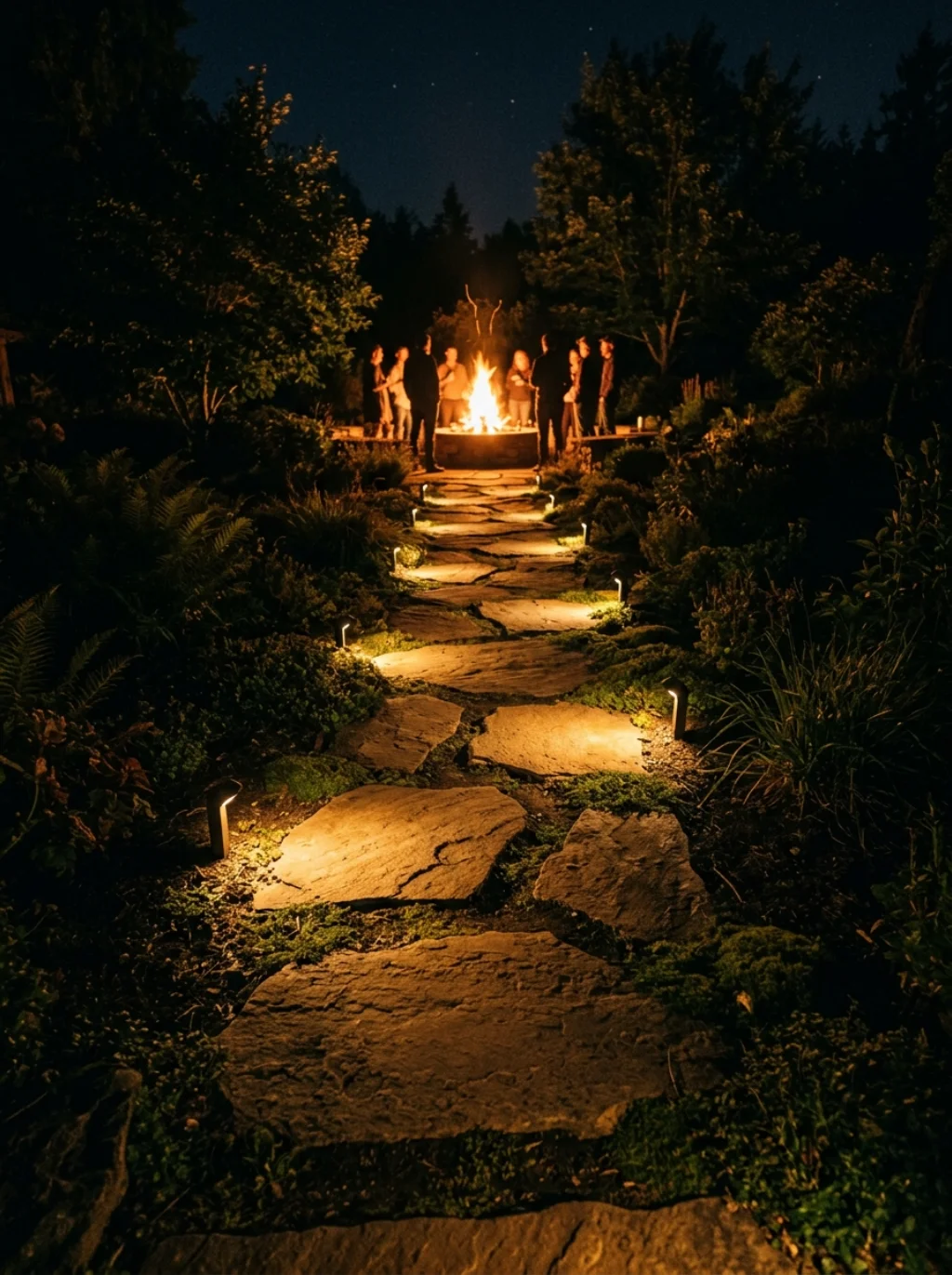
Fire pit flagstone landscaping creates more than a surface — it creates a journey. A flagstone path leading from the back door to the fire pit zone turns a simple walk across the yard into a small ritual of arrival that heightens the destination feeling of the fire pit space. Flagstone set in irregular patterns suits cottage and rustic garden styles while precision-cut flagstone in uniform sizes suits contemporary and formal landscape designs.
Fire pit with flagstone pathway design should account for the path width and material relationship to the fire pit circle. A pathway that terminates in a circular paver design — the stepping stones transitioning to the fire pit circular paver design — creates a satisfying compositional resolution that makes the whole landscape feel planned from entry to destination. Fire pit landscaping ideas with flagstone using ground cover plants like creeping thyme, moss or Irish moss planted in the joints between stones creates a softening effect that integrates the hard path material into the surrounding planted landscape beautifully.
String Lights Outdoor Lanterns and Layered Lighting That Extend Every Fire Night
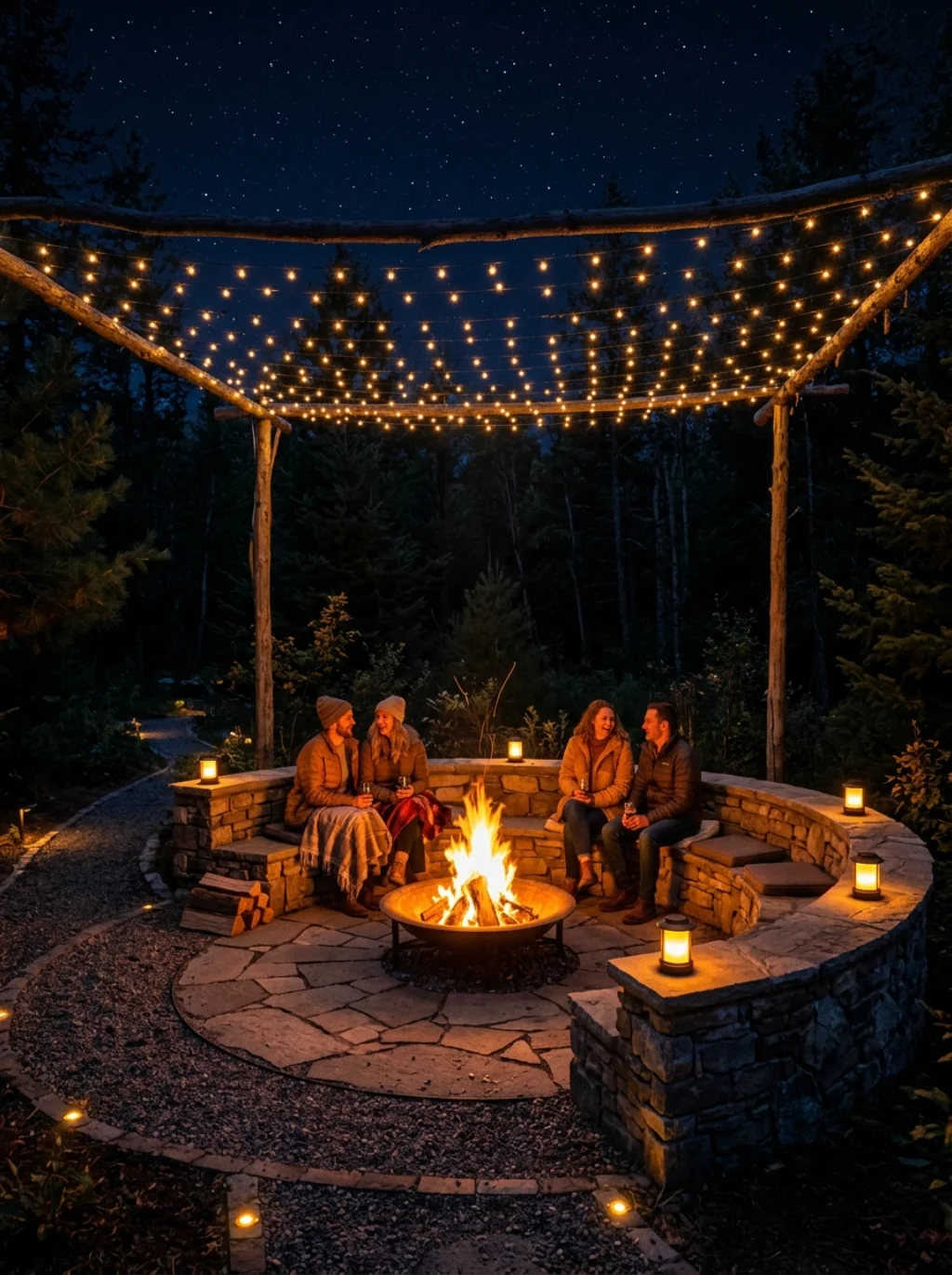
Fire pit lighting landscape ideas extend the functional use of the fire pit zone beyond sunset in ways that dramatically increase the return on the landscape investment — a beautifully designed fire pit area that can only be used in daylight delivers a fraction of the social value of a space that performs equally well at 11pm. String lights suspended above the fire pit zone from a pergola structure or between landscape timber posts create the overhead ambient glow that makes outdoor spaces feel inhabited and festive simultaneously.
Evening ambiance backyard design using layered lighting sources follows the same principle as interior lighting design — multiple light sources at different heights and intensities create depth that single-source illumination cannot achieve. Outdoor lighting at the seating wall cap level creates seat surface visibility without the harsh overhead brightness that makes evening gatherings uncomfortable. Path lighting along the flagstone approach adds safety and beauty simultaneously. Fire pit landscaping ideas with lighting that combine string lights overhead, seated-level lanterns and path lighting create evening environments of extraordinary atmosphere at surprisingly modest cost.
Small Backyard Fire Pit Landscaping Ideas That Maximize Every Square Foot
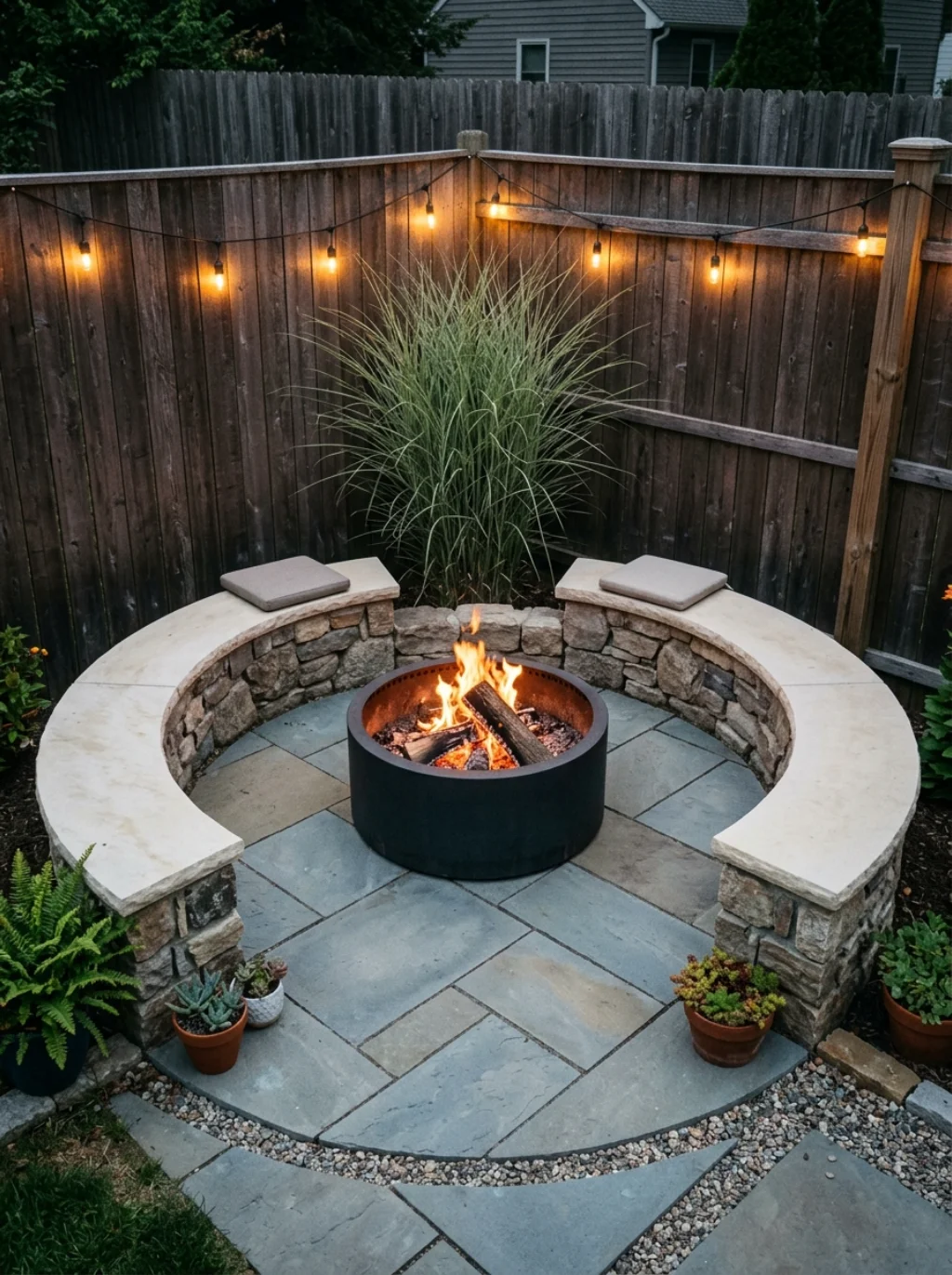
Fire pit small backyard landscape design demands spatial efficiency that larger suburban yards don’t require — every element must earn its place and the fire pit itself must be scaled appropriately to the available area. Fire pit landscaping ideas small backyard typically call for a 36-inch diameter fire pit rather than the 48 to 60-inch versions suited to larger spaces — the smaller unit creates adequate warmth and ambiance while preserving the seating clearance that safety and comfort both require.
Fire pit landscaping ideas for small spaces use the corner position strategically — a fire pit corner ideas approach positions the fire feature in the yard’s corner and arranges seating in an arc facing outward, which maximizes usable seating area while minimizing the fire pit zone’s footprint. Fire pit small backyard landscape design also benefits from eliminating the traditional circular paver pad in favor of a simpler square or rectangular hardscape that fits more naturally into rectilinear small yards. Outdoor lounge area design concept for small spaces uses built-in seating wall rather than adirondack chairs to eliminate furniture storage demands and visual clutter.
Raised Fire Pit Platforms That Elevate the Entire Outdoor Experience Literally
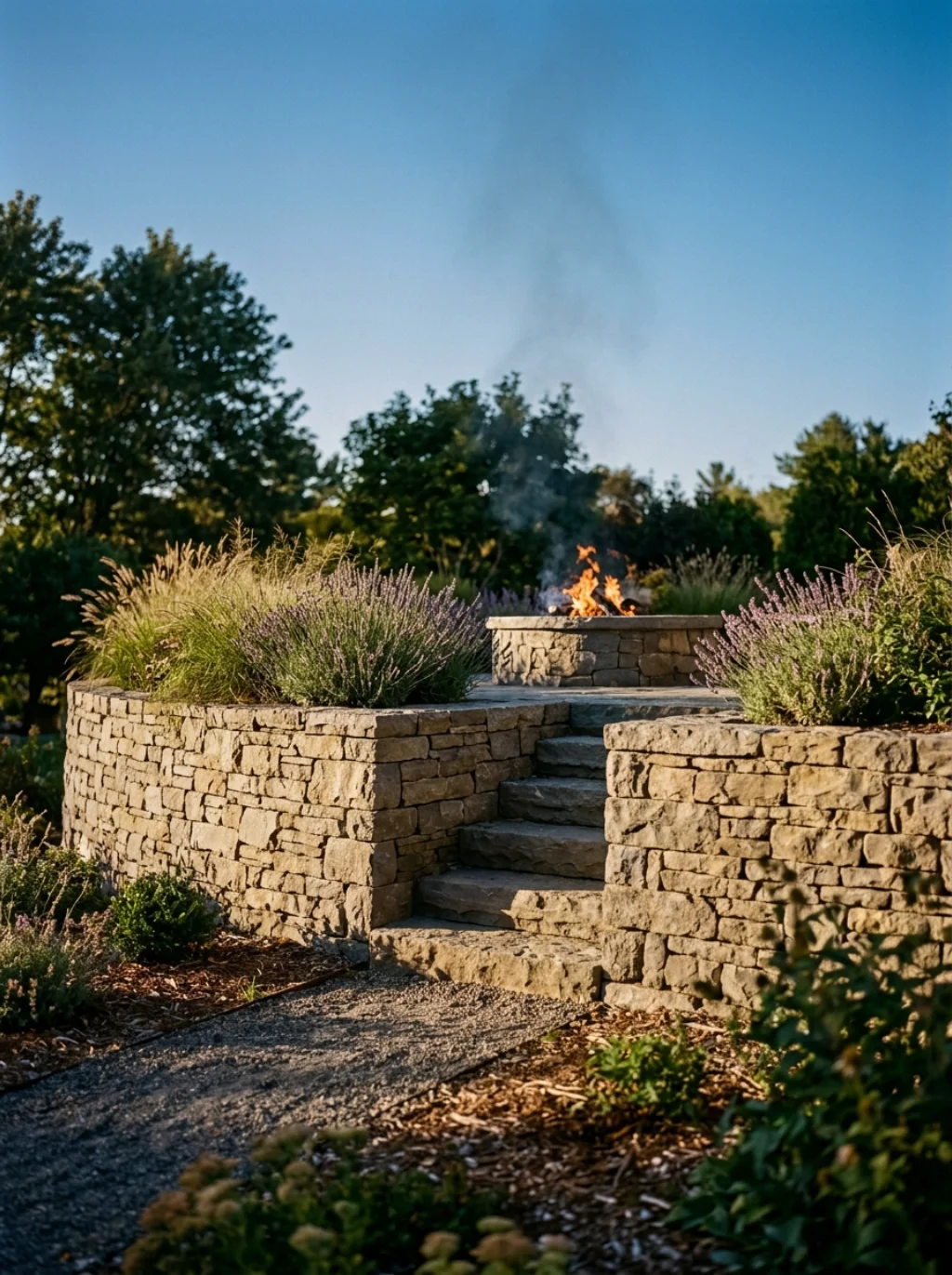
Fire pit raised platform landscape design creates one of the most dramatic transformations available in residential landscaping — elevating the fire pit zone above the surrounding grade creates a stage-like quality that makes the space feel definitively special. Raised fire pit platform design using natural stone, landscape timbers or concrete pavers as the platform material adds architectural interest to flat yards that would otherwise read as undifferentiated lawn.
Fire pit landscaping ideas with raised garden beds incorporated into the platform perimeter creates the most complete raised landscape composition — the raised garden bed forms both a planting opportunity and a visual frame for the elevated fire zone. Platform heights between 18 and 30 inches create the most usable elevation — high enough to create visual distinction but accessible without steps for most users. Fire pit slope landscaping on gentle grades often achieves a natural raised platform effect through selective grading rather than built construction — cutting into the slope on one side and filling on the other creates a level platform that integrates organically with the existing topography.
Low Maintenance Landscaping Around Fire Pits That Actually Stays Beautiful
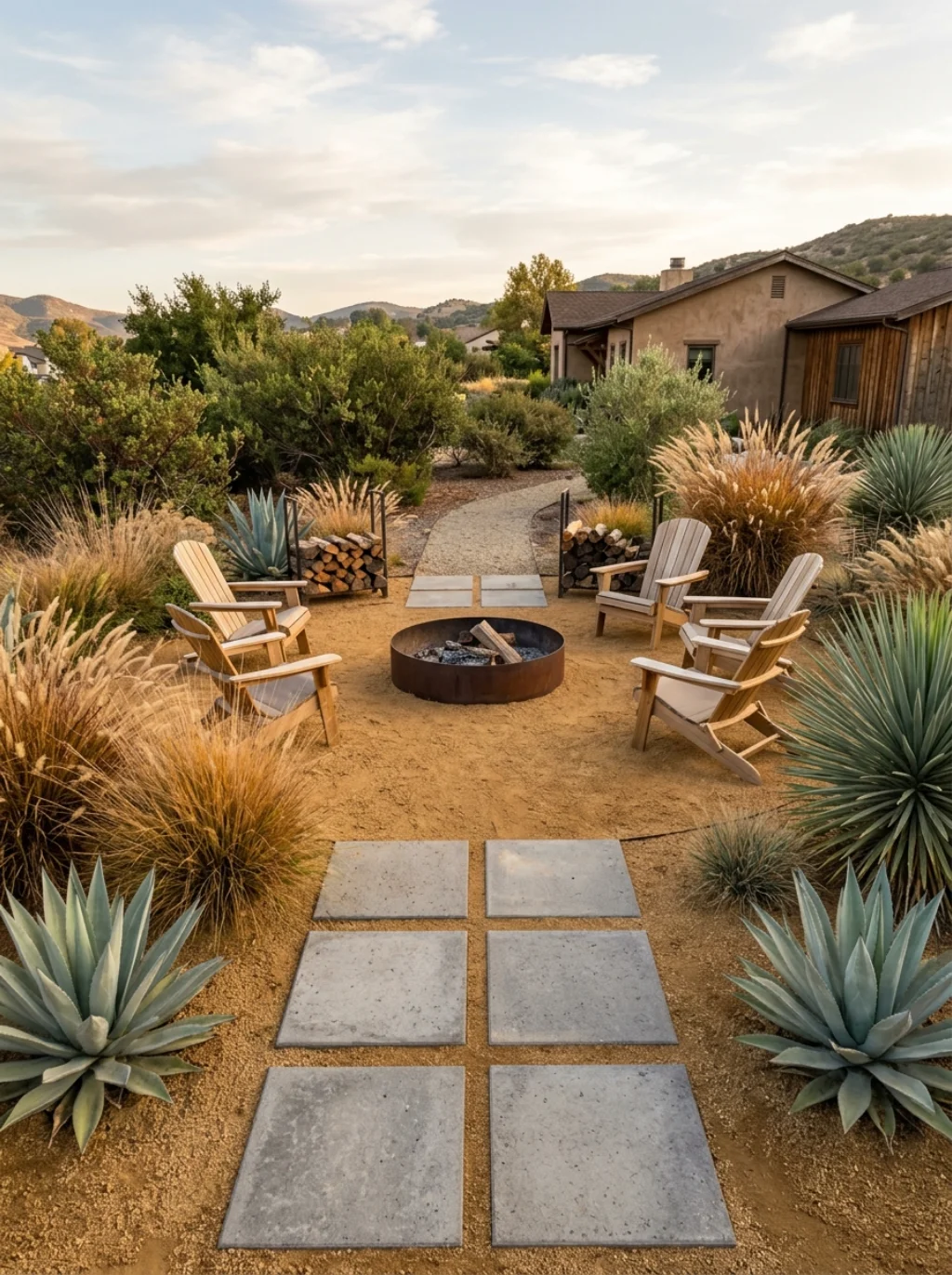
Fire pit low maintenance landscape design starts with an honest assessment of how much time the homeowner will realistically invest in ongoing maintenance — because the most beautiful high-maintenance landscape that never gets maintained quickly becomes the most disheveled space in the yard. Low maintenance fire pit area design relies on decomposed granite or gravel ground covers rather than planted ground covers, drought tolerant plants rather than thirsty perennials and concrete pavers rather than flagstone with planted joints.
Fire pit landscaping ideas with low maintenance plants selection should prioritize species that require no deadheading, minimal pruning and irrigation that a drip system can handle without human intervention. Ornamental grasses rank consistently as the highest-performing low-maintenance plants in fire pit perimeter applications — they require a single annual cutback in late winter and provide dramatic vertical interest, movement and four-season presence for all other months. Drought tolerant plants like agave, yucca and native wildflowers suit hot summer climates where fire pit use naturally coincides with drought conditions that would stress water-demanding plant selections.
Rustic Fire Pit Landscaping That Feels Wild Warm and Completely Intentional
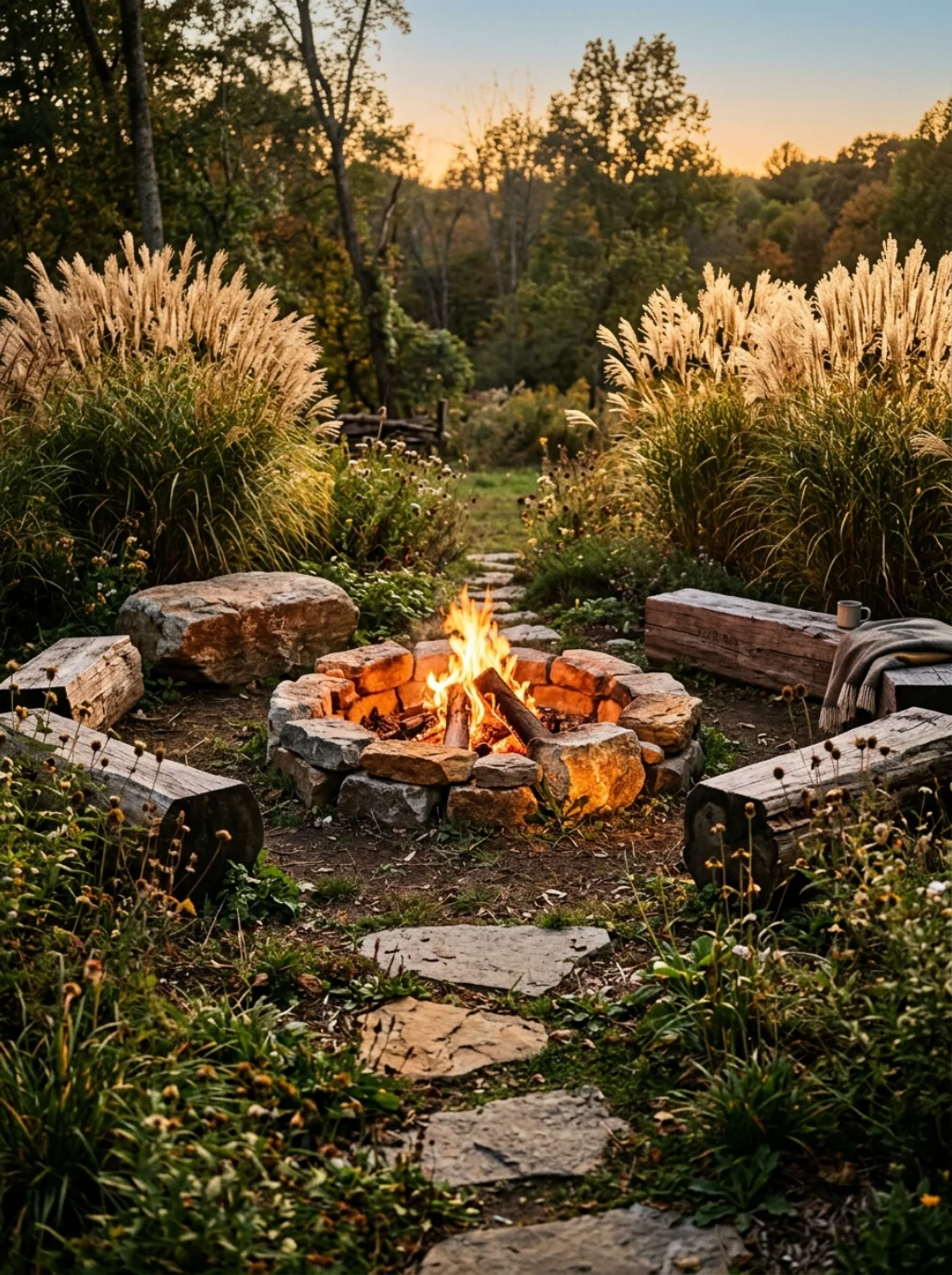
Fire pit rustic landscape design creates an environment that looks like it belongs to the land rather than having been imposed upon it — rough-cut natural stone, irregular flagstone arrangements, reclaimed landscape timbers, boulders that appear to have always been there and plants that reference meadow and woodland rather than formal garden traditions. Fire pit landscaping ideas rustic appeal to homeowners who want their backyard fire space to feel like a campfire clearing that happened to be beautifully designed rather than a constructed landscape that happens to contain a campfire.
Fire pit surrounded by garden in the rustic tradition uses native plants, meadow grasses and naturalized flowering perennials at the perimeter rather than the clipped hedges and formal borders of traditional landscape design. Fire pit mulch area ideas with aged wood chip mulch rather than manufactured colored mulch suit the rustic aesthetic while providing functional weed suppression and soil moisture retention. Rustic fire pit landscaping that incorporates an existing tree as a canopy element — the fire pit positioned naturally beneath the tree’s spread with an appropriate clearance from the lowest branches — creates the most genuinely campfire-like atmosphere available in a residential backyard.
Modern Fire Pit Landscape Designs That Make Minimalism Look Dramatic
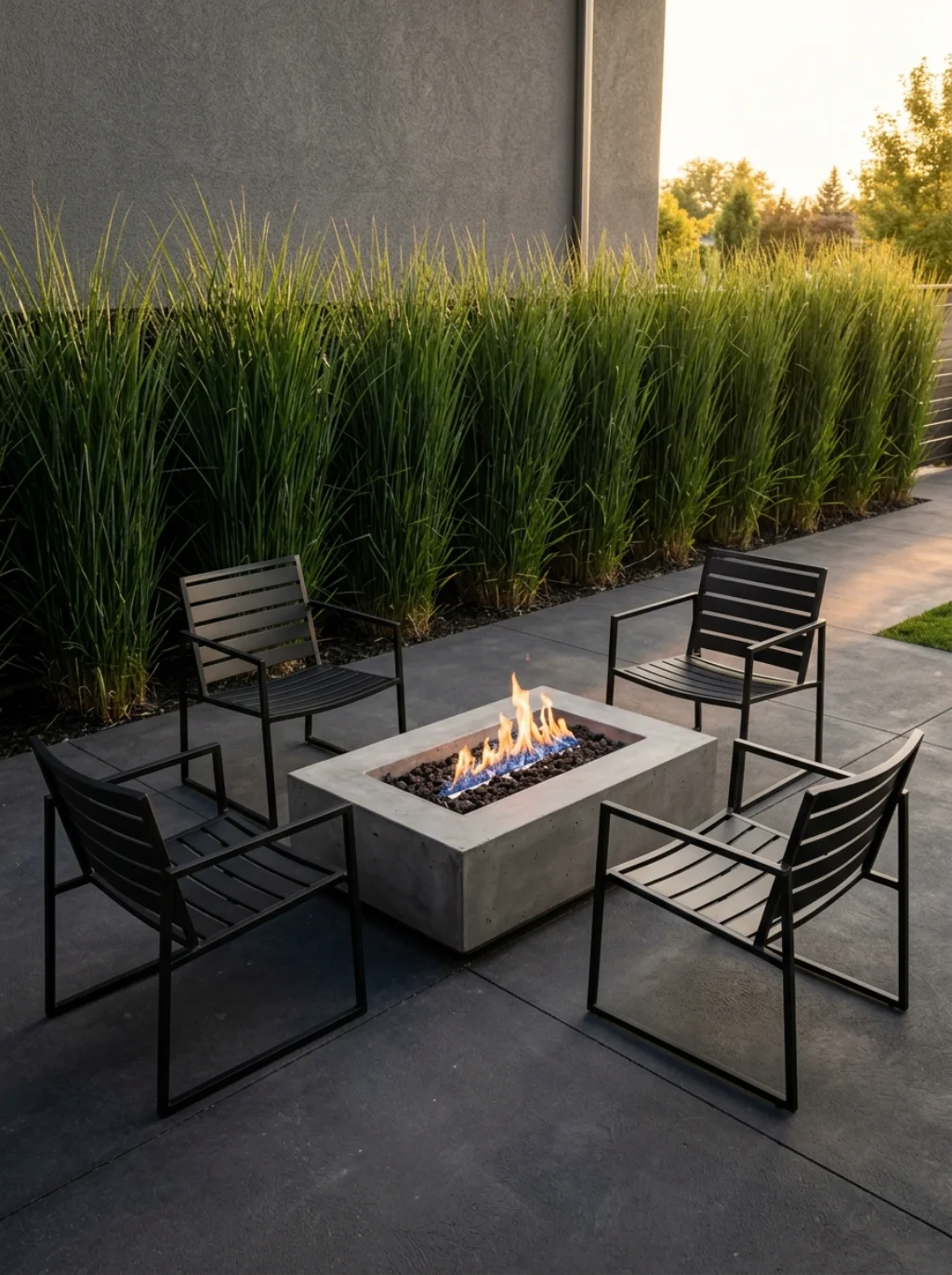
Fire pit modern landscape design operates on the principle that reduction creates power — fewer materials, cleaner lines, more deliberate negative space and a color palette of two or three tones maximum create contemporary fire pit landscapes of extraordinary visual authority. Fire pit landscaping ideas modern favor linear paver configurations over circular ones, gas fire features over wood-burning ones and architectural plants like agave, ornamental grass and boxwood over the romantic planting of cottage-style gardens.
Outdoor entertainment area landscaping in the modern register uses concrete pavers in large format sizes — 24-by-24 or 24-by-48 inch formats — laid in clean grid patterns that read as architectural floor extensions of the home’s interior aesthetic. Fire pit modern landscape design also benefits from the integration of outdoor furniture in powder-coated steel, concrete or composite materials that continue the material language of the paver and fire pit structure. Monochromatic color palettes — charcoal pavers, black steel fire pit, dark green architectural plants against a pale grey house exterior — create compositions of remarkable visual sophistication that photograph exceptionally well for the contemporary homeowner.
Budget Fire Pit Landscaping Ideas That Look Like a Professional Designed Them
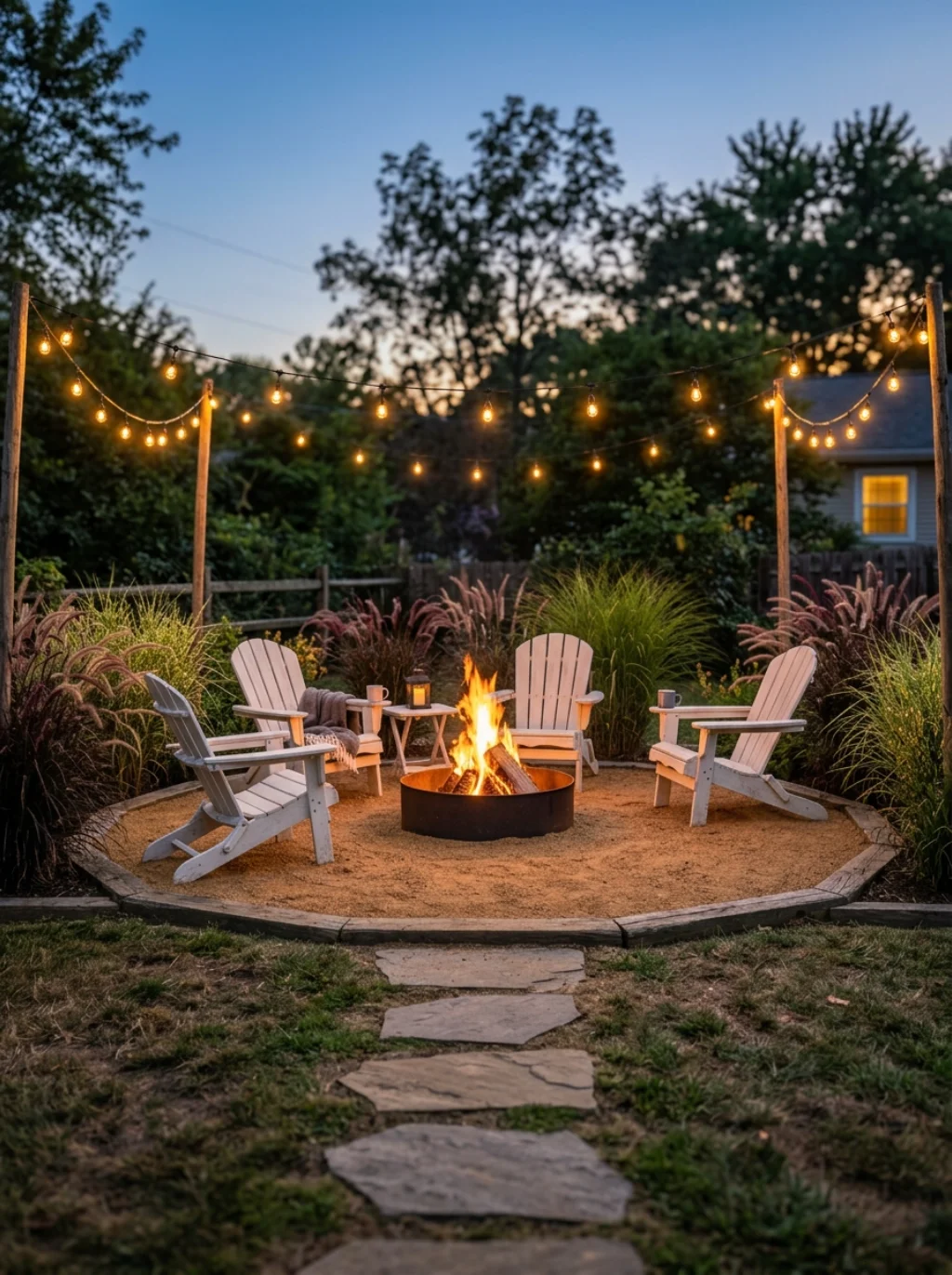
Fire pit landscaping budget ideas prove consistently that landscape atmosphere is determined more by spatial intelligence and material coordination than by material cost — a well-designed fire pit area using crushed limestone, a simple steel fire pit ring and a few well-placed ornamental grasses creates more atmosphere than an expensive installation assembled without compositional thought. Fire pit DIY landscaping design approaches that focus budget on the fire pit structure itself and use lower-cost materials for the surrounding landscape consistently produce better results than the reverse investment priority.
Fire pit landscaping budget ideas for backyard fire pit areas on strict budgets should prioritize in this sequence: the fire pit and its immediate non-combustible surround, the seating arrangement, the approach path and finally the planted perimeter. Fire pit DIY landscaping design using decomposed granite as the ground cover, landscape timbers as the edging material and adirondack chairs from a warehouse retailer creates a complete and functional fire pit landscape for under 500 dollars in most American markets. The planted perimeter can grow incrementally over subsequent seasons without diminishing the space’s immediate usability.
Water Features and Fire Pits Combined Into One Landscape Statement That Stuns
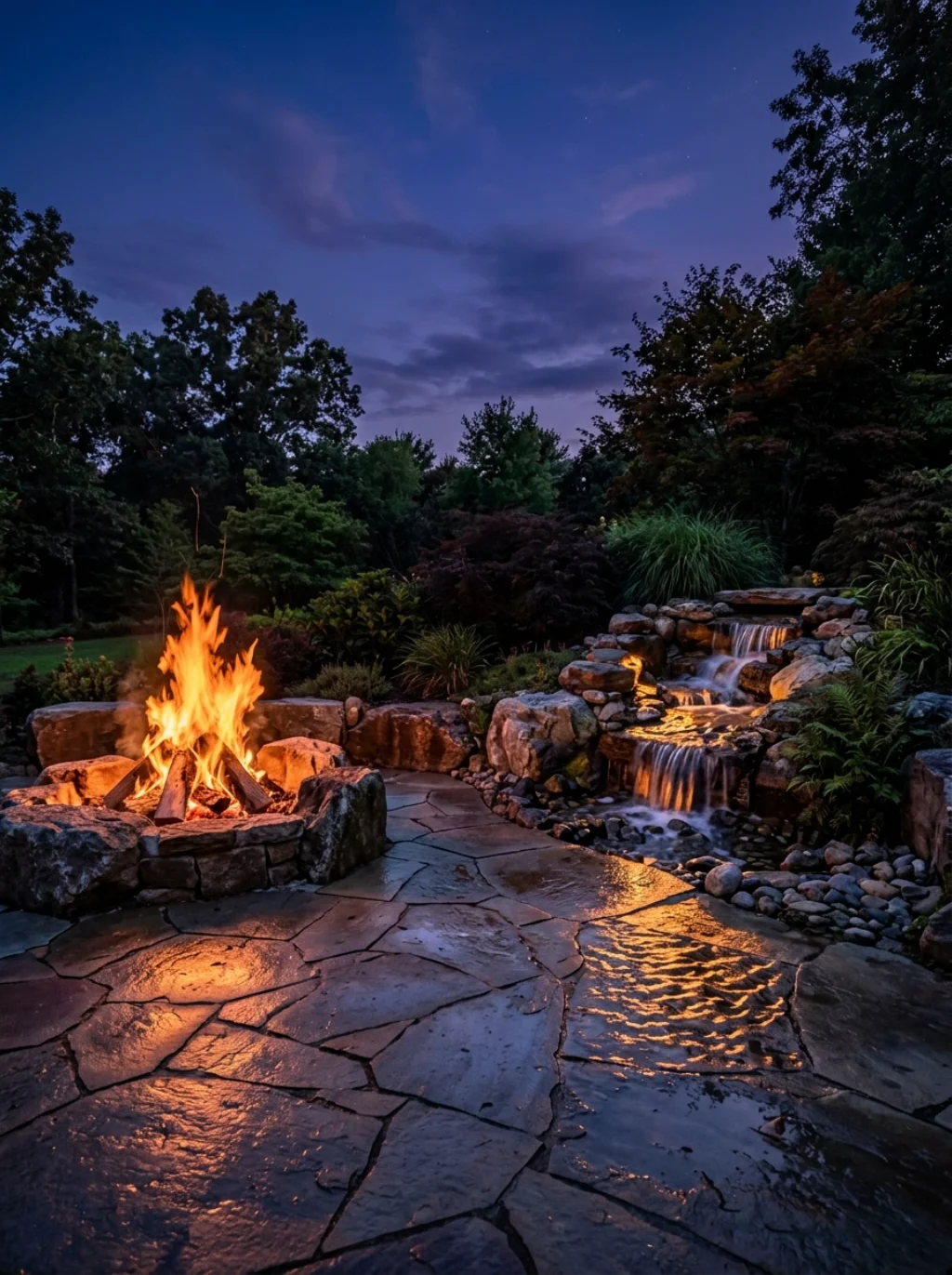
Fire pit water feature landscape combinations create one of outdoor design’s most striking contrasts — the primordial opposition of fire and water resolved into a single harmonious landscape composition. Fire pit water feature combination design positions a small recirculating water feature — a spillway, a pondless waterfall or a reflecting pool — at the landscape’s perimeter where its sound is audible from the fire pit seating but its spray cannot reach the fire zone. The combination of fire’s warmth and the sound of moving water creates a sensory environment of remarkable completeness.
Evening outdoor space design using fire and water combination landscaping creates a multi-sensory evening environment that single-element designs cannot match. The water feature’s reflective surface also captures and multiplies the fire’s ambient light, creating secondary visual interest across the larger landscape at night. Fire pit water feature landscape design requires careful hydraulic planning — the water feature pump needs access to power and the recirculation system should be positioned where maintenance access doesn’t require crossing the fire zone. Fire feature garden design at its most sophisticated uses the fire and water combination as the landscape’s dual focal points rather than treating one as primary and the other as supplementary.
Frequently Asked Questions
What should I put around a fire pit for landscaping?
Fire pit surroundings ideas that work best combine non-combustible ground cover immediately around the fire pit — gravel, decomposed granite, flagstone or concrete pavers — with planted perimeter beds at a safe distance. A seating wall or adirondack chairs arranged at 6 to 8 feet from the fire pit edge creates the seating zone. Outdoor lighting, string lights overhead and ornamental grasses or drought tolerant plants at the perimeter complete the fire pit landscaping design.
How far should plants be from a fire pit for safety?
Fire safety guidelines recommend keeping combustible plant material at least 6 feet from the fire pit edge and non-combustible hardscape materials in the immediate 3-foot radius. Fire pit landscaping ideas with plants that position highly resinous or aromatic species — conifers, rosemary, eucalyptus — at the outermost perimeter create the most fire-safe landscape. Fire safe landscaping design concept principles recommend lavender, ornamental grasses and succulent species in the mid-distance zone between 6 and 12 feet from the fire pit.
What is the best ground cover for a fire pit area?
Fire pit gravel area ideas consistently outperform organic ground covers in the immediate fire zone. Decomposed granite provides the best combination of fire safety, weed suppression, drainage and aesthetic integration. River rock and crushed limestone are strong alternatives. Fire pit mulch area ideas using organic mulch should reserve that material for planted beds beyond the 6-foot fire-safe zone rather than immediately around the fire pit structure.
Can I build a fire pit on a slope with landscaping?
Fire pit landscaping ideas on a slope are entirely achievable through retaining wall terracing that creates a level platform at the chosen elevation. Fire pit slope landscaping using dry-stacked natural stone retaining walls creates the most visually integrated solution in organic landscape styles. Fire pit retaining wall landscape design should account for drainage direction — water should route away from the fire pit zone rather than pooling on the level platform. Slopes steeper than 15 percent typically require professional engineering for structurally sound retaining wall installation.
What pavers work best for a fire pit landscaping design?
Fire pit landscaping ideas with pavers that prioritize durability should consider flagstone, bluestone or tumbled natural stone as the premium options. Concrete pavers provide excellent durability at lower cost with the widest range of colors and sizes. Fire pit area paver design for high-use fire pit areas should avoid glazed or polished surfaces that become slippery when wet. Fire pit with pavers ideas that use permeable joint materials between pavers — decomposed granite or polymeric sand — allow drainage that reduces puddle formation and frost heave.
Conclusion
A backyard with a thoughtfully designed fire pit zone becomes something more than outdoor space — it becomes the place where people choose to spend their time. Fire pit landscaping ideas implemented with attention to material quality, spatial proportion and seasonal performance create outdoor destinations that rival any interior room in the home for daily use hours. Whether you’re working with a 2000 square foot suburban backyard or a compact urban lot, a sloped hillside or a perfectly flat suburban rectangle, a generous budget or a disciplined one — the principles are consistent. Start with safe, intelligent placement. Build with durable non-combustible materials. Choose plants that earn their position at every season. Add light that extends the evening. Then light the fire and let the design do what it was always meant to do — bring people together in the most compelling outdoor room you’ll ever build.
One Comment