
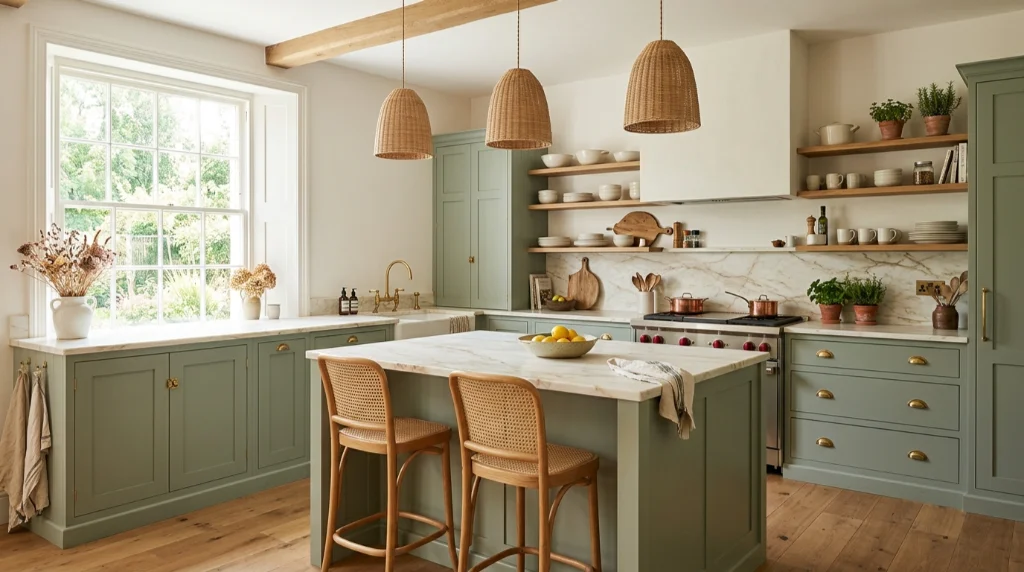
17 Green Kitchen Ideas to Create a Fresh and Stylish Space
Green has arrived in the American kitchen with the conviction of a color that knows exactly what it’s doing. After decades of white kitchen dominance, homeowners across the country are painting cabinets, tiling backsplashes, and selecting islands in every shade from whisper-soft sage to deep, saturated forest green. The shift isn’t arbitrary — it’s rooted in something real about how color affects the experience of being in a space. Green kitchens feel alive. They feel grounded. They bring the natural world indoors in a way that marble and chrome alone never manage. This guide covers every dimension of the green kitchen: the psychology behind why it works so well, the specific shade families and their distinct personalities, the material pairings that elevate each green into something extraordinary, and the practical decisions that determine whether your green kitchen looks expensive or merely brave.
The Color Psychology Behind Green Kitchens That Designers Swear By
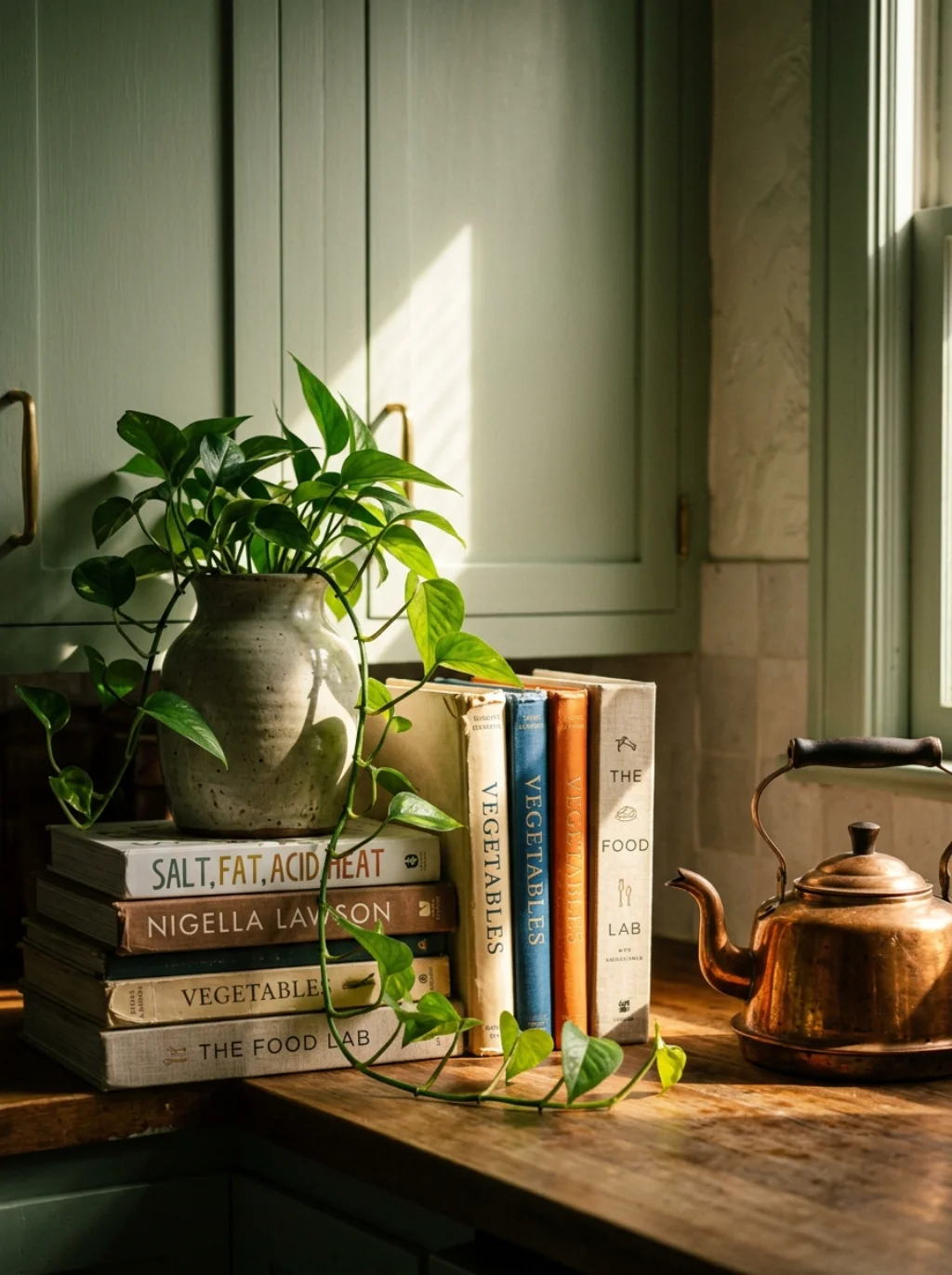
Color psychology in interior design isn’t pseudo-science — it’s a well-documented field with practical applications that experienced designers leverage every day. Green occupies a unique position in the color spectrum: it sits at the intersection of cool blue’s calming influence and warm yellow’s energizing quality, producing a perceptual experience that is simultaneously restful and stimulating. Nature inspired kitchen design consistently exploits this dual quality — green makes a kitchen feel active enough to cook in but calm enough to linger in afterward.
Biophilic kitchen design concepts built around green leverage the evolutionary human response to green environments — our nervous systems literally downregulate stress responses in the presence of green, a remnant of the association between green vegetation and safe, resource-rich environments. Kitchen cabinet color trends tracked by HGTV green kitchen designs and Architectural Digest green kitchens confirm that green adoption in American kitchens has accelerated consistently since 2019 because homeowners are explicitly seeking kitchens that feel restorative rather than merely functional. A kitchen you love spending time in is more valuable than one that merely photographs well.
Sage Green Kitchen Cabinets — the Shade That Conquered Every Design Feed
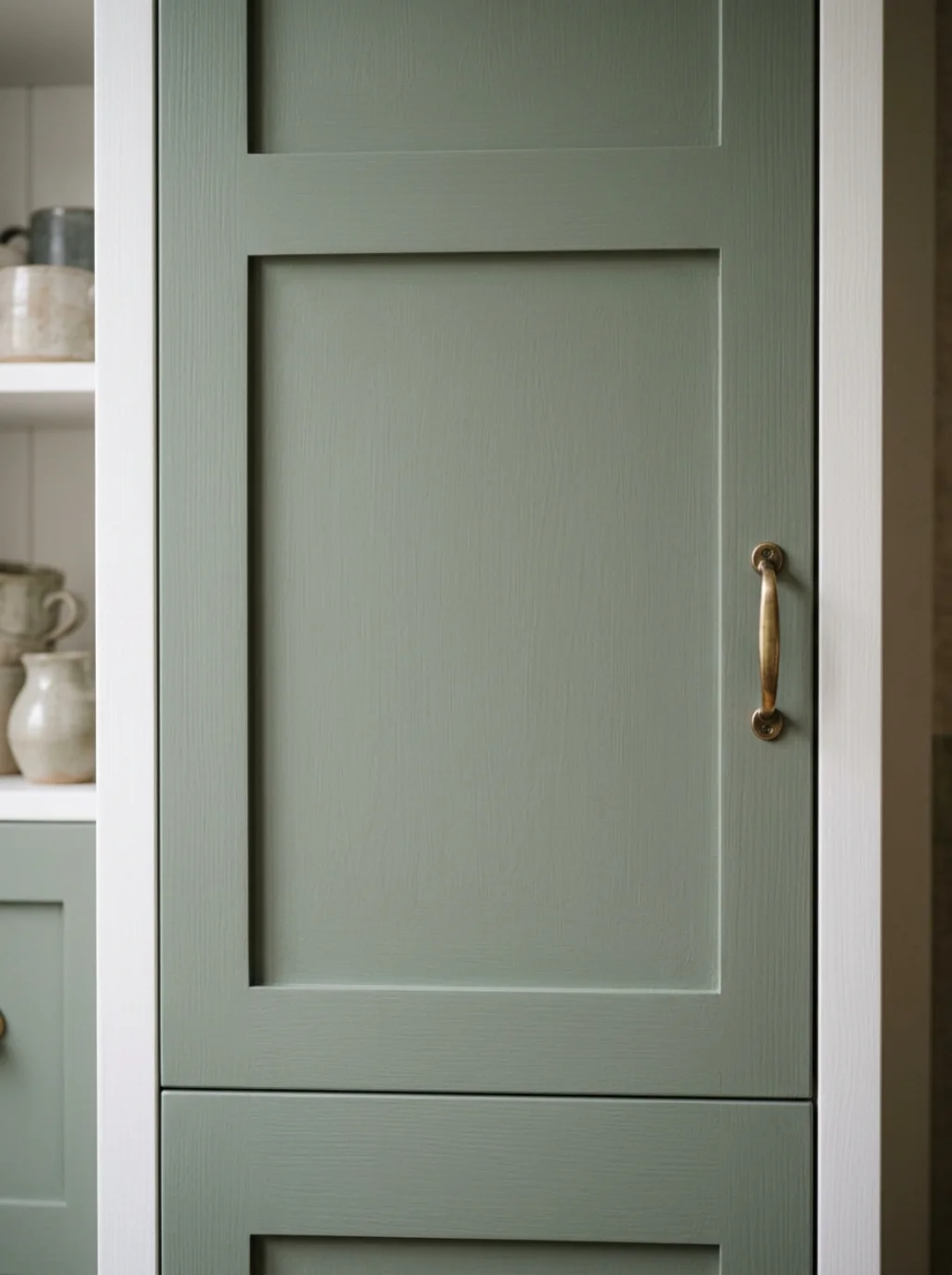
Sage green is not one color. It’s a family of soft, grey-modified greens that sit in the perceptual space between green and grey — warm in some lights, cool in others, shifting subtly as natural light changes through the day. This chromatic flexibility is precisely what made sage green kitchen cabinets the dominant kitchen design story of the past four years. They photograph beautifully. They pair with virtually every hardware finish. And they work in both contemporary and traditional kitchen architectures without requiring a complete stylistic commitment.
Sage green kitchen design ideas and inspiration consistently return to three specific undertone families: grey-sage (cooler, more contemporary, works beautifully with white and black), yellow-sage (warmer, more artisanal, pairs naturally with brass and natural wood), and blue-sage (cooler still, slightly more formal, suits shaker cabinet profiles in traditional settings). Sage green paint undertone selection is the most critical decision in any sage kitchen project. Farrow and Ball kitchen green shades like Mizzle, Mist, and Cromarty demonstrate this undertone variation beautifully — seemingly similar shades that read completely differently depending on the room’s light exposure and the surrounding materials.
Dark Green Kitchens — the Moody Drama That Changes Everything at Once
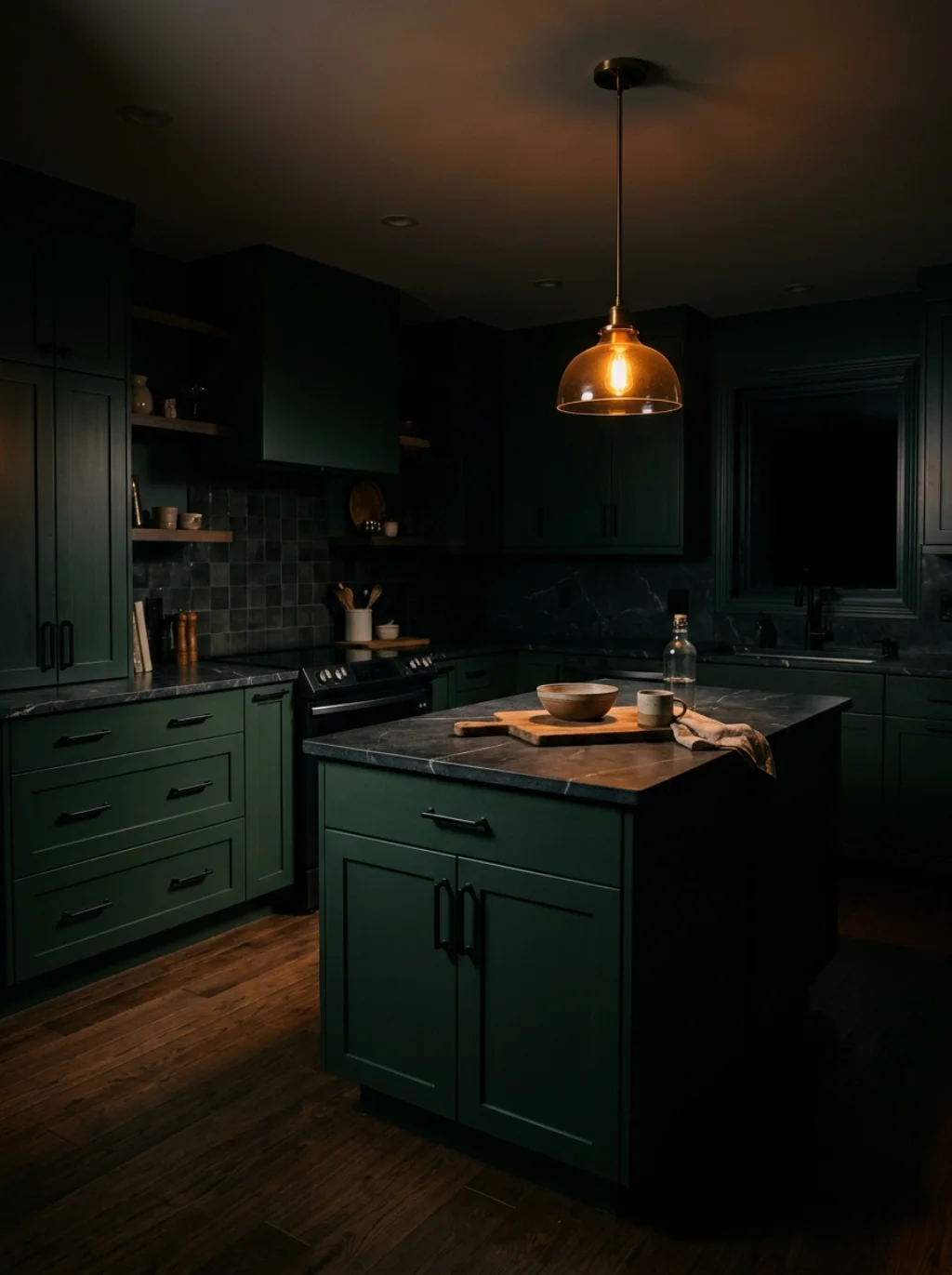
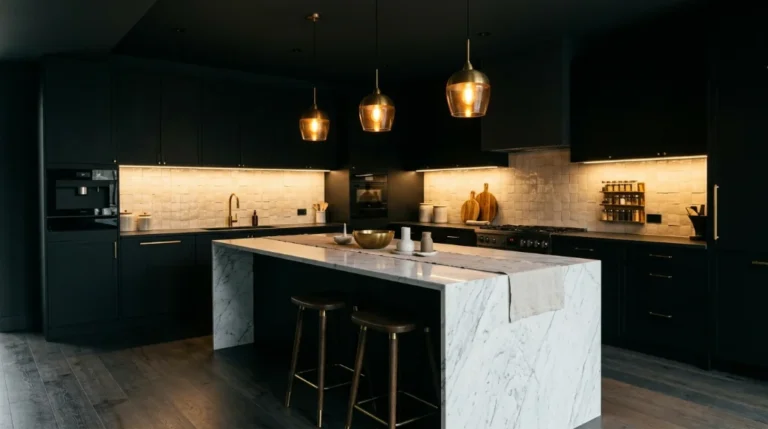
Dark green kitchens require a specific kind of design courage but deliver returns on that courage that lighter greens simply can’t match. Dark green kitchen ideas with black hardware create the most dramatic version of this aesthetic — the deep cabinet color amplified by the contrast of matte or satin black pulls, faucets, and light fixtures creates a kitchen that reads as genuinely luxurious rather than merely painted. The drama is calibrated. Nothing shouts. Everything simply radiates depth and confidence.
Moody kitchen design ideas built on dark green work best when they commit fully to the depth rather than hedging with excessive white elements that dilute the dramatic impact. Hunter green kitchen and emerald green kitchen shades in particular — Sherwin Williams’ Rookwood Antique Green, Benjamin Moore green paint kitchen shade Salisbury Green, or Farrow and Ball kitchen green Teal Blue — create interiors that Architectural Digest green kitchens features describe as some of the most requested residential kitchen aesthetics among their readership. The dark green kitchen is having its moment, but more importantly, it’s built on design logic substantial enough to make that moment permanent.
Forest Green Kitchen Ideas With Natural Wood for a Grounded Earthy Look
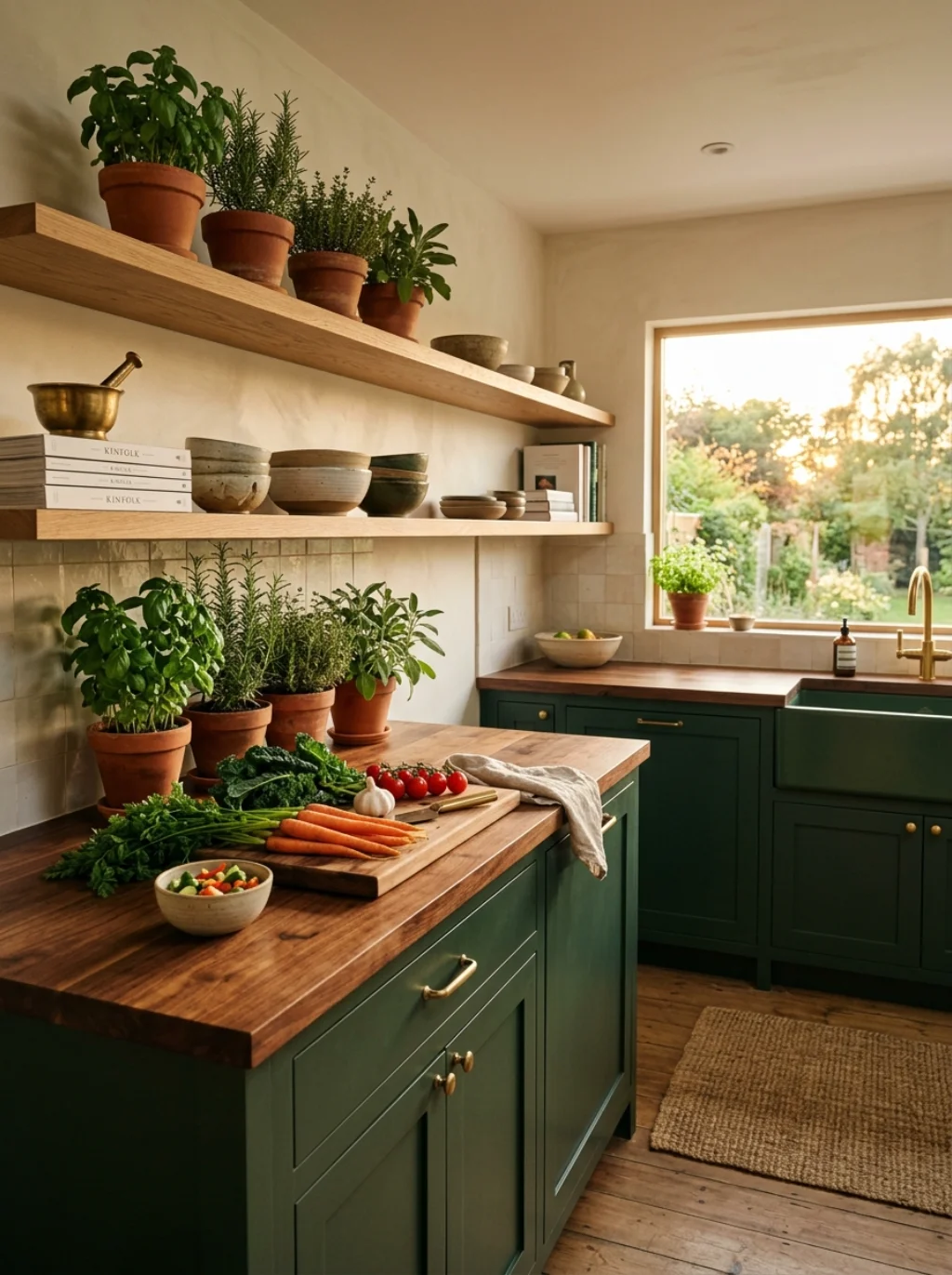
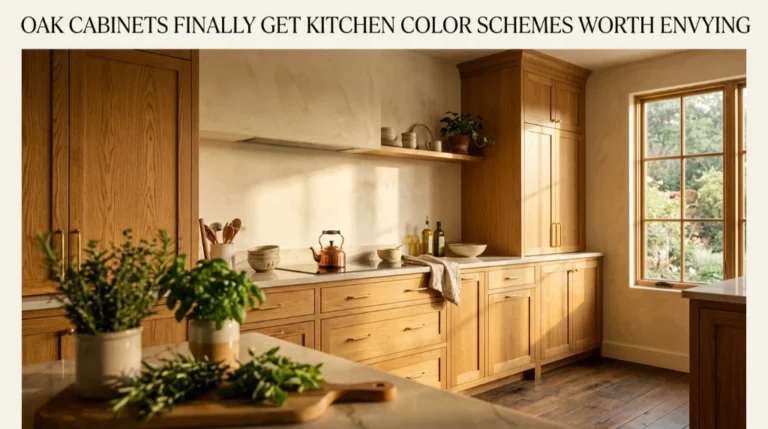
The pairing of forest green with natural wood is one of the most compositionally coherent combinations available in kitchen design. Both materials reference the same environmental vocabulary — the wood evokes forest floor and timber, the green evokes forest canopy and vegetation — creating an interior ecology that feels genuinely unified rather than deliberately assembled. Forest green kitchen design concepts executed with warm-toned wood (walnut, white oak, ash) produce kitchens that feel like they grew from the landscape rather than being built on top of it.
How to style a green kitchen with natural wood requires understanding the warm-cool relationship between the materials. Forest green kitchen shades with yellow or brown undertones — olive, hunter, moss — pair most naturally with warm-toned woods whose amber tones echo the green’s warmth. Cooler forest greens with blue undertones pair better with lighter, cooler-toned woods or with painted white elements that mediate between the cool green and the warm wood. Green kitchen with butcher block counter is the most accessible version of this pairing — butcher block’s warmth and texture complement green cabinetry beautifully at a price point that marble and stone countertops don’t approach.
Green Kitchen Ideas With Brass and Gold Hardware That Feel Instantly Luxurious
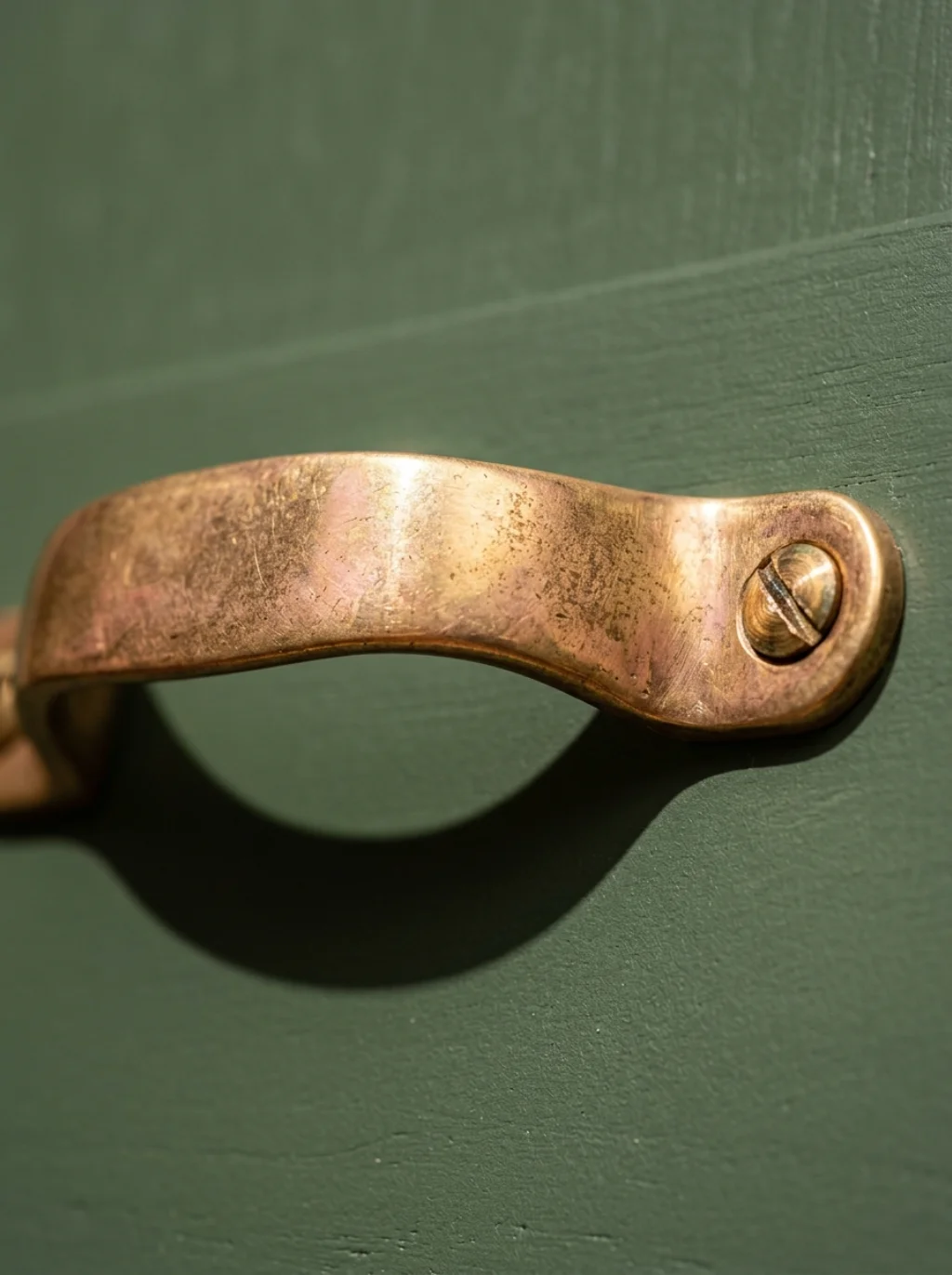
The combination of green cabinetry with brass or gold hardware elevates a kitchen from pleasant to genuinely luxurious, and the reason is both perceptual and historical. Green and gold is the color combination of moss on stone, of patinated copper against aged forest, of the natural world’s most convincing luxury reference. Green kitchen with brass fixtures creates this association instantly — the warm metallic against the cool-green cabinet surface generates a visual tension that reads as organic chemistry rather than deliberate styling.
Green kitchen with gold hardware ideas that achieve the most sophisticated results choose hardware finish carefully relative to the specific green shade in use. Unlacquered brass — which patinates over time — suits warmer, earthier greens and develops a character that improves with age. Polished brass suits cooler, more formal greens where the high reflectivity of the finish creates maximum contrast. Satin brass occupies the middle ground that works across almost every green family. Green cabinet hardware finish pairing decisions benefit from testing actual hardware samples against painted cabinet samples in your specific kitchen lighting before committing — the same brass finish reads completely differently against sage versus dark green versus olive.
Two Tone Green Kitchen Designs That Balance Contrast With Harmony
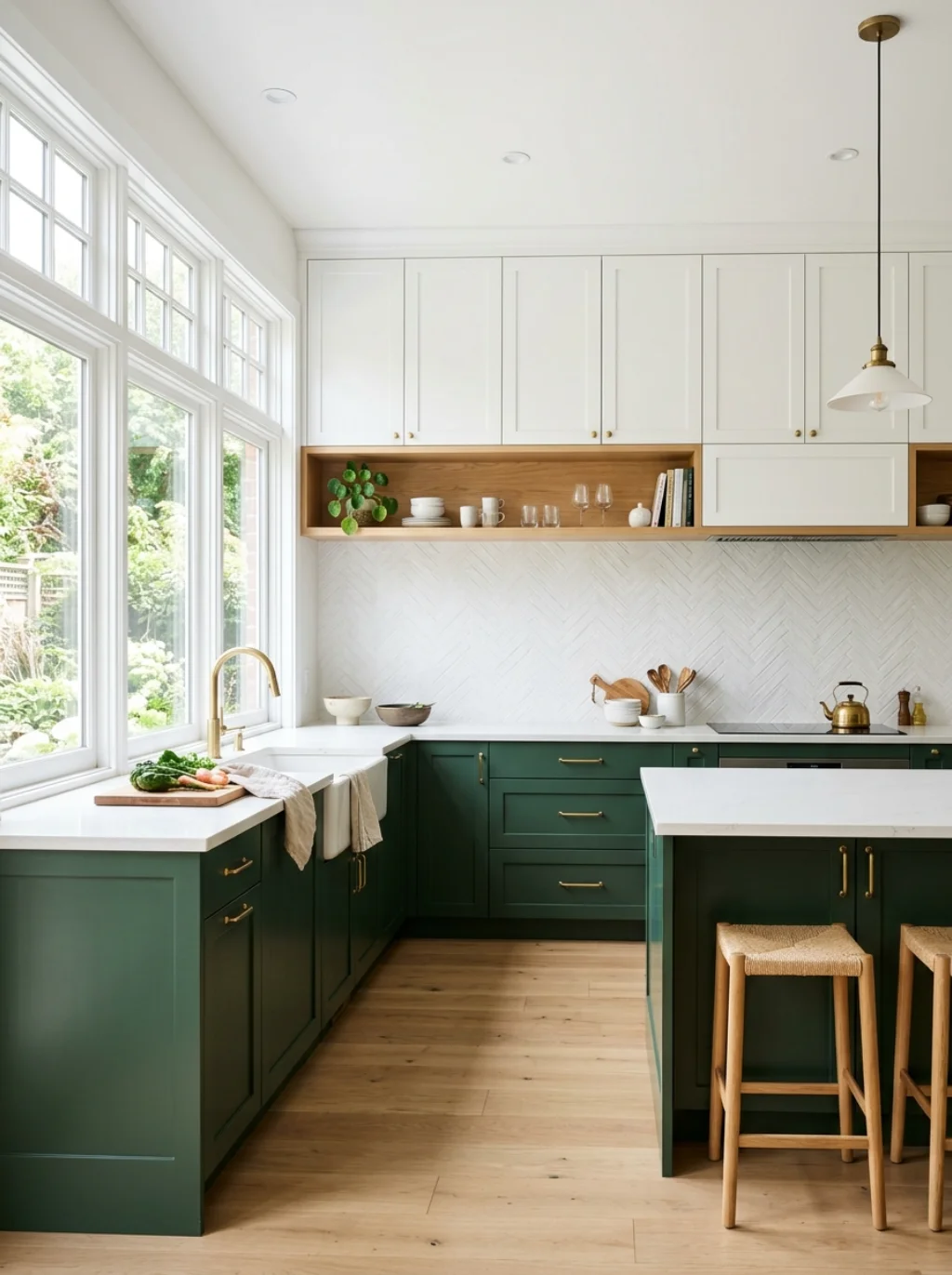
Two tone green kitchen design technique creates compositional sophistication that single-color cabinet approaches can’t match, and the specific two-tone approach you choose determines the entire visual character of the result. The most classic two-tone kitchen formula uses a darker shade on the lower cabinets and a lighter shade — or white — on the upper cabinets, which grounds the composition visually and maintains the airy feeling of the upper section while the lower zone carries the kitchen’s dominant character.
Dark green lower cabinet contrast technique paired with white, cream, or light sage uppers is the most requested version of this approach on Houzz green kitchen gallery and Pinterest green kitchen boards because it delivers the drama of a dark green kitchen while maintaining the brightness that smaller kitchens require in the upper zone. A more unexpected two-tone approach uses two related but distinct greens — forest green lowers with sage green uppers, or olive lowers with mint green uppers — creating a tonal gradient rather than a light-dark contrast. This monochromatic two-tone approach suits kitchens where the homeowner wants coherent color throughout without the starkness of a white-and-dark contrast scheme.
The Green Kitchen Island That Becomes the Room’s Undeniable Focal Point
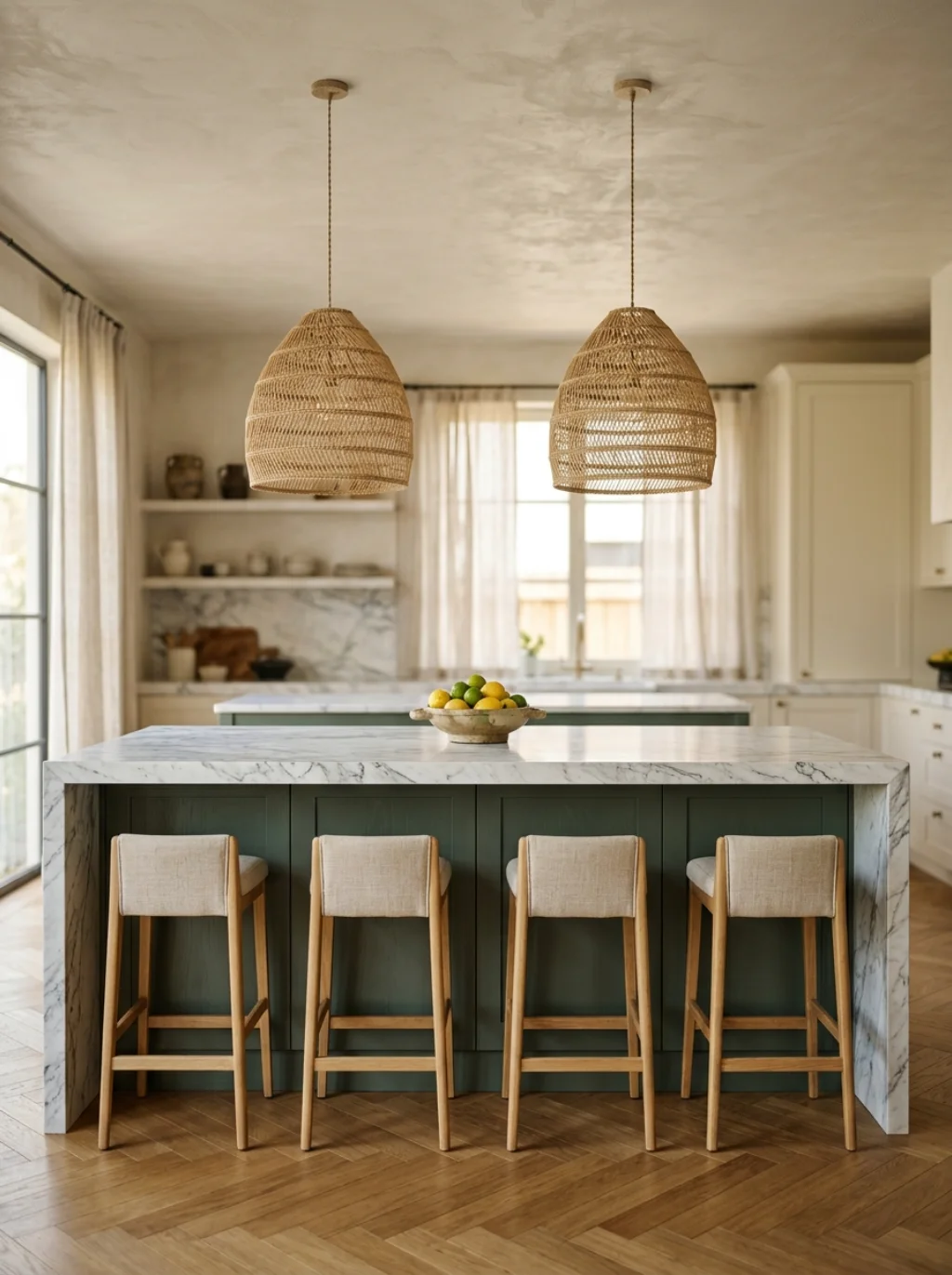
A statement green kitchen island design in an otherwise neutral kitchen is the most efficient single intervention available for introducing green without committing to a fully green kitchen. The island sits at the compositional center of an open-plan kitchen — it’s where the eye lands first, where activity concentrates, and where the kitchen’s visual identity is most legibly communicated to anyone entering the space. Green kitchen island ideas for open plan homes leverage this centrality deliberately.
you may also like this:17 Dark Cabinet Kitchen Backsplash Ideas to Elevate Your Kitchen Design
Green kitchen island designs that achieve the greatest visual impact typically use a deeper, more saturated green than any green used elsewhere in the kitchen — forest green, sage, or hunter green against white or neutral surrounding cabinetry creates a contrast that makes the island read as a statement piece rather than a matching element. Studio McGee green kitchen design features consistently demonstrate this high-contrast island approach, positioning a dramatically colored island against neutral perimeter cabinetry to create a kitchen that photographs compellingly from every angle. The island’s hardware, countertop material, and pendant lighting all amplify or dilute its statement quality — brass pendants and a marble or butcher block top typically deliver the most visually coherent result.
Green Kitchen Backsplash Tile Ideas That Add Texture Layer and Life
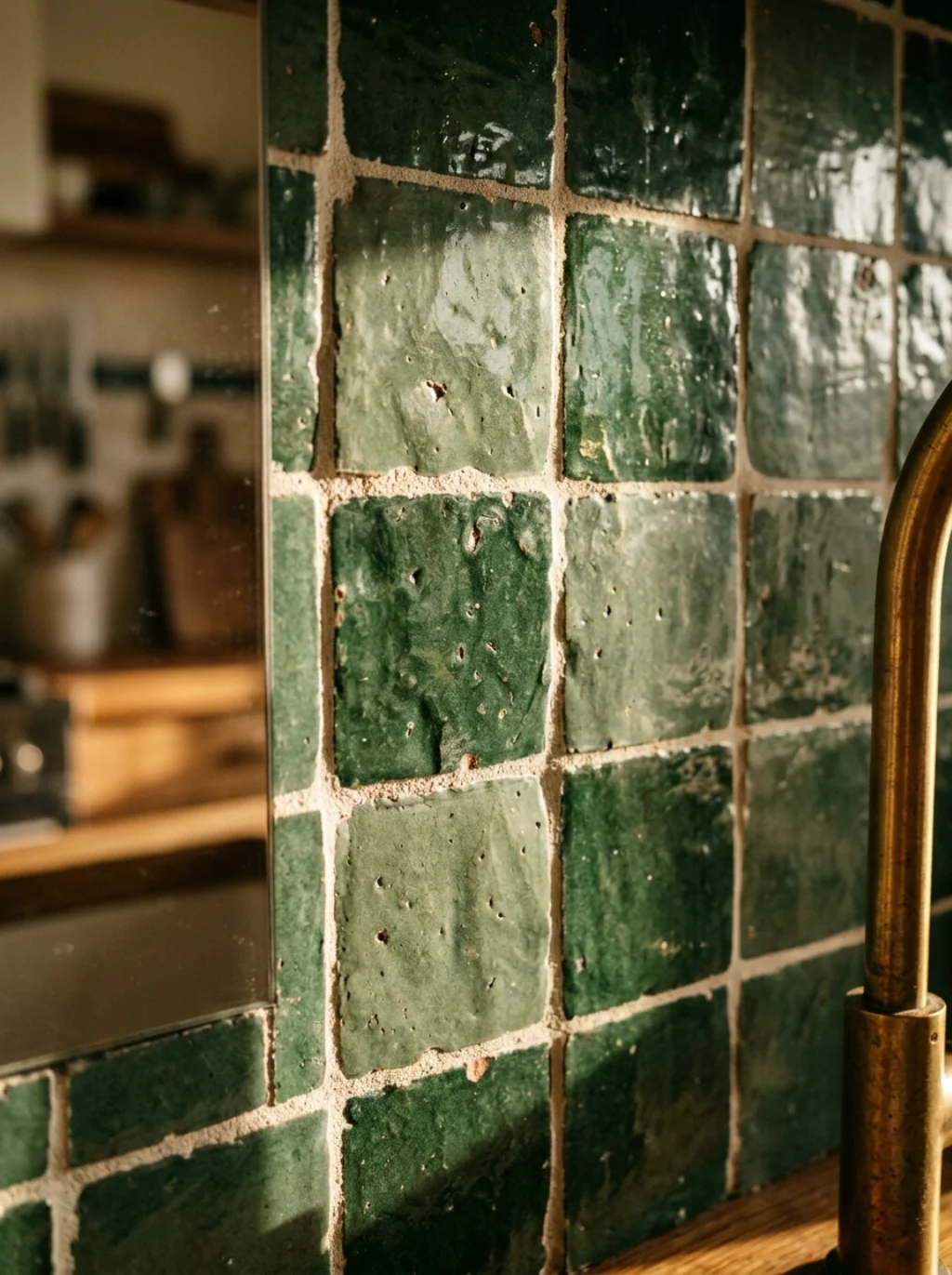
A green kitchen backsplash introduces texture, material variation, and an additional layer of visual complexity that painted cabinetry alone cannot provide. The backsplash zone — between countertop and upper cabinet — is a visual transition plane that either mediates between the counter material and the cabinet color or creates an independent textural statement of its own. Green kitchen backsplash tile ideas that succeed use this zone’s architectural function intentionally rather than treating the tile selection as an afterthought.
Green kitchen tiles in the backsplash position come in forms that each contribute differently to the kitchen’s character. Handmade zellige tiles in sage or olive create organic variation — no two tiles identical — that introduces artisanal warmth into even the most contemporary green kitchen. Green kitchen with white subway tile in a stacked or herringbone pattern provides clean contrast without visual competition in kitchens where the cabinetry is the primary design element. Terracotta-toned green tiles — where the green has a warm, slightly brown undertone — pair naturally with olive and forest green cabinets and green kitchen with terracotta floor tile combinations that create an earthy Mediterranean atmosphere.
Marble Countertops in a Green Kitchen — the Pairing That Always Looks Rich
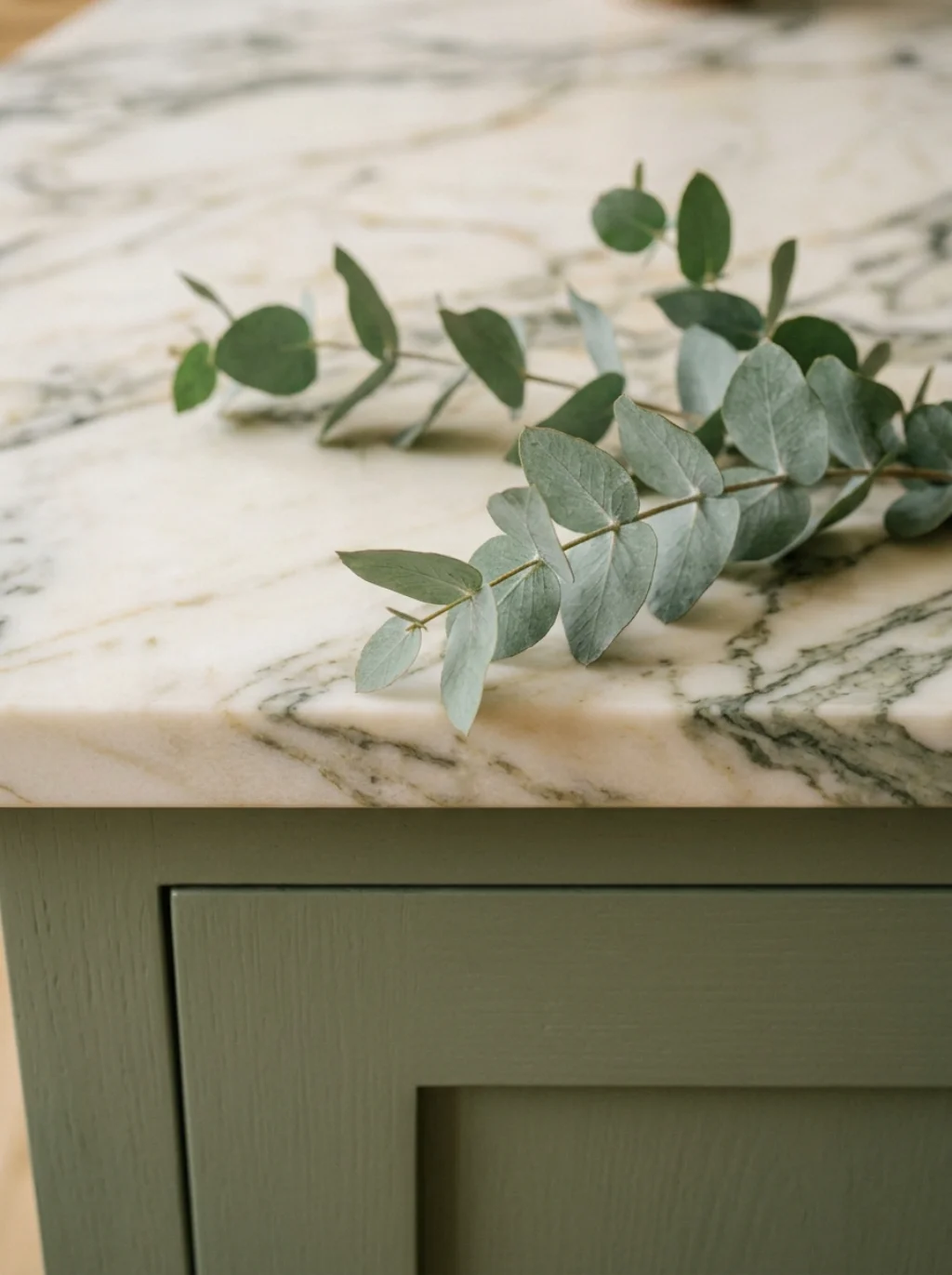
Green kitchen with marble countertop pairings leverage the natural geological relationship between green and the mineral veining that marble characteristically contains. Many marble varieties feature green-grey veining — Calacatta Verde, Verde Guatemala, the green vein running through certain Carrara slabs — that creates a material harmony with green cabinetry that reads as natural rather than coordinated. The marble’s white or grey ground provides visual relief from the cabinet color while its veining connects back to it.
Rich kitchen color palettes built around green cabinets and marble surfaces benefit from careful marble selection relative to the specific green shade. Cool-toned greens pair best with cooler-toned marbles — brighter whites, blue-grey veining. Warm-toned greens like sage and olive suit warmer marbles — creamy whites, warm grey and gold veining. Green kitchen countertops in quartzite, a more durable alternative to marble that often presents similar visual characteristics, offer the same pairing quality at significantly improved performance in kitchen conditions where marble’s inherent porosity and acid-sensitivity create maintenance challenges.
Open Shelving on Green Kitchen Walls Done in Ways That Actually Work
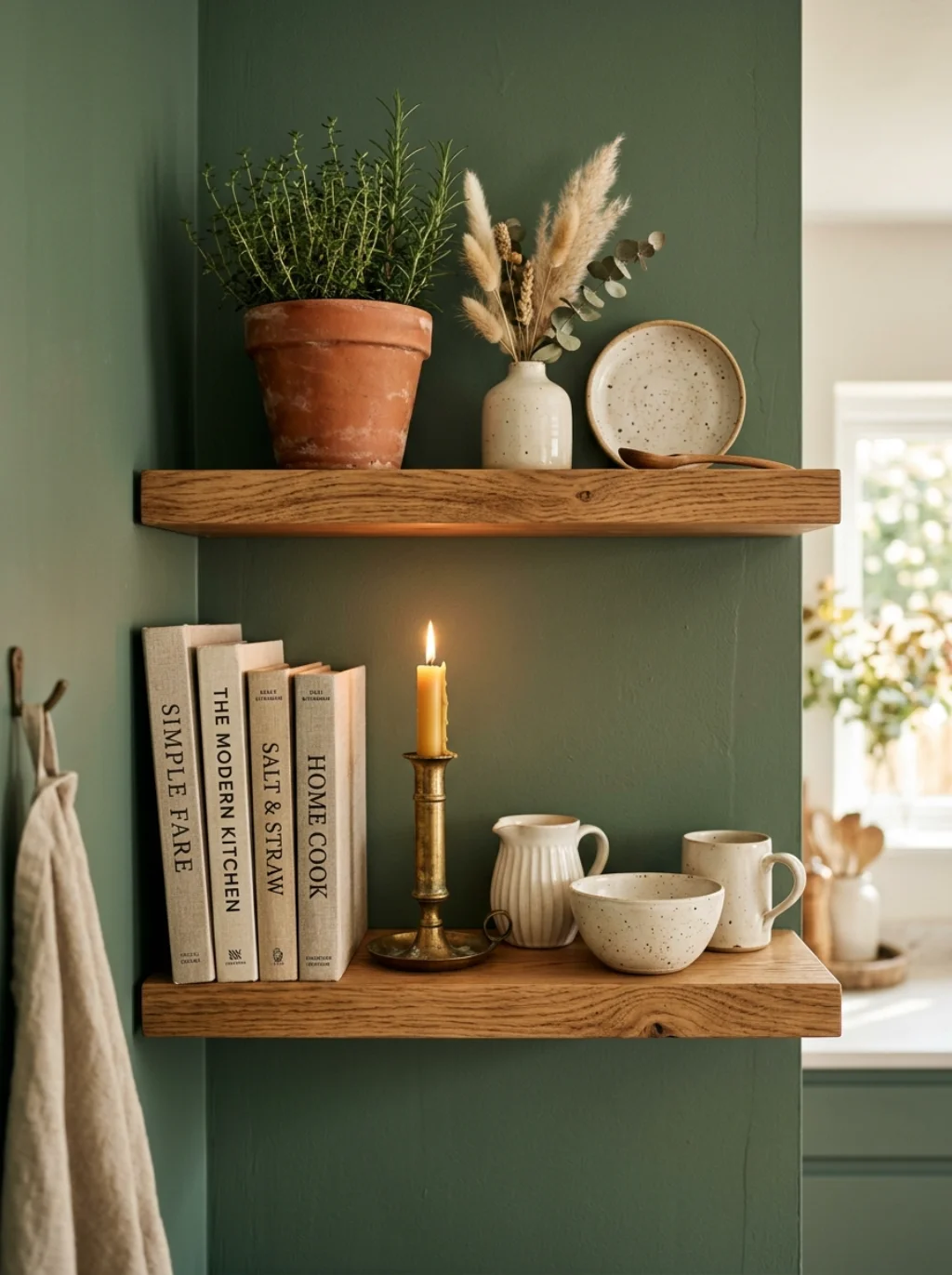
Open shelving green kitchen wall applications divide design opinion more decisively than almost any other kitchen decision. Critics argue that open shelving requires a level of styling discipline and organizational consistency that most households can’t sustain. Proponents argue that styled open shelves transform a kitchen into a living display space that reveals the owner’s personality in a way that concealed cabinetry entirely prevents. Both positions contain truth and the resolution lies in selective application rather than wholesale adoption.
Green kitchen design that uses open shelving most successfully limits floating shelves to one or two specific wall zones — typically flanking a range hood, above a window, or replacing upper cabinetry on one wall section — while retaining closed storage elsewhere. This hybrid approach captures the visual warmth and personal expression that open shelving provides without requiring the entire kitchen to sustain the styling discipline that full open-shelf kitchens demand. Objects on green-walled open shelves benefit from a curated color palette — warm neutrals, natural materials, white ceramics — that complements the green rather than competing with it visually.
Small Green Kitchen Ideas That Use Color to Create Space Not Shrink It
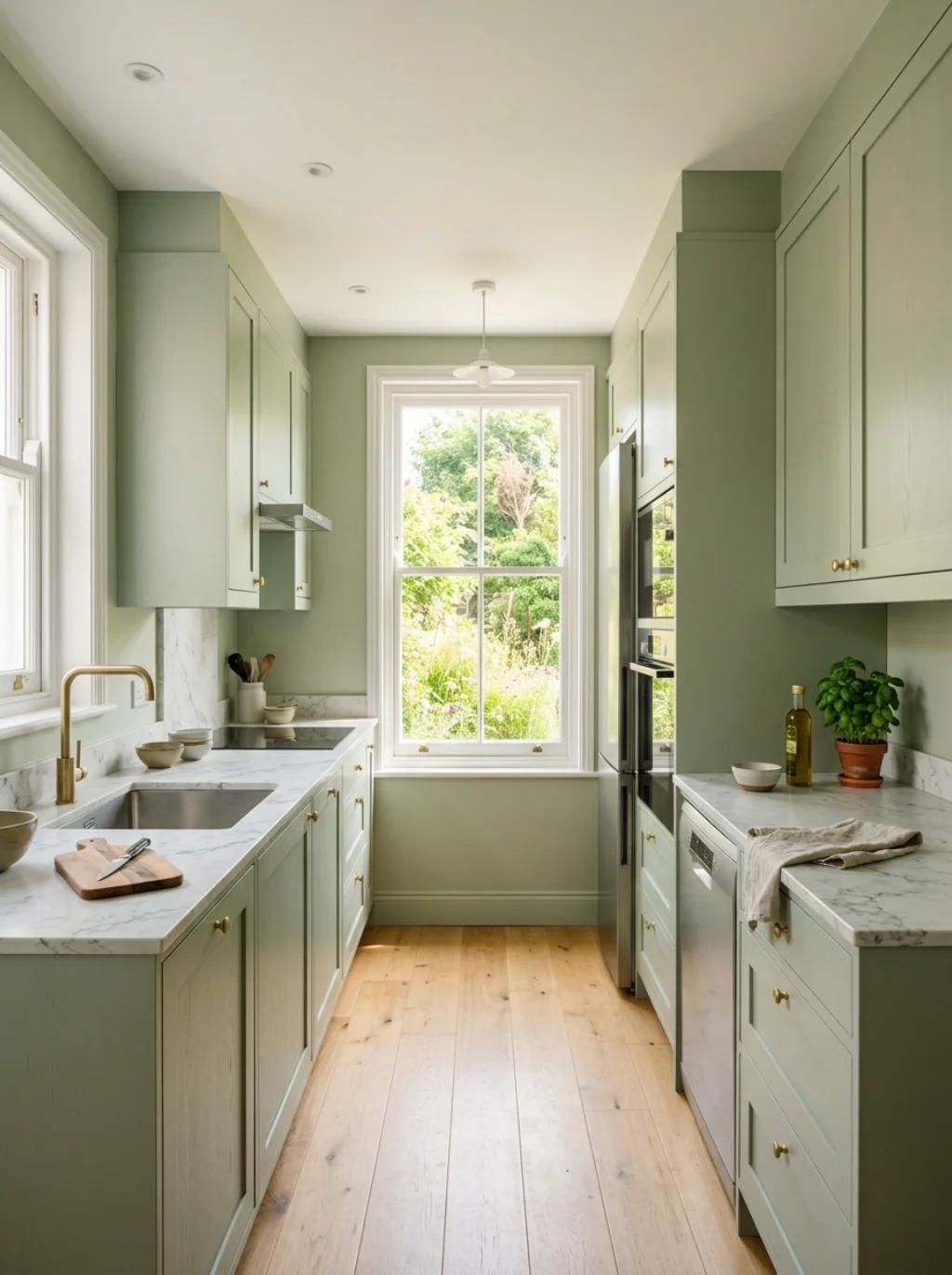
The conventional wisdom that small kitchens should be painted white to maximize perceived space is partially true and mostly overstated. Smaller rooms feel larger not because of light colors but because of visual coherence — spaces where surfaces read as unified rather than fragmented produce an expansive spatial impression regardless of their actual dimensions. Green kitchen ideas for small spaces that apply a consistent green across cabinets, walls, and even ceiling create exactly this unified coherence, producing an enveloping color environment that reads as a deliberate interior choice rather than a spatial limitation.
Light green kitchen applications — mint, pale sage, soft celadon — suit small kitchens particularly well because they maintain the tonal lightness that the conventional wisdom correctly values while delivering the warmth and botanical personality that white lacks. Mint green kitchen shades in particular have experienced a resurgence in Better Homes and Gardens kitchen design coverage because they work beautifully in smaller spaces, particularly those with limited natural light where richer greens can feel heavy. Green kitchen color ideas for compact spaces also benefit from limiting the palette’s tonal range — keeping the green, natural wood, and white or cream accents within a narrow tonal band creates visual simplicity that small kitchens need.
The Matte Versus Gloss Green Cabinet Debate Finally Settled for Good
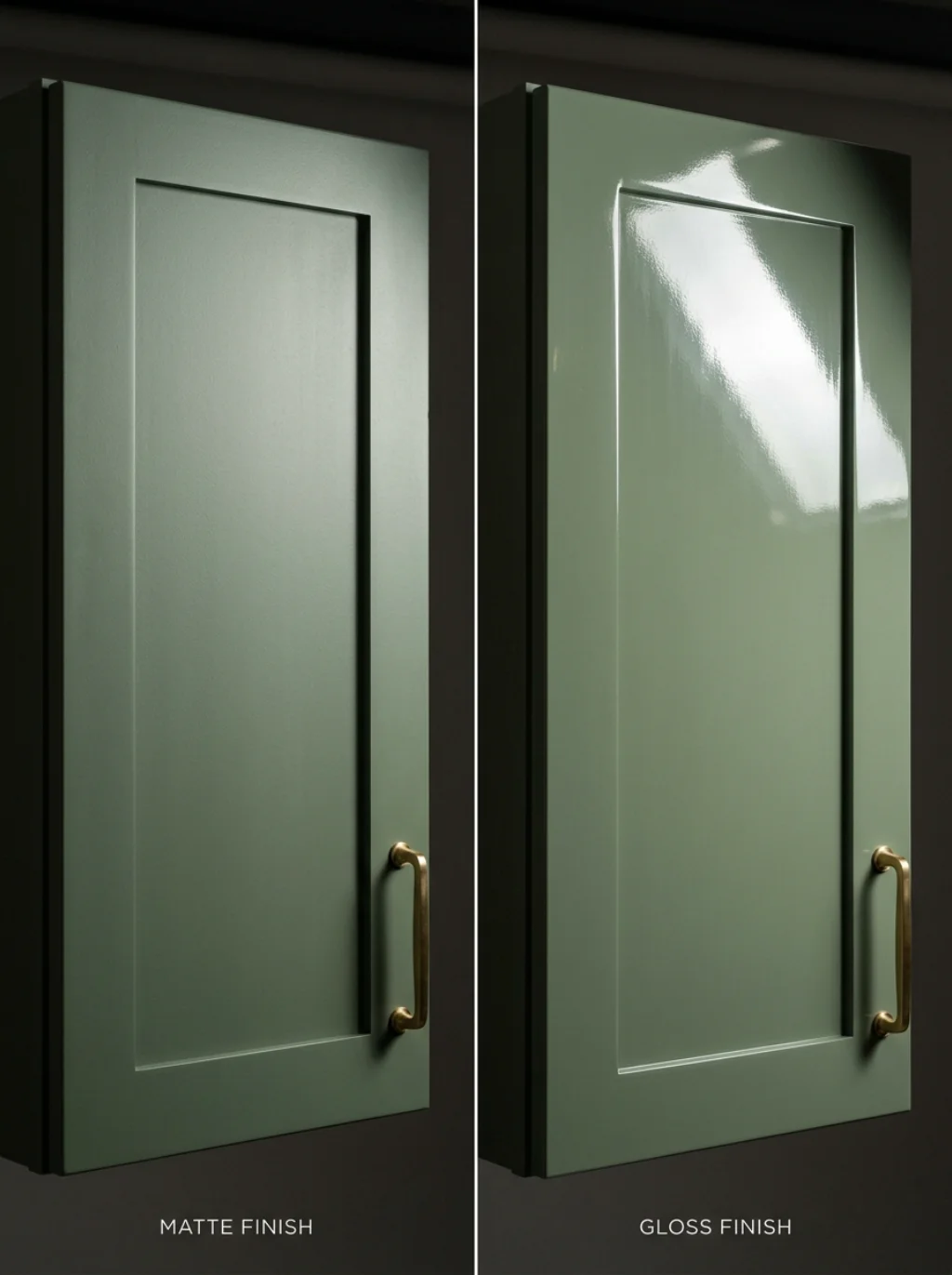
Matte versus gloss green cabinet finish is a decision that affects not just the visual quality of the finished kitchen but its practical maintenance experience over time, and the right choice depends on factors that most buying guides underaddress. Matte finishes absorb light, minimize surface imperfections in the cabinet face, and create a depth of color that gloss cannot match — the green appears richer, more sophisticated, and more consistent across varying light conditions. Gloss finishes reflect light, make colors appear brighter and more saturated, and are generally easier to wipe clean of grease and fingerprints.
The design community has moved decisively toward matte in recent years — Magnolia green kitchen design aesthetics, Studio McGee green kitchen projects, and the Joanna Gaines green kitchen style all favor eggshell to matte finishes that deliver the organic, handcrafted quality that contemporary green kitchen aesthetics prioritize over the hard precision of high-gloss work. However, matte finishes require more careful cleaning — abrasive materials that would be harmless on gloss damage matte surfaces permanently. Farrow and Ball kitchen green modern emulsion in their estate range specifically formulated for kitchen environments offers the matte depth the brand is celebrated for with improved cleanability compared to their standard interior finishes.
Green and White Kitchen Combinations That Feel Fresh Without Being Boring
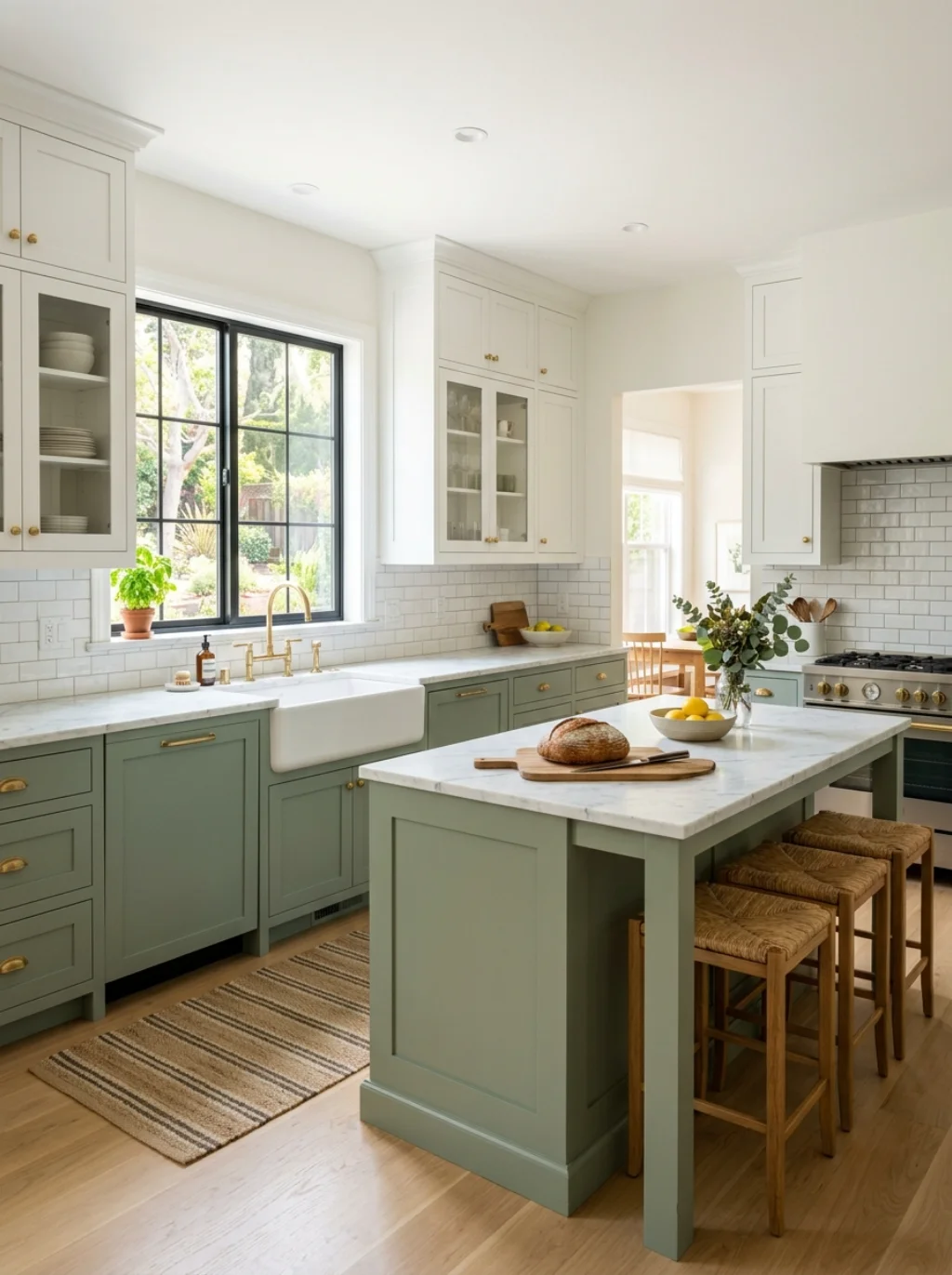
Green and white kitchen design ideas work because the two colors occupy opposite positions on the perceptual spectrum — green brings organic warmth, botanical personality, and visual weight while white provides luminous relief, visual spaciousness, and a neutral foil that allows the green to breathe. Neither color overwhelms the other when the proportional relationship is thoughtfully managed. Green and white kitchen combinations that feel genuinely fresh rather than decoratively safe use the green as the active design agent and white as the architectural backdrop.
Green painted kitchen cabinet ideas on a budget that use white as a companion color benefit from consistency in the white’s undertone — a warm white (with yellow or cream undertones) complements warm greens naturally, while a cool white (with blue or grey undertones) suits cooler sage and forest greens. The failure mode of most green and white kitchens is choosing whites that fight rather than complement the green — the two colors’ undertones pulling in different perceptual directions and creating a visual tension that reads as unresolved rather than intentional. Martha Stewart green kitchen design archives demonstrate this complementary relationship across decades of kitchen content, consistently pairing specific greens with whites that share their warmth or coolness.
Olive and Earthy Green Kitchens With Terracotta for a Warm Artisan Feel
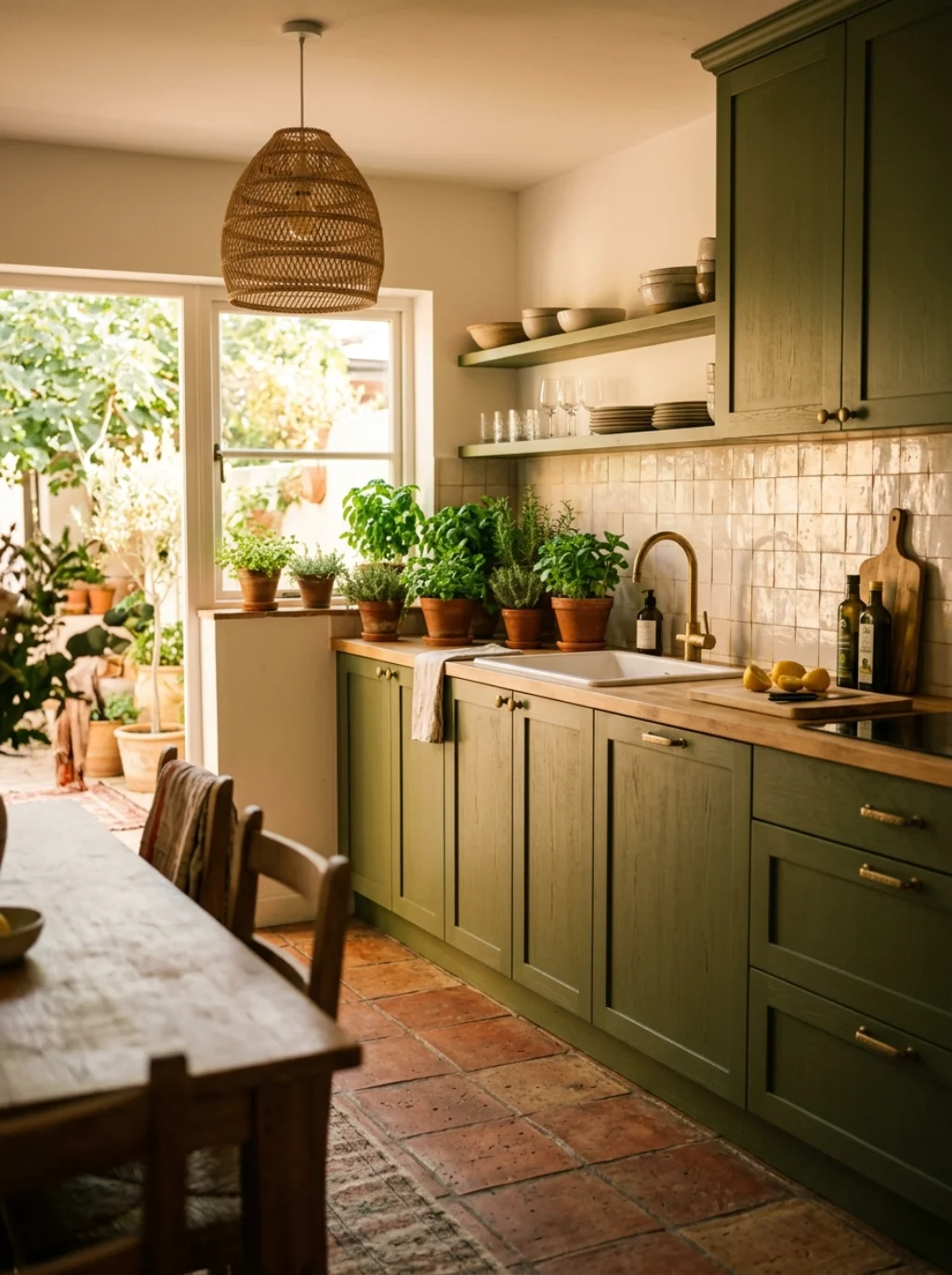
Olive green kitchen cabinet inspiration draws from one of the most historically resonant color families in the green spectrum — earthy, warm, slightly brown-toned greens that reference aged patina, Mediterranean landscapes, and the organic materials of artisanal craft traditions. Olive green kitchen cabinets in the kitchen create an atmosphere immediately distinct from the cooler register of sage or the darker drama of forest green — warmer, more intimate, more visually complex in how they interact with natural light.
Green kitchen with terracotta floor tile pairings with olive cabinetry create the most compelling earthen-palette kitchen aesthetic available in contemporary design. The terracotta’s warm orange-red against the olive’s warm green creates a complementary color relationship — the two colors sitting opposite each other on the color wheel — that generates maximum chromatic vibrancy without visual conflict. Artisan kitchen decor ideas built on this olive-and-terracotta palette typically incorporate natural linen window treatments, handthrown ceramic vessels, woven rattan pendants, and brass hardware that reinforces the warm, earth-toned material story throughout the space.
Rattan Lighting and Natural Textures That Make Green Kitchens Come Alive
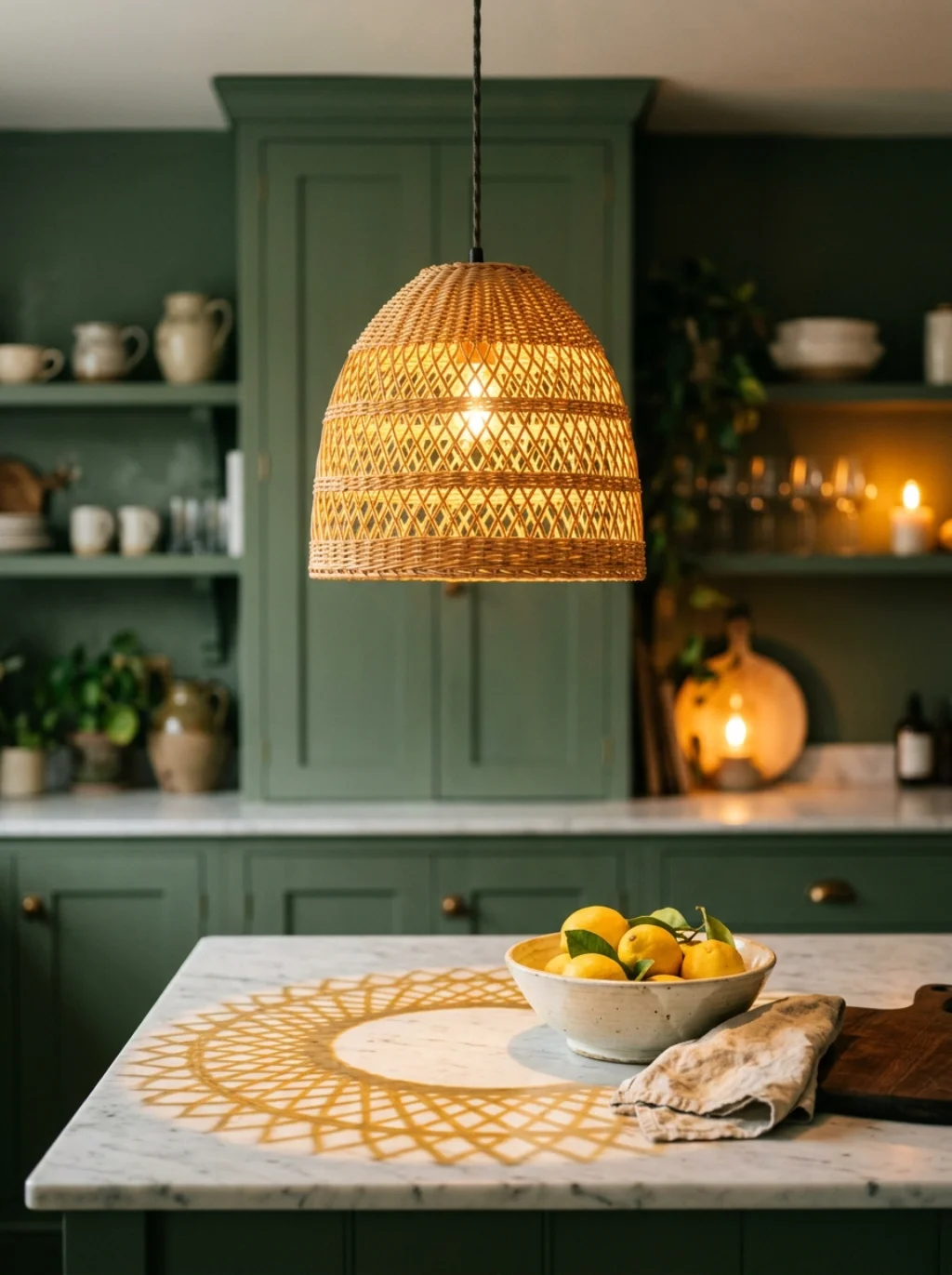
A green kitchen without textural variation risks feeling flat regardless of how beautiful the color itself is. The specific texture additions that elevate green kitchens most reliably are those that reference natural materials — organic forms, variable surfaces, warm tones. Green kitchen with rattan pendant light is the textural addition that appears most consistently in published green kitchen design because rattan’s woven geometry, warm honey tone, and organic form quality perfectly complement the botanical associations of green cabinetry.
Green kitchen with natural linen accents — window treatments, chair seat cushions, table runners — extends the organic texture vocabulary into the kitchen’s soft furnishing elements. Textured kitchen design concepts in green kitchen contexts also include stone texture (exposed brick, rough plaster, natural stone), wood texture (open shelving in oiled oak, butcher block countertops, timber ceiling beams), and ceramic texture (handmade zellige tiles, handthrown pottery, artisanal mugs as display objects). Each textural layer adds to the kitchen’s sensory richness and reinforces the connection to natural materials that green kitchen aesthetics depend on for their emotional impact.
Green Kitchen Paint Colors That Work Across Every Natural Light Condition
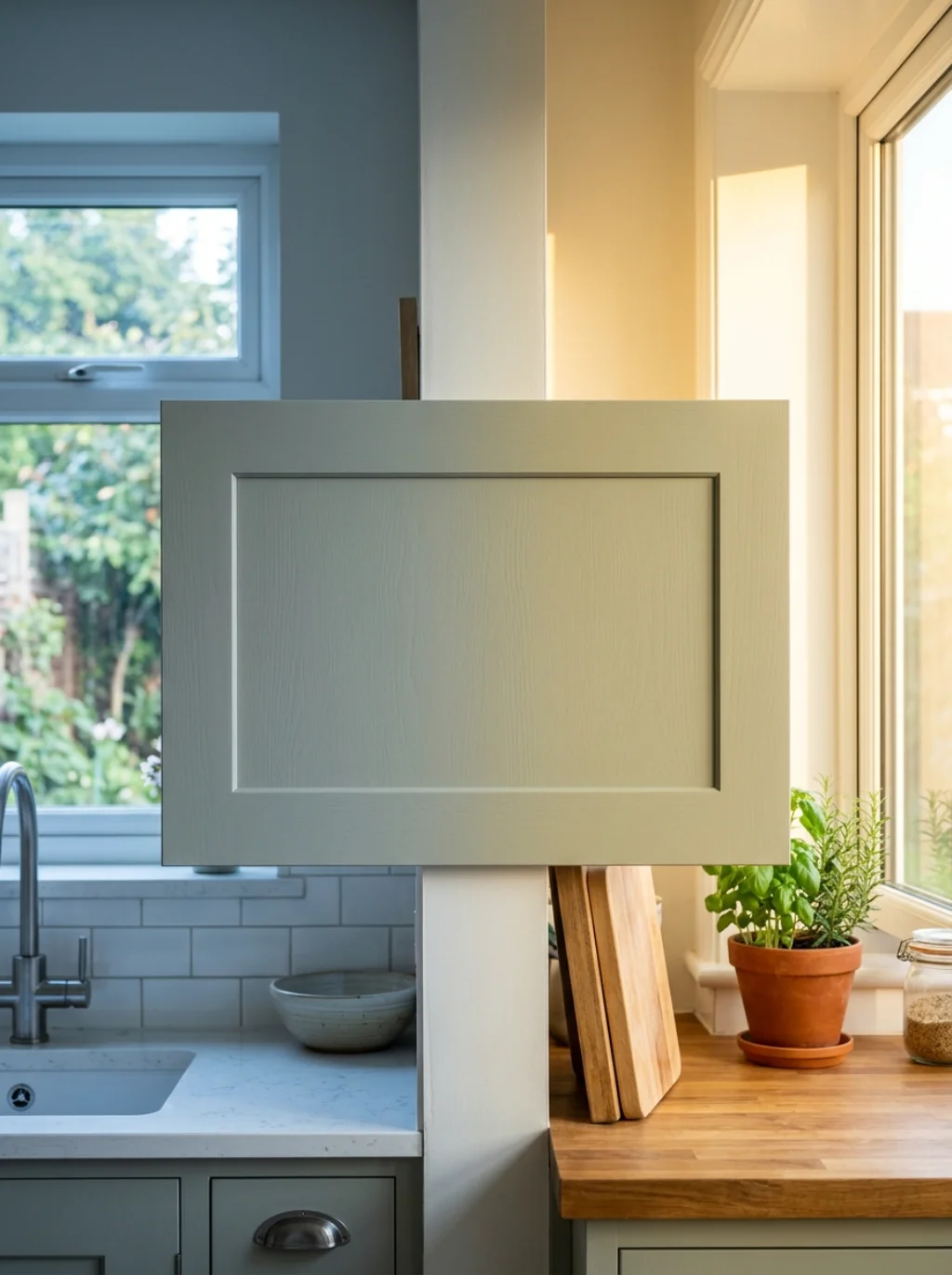
Natural light is the variable that most determines whether a specific green paint color succeeds or fails in a kitchen environment. A green that looks perfect in a north-facing showroom may read entirely differently on a south-facing kitchen wall where summer afternoon light turns it almost yellow. A sage that photographs beautifully in bright natural light may look dull and grey in the artificial light of a windowless galley kitchen. Best green paint colors for kitchen cabinets decisions require testing in actual light conditions rather than relying on paint chip or digital representations.
Green kitchen paint colors that perform consistently across varied lighting conditions include those with grey modification — the grey component moderates the color’s saturation response to different light intensities, preventing the extreme shift from bright to dull that pure greens experience. Sherwin Williams kitchen green options like Rosemary, Pewter Green, and Shade-Grown all demonstrate this grey-modification principle — they hold their visual character from morning sun to artificial evening light without the dramatic undertone shifts that make some greens unreliable across conditions. Benjamin Moore green paint kitchen Aura line in colors like October Mist and Mountain Laurel performs similarly — consistently readable across the full daily light cycle in most American kitchen orientations.
Accessories and Accents That Complete a Green Kitchen Without Overdoing It
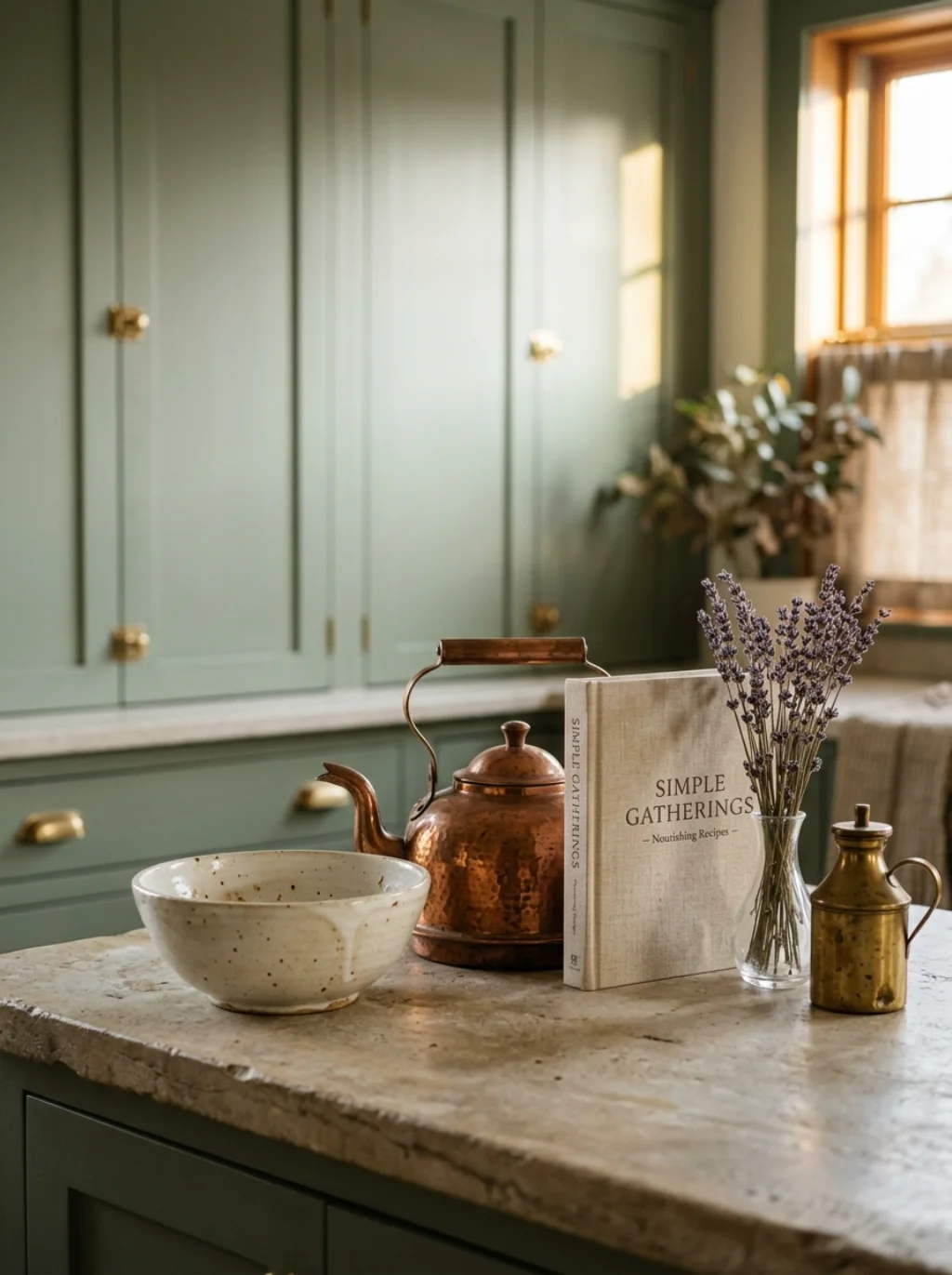
Green kitchen accessories function as the final editorial layer — the element that communicates the inhabitant’s personal sensibility rather than simply the designer’s material competence. Getting this layer right requires the same restraint principle that governs accessories in every design context: choose objects that contribute to the room’s visual story, remove anything that merely occupies space, and let each piece earn its presence through beauty, function, or both.
Green kitchen accessories that add most effectively to the kitchen’s visual narrative include: ceramic vessels in complementary earth tones (cream, terracotta, warm grey), copper or brass kitchen tools hung on a wall rail, fresh or dried botanical elements (a trailing pothos, a bundle of dried herbs, a branch of seasonal foliage), and quality cookware in tones that complement the green — cream enamel, hammered copper, matte black cast iron. West Elm kitchen accessories and Anthropologie kitchen decor both stock accessory ranges specifically calibrated to the earth-toned, botanical kitchen aesthetic that green kitchens inhabit, providing curated starting points for homeowners uncertain about how to complete their kitchen’s material story without tipping from considered into crowded.
Frequently Asked Questions
What is the most popular shade of green for kitchen cabinets?
Sage green kitchen cabinets remain the most popular green kitchen shade by a significant margin in current American design trends. Sage green kitchen design ideas and inspiration consistently dominate Pinterest green kitchen boards and Houzz green kitchen gallery traffic because sage green’s chromatic flexibility — warm in some lights, cool in others — makes it the most reliably successful choice across diverse kitchen architectures and natural light conditions. Benjamin Moore green paint kitchen October Mist and Sherwin Williams kitchen green Pewter Green are the two most-requested sage cabinet colors from professional designers.
Do green kitchens add value to a home?
Green kitchen design in the current market generally adds rather than diminishes resale value when executed in quality materials and neutral-leaning shades — particularly sage, forest green, and olive. Architectural Digest green kitchens and HGTV green kitchen designs coverage has significantly normalized green kitchen aesthetics among American buyers. Highly saturated or neon greens may narrow buyer appeal, but the sage-to-hunter-green range now reads as sophisticated mainstream choice rather than personal quirk in most US real estate markets.
Does a green kitchen work with other colors in an open plan space?
Green kitchen color combinations that work in open-plan settings depend on how the kitchen’s color relates to the adjacent living and dining areas. Green cabinets pair naturally with neutral living room palettes in white, cream, camel, and warm grey. More adventurous combinations use complementary colors — terracotta, rust, and warm amber in adjacent spaces — that create chromatic vibrancy through contrast. Green kitchen aesthetic transitions most smoothly into open-plan spaces when the green is present in both the kitchen zone and the broader living area through accent objects, plants, or soft furnishings.
What hardware color works best with green kitchen cabinets?
Green cabinet hardware finish pairing consistently returns to brass as the most universally flattering hardware choice across all green kitchen shade families. Unlacquered or satin brass suits warm greens — olive, sage, forest. Polished brass suits cooler, more formal greens. Matte black hardware creates the most dramatic contrast and suits dark green kitchens particularly well. Chrome and nickel hardware suits cooler, contemporary green kitchens where the kitchen design language is more minimal and precise than earthy and textured.
Is a dark green kitchen too heavy for a small space?
Dark green kitchen ideas with black hardware in small spaces can work effectively when several design compensations are applied: maximizing natural light through window treatment choice, using lighter countertop materials that reflect light upward, limiting the dark green to lower cabinets and using white or light paint on upper cabinets and ceiling, and maintaining visual openness through controlled clutter. Green kitchen ideas for small spaces in darker shades specifically benefit from the two-tone approach that reserves dark green for the lower half of the kitchen while the upper half remains light.
What countertop material works best in a green kitchen?
Green kitchen countertops in marble, quartzite, butcher block, and white quartz all work beautifully depending on the green shade and kitchen style. Green kitchen with marble countertop pairings suit formal, luxury-register green kitchens. Green kitchen with butcher block counter suits earthy, artisanal green kitchens with natural wood accents. White quartz suits contemporary, high-contrast green kitchens where maintenance practicality and visual cleanliness are priorities. Concrete countertops in warm grey tones suit darker, moodier green kitchens particularly well.
Conclusion
Green kitchen ideas represent one of the most creative, personally expressive decisions available to American homeowners — a category of design choice rich enough to accommodate the soft whisper of sage, the earthy depth of olive, and the dramatic authority of dark forest green within a single color family’s range. The designs that succeed most consistently share one quality: they treat green not as a trend to follow but as a language to speak — a way of declaring a specific relationship between the kitchen environment and the natural world. Combine your chosen green with the right hardware, the right countertop material, the right textural accents, and the right lighting, and you won’t just have a kitchen that looks beautiful. You’ll have a kitchen you love spending time in. That’s the real measure of a great design decision — not how it photographs but how it feels to live inside it every single day.
One Comment